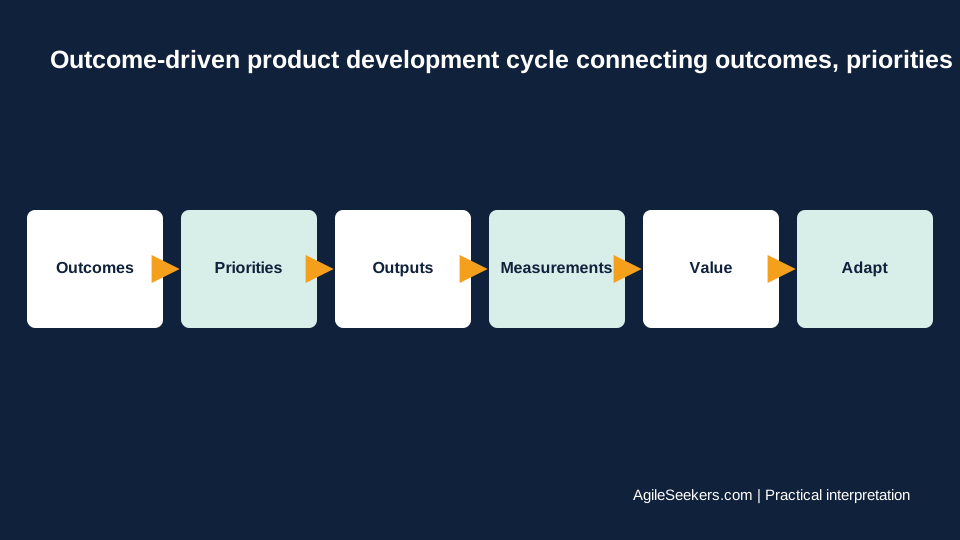
AI can produce code, designs, analysis, content, and experiments faster than many organizations can evaluate them. That makes output volume a poor proxy for progress. AI-Native SAFe responds with an outcome-driven product development cycle that asks whether the work changed something valuable for customers and the business.
The cycle starts with an observable destination
An outcome describes a meaningful change, not an item to ship. It may concern customer behavior, retention, reliability, operating cost, revenue, safety, or another measurable result. The official outcome-driven guidance connects outcomes to prioritization, outputs, measurements, and realized value at portfolio, ART, and team levels.
Six moves through the loop
| Move | Decision | Useful evidence |
|---|---|---|
| Outcomes | What change matters and why? | Baseline, target, timeframe, guardrail |
| Priorities | Where will money and capacity go? | Options, economics, constraints, strategic fit |
| Outputs | What can test or create the outcome? | Feature, prototype, enabler, experiment |
| Measurements | Is the output moving the signal? | Adoption, quality, behavior, cost, risk |
| Value | What customer and business result occurred? | Outcome evidence and ROI |
| Adapt | Continue, change, scale, or stop? | Learning compared with the original assumption |
A feature is evidence-seeking work
A feature can be well built and still fail to produce an outcome. Write the expected signal before implementation, then choose the smallest output that can challenge the assumption. A prototype might disprove demand. An enabler might reduce inference cost enough to make the product viable. A feature might improve task completion but damage trust. The cycle keeps all three results visible.
Worked example: reduce onboarding abandonment
An ART sets an outcome of reducing verified-user abandonment from 38 percent to below 25 percent without increasing support contacts or fraud. Teams test a shorter identity flow, contextual help, and a pre-validation service. Weekly evidence shows the shorter flow increases completion but also fraud flags. The ART retains contextual help, changes the validation design, and stops scaling the risky output. Shipping three items was not the result; learning which intervention created safe improvement was.
Keep flow metrics, but give them the right job
Flow time, throughput, WIP, predictability, and deployment frequency reveal the health of the delivery system. They do not prove customer value. Pair flow evidence with outcome and product-performance measures. Faster delivery is useful when it shortens the time from hypothesis to validated impact.
A review agenda built around decisions
- Which outcome and baseline does this work address?
- What signal changed, and how confident are we about causation?
- Did a guardrail worsen while the primary measure improved?
- Which output should receive more capacity?
- Which output should stop before AI amplifies its cost or risk?
SAFe POPM training helps product roles connect vision, features, backlogs, and evidence. Leading SAFe training helps leaders understand the portfolio and ART conditions required to fund outcomes instead of rewarding output volume.
Put evidence gates inside the cycle
An outcome-driven cycle moves from problem framing to hypothesis, experiment, delivery and outcome review. It does not require waiting for a full release before learning. Define evidence milestones where the team can continue, adapt or stop.
Responsible AI checkpoints
- Verify research sources and remove sensitive data.
- Separate generated alternatives from approved decisions.
- Test prototypes with real users or valid operational evidence.
- Record model limitations and human ownership.
Measure time to evidence, assumptions retired, outcome movement and work stopped before unnecessary investment. Avoid rewarding feature volume when the intended behaviour does not change.