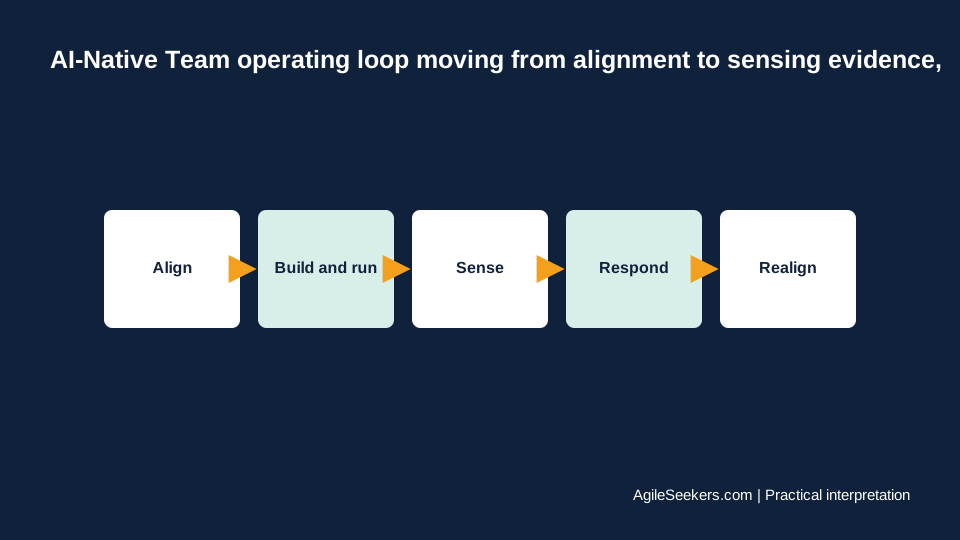
An AI-Native Team combines human creativity, domain judgment, product thinking, engineering capability, and AI. It is not a conventional team with one person renamed as the AI specialist. The system must be able to align on intent, sense evidence continuously, and respond while preserving accountability.
Four capabilities shape the team
| Capability | Contribution | Risk when absent |
|---|---|---|
| Product | Vision, customer problem, outcomes, priorities | Fast output without useful direction |
| Builder | Turns intent into working products and experiments | Ideas never become testable value |
| Domain Expert | Specialized operating, customer, legal, or scientific context | Plausible but contextually wrong decisions |
| AI | Generation, analysis, automation, and machine-scale sensing | Manual bottlenecks and missed patterns |
Align establishes a decision frame
Alignment clarifies the outcome, current evidence, constraints, responsibilities, and boundaries for autonomous action. It can happen on cadence, but it should not require every decision to wait for the next event. Strong alignment enables local speed because teams and agents know what they may change and what requires escalation.
Sense turns operation into evidence
Sensing combines product analytics, customer feedback, operational telemetry, experiment results, quality signals, market changes, and model behavior. Teams should detect both intended movement and guardrail breaches. More dashboards do not create sensing unless a signal is connected to a decision.
Respond changes investment or behavior
Response may scale a successful output, alter an experiment, update context, restore service, change a specification, reallocate capacity, or stop work. Scaled Agile's AI-Native Teams guidance describes Align, Sense, and Respond as a flow-based approach rather than a fixed sequence of ceremonies.
Human-centric does not mean human bottleneck
Human accountability should be concentrated where judgment, safety, ethics, customer impact, or irreversible consequences require it. Low-risk reversible actions can be delegated within explicit guardrails. Record agent actions, monitor outcomes, provide intervention paths, and make ownership visible when several humans and agents contribute.
A team-readiness experiment
- Choose one outcome with a reliable baseline and a reversible intervention.
- Map Product, Builder, Domain, and AI capability gaps.
- Define what the AI may recommend, create, or execute.
- Connect two or three sensing signals to explicit response rules.
- Run for one short learning cycle and review value, cost, quality, and human effort.
- Expand only when evidence supports broader autonomy.
AI-Empowered SAFe Scrum Master training supports team facilitation, flow, and ART participation. SAFe Advanced Scrum Master training is relevant for experienced coaches working across team boundaries, systemic impediments, and evolving collaboration patterns.
Create a closed learning loop
Align–sense–respond is useful only when teams share intent, observe meaningful signals and have authority to adapt. AI may detect patterns or summarize evidence, but the team must understand data quality, delay and possible harm.
Design the loop
- State the outcome and guardrails.
- Select leading and balancing signals.
- Define who reviews evidence and how often.
- Set thresholds for investigation, adaptation or escalation.
- Record the decision and later inspect its effect.
Avoid dashboards that create alerts without action ownership. Measure signal-to-decision time, false alerts, decisions reversed and whether customer or operational outcomes improve.