Project managers and delivery leaders preparing for predictive, Agile, and hybrid work


Project Management
PMP Certification Training with 35 Contact Hours
Project management certification trainingProject Management
PMP Certification Training with 35 Contact Hours
Strengthen predictive, Agile, and hybrid project leadership skills with live preparation aligned to the current PMP® examination.
Duration35 hours
FormatLive online
LearningInstructor-led
CredentialPMP®
35 hours of live instructor-led PMP exam preparation
Choose the right preparation path for exams before or from July 9, 2026
Practice predictive, adaptive/agile, and hybrid project scenarios
4.9/5 learner rating10,000+ learners sitewideLive instructor-led
Next live online batch
New dates being confirmed
BatchLive online
TimeTiming will be confirmed with the batch
TrainerConfirmation pending
Course fee₹9,999+ applicable GST
Standard fee₹19,999
- 35 hours of live PMP examination preparation
- Situational practice across predictive, Agile, and hybrid delivery
- Application, study-plan, and examination-readiness guidance
Secure Razorpay payment is available after you choose a batch. Final GST and invoice details are shown before payment.
Choose with clarity
What to know before you enrol
Course-specific fit, outcomes, inclusions, and payment checks in one place.
Exam domains, situational decisions, planning, risk, leadership, and hybrid delivery
35 hours of live preparation, learning resources, practice questions, and application guidance
Confirm PMI eligibility, batch, trainer, GST-inclusive total, and whether the exam fee is separate
Compare dates and enrol online →Need an invoice or team booking?
Plan for your target exam date
Prepare for the PMP Exam Version You Will Take
PMP certification validates your ability to lead people, manage project delivery, and connect project decisions to business priorities. This 35-hour course builds those capabilities through realistic scenarios across predictive, adaptive/agile, and hybrid ways of working.
PMI launches an updated PMP exam on July 9, 2026. Your preparation should match your exam date: use the current exam path when testing before July 9, or prepare for the updated domains, AI, sustainability, value delivery, case studies, and practicum-style questions when testing from July 9 onward.
PMP Certification at a Glance
- Training requirement
- 35 hours
- Exam questions
- 180
- Current exam time
- 230 minutes
- New exam time
- 240 minutes
- Credential cycle
- 3 years / 60 PDUs
Current PMP Exam and July 2026 PMP Exam
Testing before July 9, 2026
Current PMP Exam
- 180 questions in 230 minutes
- People 42%, Process 50%, Business Environment 8%
- Predictive, agile, and hybrid scenarios
- Prepare using current exam resources
Testing from July 9, 2026
Updated PMP Exam
- 180 questions in 240 minutes
- People 33%, Process 41%, Business Environment 26%
- Greater focus on AI, sustainability, and value delivery
- Adds case-study and practicum-style testing
 +91-9143964396
PMP Training Highlights

35 hours of live instructor-led PMP exam preparation
Choose the right preparation path for exams before or from July 9, 2026
Practice predictive, adaptive/agile, and hybrid project scenarios
Prepare for 180-question, scenario-based PMP exams
Learn the updated 2026 domains: People 33%, Process 41%, and Business Environment 26%
Understand emerging exam topics including AI, sustainability, and value delivery
Use mock exams, quizzes, and guided answer reviews to assess readiness
Receive support with the PMP application and experience documentation
Join weekday or weekend live online batches
Build a practical study plan around your target exam date
Career relevance
Why earn the PMP Certification Training with 35 Contact Hours?
Strengthen practical capability for roles that value structured delivery, collaboration, and measurable business outcomes.
10th–90th percentile thresholds
Median pay$100,750
Projected U.S. employment growth, 2024–34
Closest related occupation: Project Management Specialists
- Project Managers
- Project Leads
- PMO Professionals
- Delivery Managers
Labor-market benchmark for the closest related occupation, not a certification-specific salary or employment guarantee. Earnings vary by location, experience, role, and employer.
Source: U.S. Bureau of Labor StatisticsTrusted by teams
Organizations whose professionals we have trained






PMP Course Curriculum

Understand the PMP credential, eligibility pathways, application process, audit readiness, and how to select the correct exam version for your target date.
Develop leadership, conflict management, coaching, emotional intelligence, stakeholder engagement, and team-performance skills.
Plan scope, schedules, cost, quality, resources, procurement, communications, and delivery while tailoring practices to project context.
Identify uncertainty, respond to risks and issues, control change, maintain compliance, and support effective project governance.
Apply predictive lifecycles, process groups, baselines, earned value concepts, forecasting, and integrated change control.
Use iterative and incremental delivery, agile roles and events, backlog practices, flow, and hybrid approaches in realistic situations.
Connect projects to strategy, benefits, organizational change, compliance, sustainability, and measurable business value.
Understand how AI-assisted analysis, responsible decision-making, data, and emerging technology affect project leadership and the July 2026 exam.
Practice scenario-based questions, case studies, question elimination, time management, mock exams, and final readiness planning.
Course Fee
Live online classroom
Learn in Expert-Led Live Sessions
Live online classroom
PMP application and audit guidance
Scenario-based practice and mock-exam review
35 hours of live instructor-led PMP exam preparation
Upcoming Batches
Solid Experiential Learning
View all schedule₹19,999
₹9,999
Enterprise Training
Upskill and Reskill Your Teams
Customized Corporate Training
Flexible onsite, virtual, or hybrid delivery
Improve governance, predictability, and stakeholder outcomes
Connect project delivery with strategic objectives
Build organization-wide project management capability
Free practice test
PMP Certification Training with 35 Contact Hours Practice Test
Immediate results20 questions per setAnswer explanations
4 mock tests80 questions15 min each
PMP Certification and Exam Details
PMP certification demonstrates experience and capability in leading people, managing project processes, and connecting delivery to business priorities across industries.
Candidates testing before July 9, 2026 follow the current exam. Candidates testing from July 9, 2026 should prepare for the updated exam with greater emphasis on AI, sustainability, stakeholder engagement, and value delivery.
The current exam contains 180 questions in 230 minutes. The July 2026 exam contains 180 questions in 240 minutes and adds case-study and hands-on practicum-style testing.
The credential tests judgment across predictive, adaptive/agile, and hybrid approaches rather than one fixed methodology.
Candidates must document their education and project leadership experience accurately. Training includes guidance for completing the application and preparing supporting records.
Effective preparation combines structured learning, scenario practice, mock exams, error review, and a study plan based on your exam date.
PMP certification is maintained in three-year cycles. Credential holders earn 60 professional development units during each cycle.
The credential supports experienced professionals who lead projects, programs, delivery teams, transformation initiatives, and cross-functional work.
Skills You Will Develop
Choose the Correct Exam Path
Build a preparation plan for the current PMP exam or the updated exam launching July 9, 2026.
01

Lead People and Teams
Handle conflict, coach teams, engage stakeholders, and make responsible leadership decisions.
02
Tailor Delivery Approaches
Select and combine predictive, adaptive/agile, and hybrid practices based on project needs.
03
Plan and Control Project Work
Manage scope, schedule, cost, quality, resources, communications, procurement, and change.
04
Manage Risk and Uncertainty
Identify threats and opportunities, evaluate responses, and act on emerging project issues.
05
Deliver Business Value
Connect project decisions with outcomes, benefits, strategy, and organizational priorities.
06
Apply Modern Project Practices
Consider AI, sustainability, data, and evolving stakeholder expectations in project decisions.
07
Answer Scenario-Based Questions
Interpret complex exam situations, identify the best next action, and manage time confidently.
08
PMP Eligibility Requirements
High school or secondary school diploma, at least 60 months of experience leading and managing projects within the past eight years, and 35 hours of project management education or an accepted alternative.
Bachelor's degree or higher, at least 36 months of experience leading and managing projects within the past eight years, and 35 hours of project management education or an accepted alternative.
Bachelor's degree or higher from a GAC-accredited program, at least 24 months of experience leading and managing projects within the past eight years, and the applicable project management education requirement.
Career Paths After PMP Certification
 Lead individual projects
Project Manager
- Own scope, schedule, cost, risk, and delivery
- Lead cross-functional teams and stakeholders
- Tailor predictive, agile, or hybrid practices
Progression focus
Build a record of reliable delivery and begin coordinating larger, higher-risk initiatives.
 Lead complex initiatives
Senior Project Manager
- Manage complex dependencies and governance
- Coach project teams and emerging managers
- Influence sponsors and executive stakeholders
Progression focus
Expand from managing one initiative to coordinating outcomes across related projects.
 Coordinate multiple projects
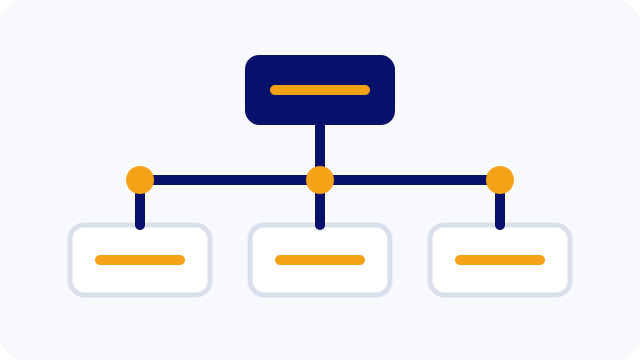
Program or PMO Leader
- Align projects with program and portfolio priorities
- Improve governance, standards, and reporting
- Manage cross-project risks and resource decisions
Progression focus
Strengthen strategic planning, benefits management, governance, and organizational influence.
 Guide strategic investment
Project or Portfolio Director
- Prioritize investments and expected business outcomes
- Guide portfolio-level risk and capacity decisions
- Connect delivery performance with strategy
Progression focus
Develop enterprise leadership, financial judgment, and portfolio decision-making capability.
PMP Certification FAQs
Project Management Professional (PMP) certification is a globally recognized credential from PMI that validates experience and capability in leading people, managing project processes, and delivering business value.
The course is intended for experienced project managers, project leads, delivery managers, PMO professionals, consultants, and professionals who meet or are working toward PMI's eligibility requirements.
Most applicants need 35 hours of project management education or training. CAPM certification and certain other accepted pathways may also satisfy the education requirement.
The updated PMP exam launches on July 9, 2026. Candidates taking the exam before July 9 should prepare for the current version; candidates testing from July 9 should use updated preparation materials.
The updated exam increases emphasis on AI, sustainability, stakeholder engagement, and value delivery. Its domains are People 33%, Process 41%, and Business Environment 26%.
The current exam contains 180 questions and allows 230 minutes. It tests People, Process, and Business Environment through scenario-based questions across predictive, agile, and hybrid approaches.
The July 2026 exam contains 180 questions and allows 240 minutes. It includes multiple-choice and multiple-response items, drag-and-drop questions, case studies, and hands-on practicum-style testing.
Yes. PMP evaluates project leadership across predictive, adaptive/agile, and hybrid ways of working.
The exam is challenging because questions test judgment in realistic project situations. Structured learning, repeated scenario practice, mock exams, and review of incorrect answers improve readiness.
PMI offers online-proctored and test-center options, subject to the current availability and policies for your location.
Yes. The training includes guidance on eligibility, documenting project experience, completing the application, and preparing for a possible audit.
Preparation time varies by experience and study schedule. Many candidates use a structured plan of several weeks that combines lessons, revision, scenario questions, and full mock exams.
PMP certification is maintained in three-year cycles. Credential holders must earn 60 PDUs during each cycle to renew it.
No. PMP is industry-independent and is relevant across technology, construction, consulting, healthcare, finance, manufacturing, and other sectors.
PMP is designed for experienced professionals who lead and manage projects. CAPM is an entry-level credential for people building foundational project management knowledge.
PMP exam requirements and formats may change. Review PMI's official exam preparation guidance and current exam update overview before scheduling your exam.

Struggling to Find the
Perfect Schedule?
Independent learner reviews
What learners say about AgileSeekers
 5.0 out of 5View Google reviews
 4.7 out of 5View all 49 reviews
Trustpilot★★★★★
“Clear explanations, patient mentoring, and deep expertise made the SAFe certification journey insightful and achievable.”
N
View on TrustpilotNithin MJul 2026
Trustpilot★★★★★
“Surya makes complex concepts easy to grasp and ensures learners are well prepared for SAFe certification.”
N
View on TrustpilotNagbushan SriJul 2026
Google★★★★★
 Google
“The SAFe POPM training was well structured, interactive, and packed with practical real world examples.”
N
View on GoogleNishitha A.Jun 2026
Trustpilot★★★★★
“The training was informative, well structured, easy to follow, and supported by clear practical examples.”
A
View on TrustpilotArun KumarJun 2026
Trustpilot★★★★★
“The PSPO trainer explained concepts clearly with practical examples, making product ownership easy to understand and apply.”
R
View on TrustpilotRajinikanth VarmaJul 2026
Trustpilot★★★★★
“The SAFe AI Empowered POPM course was well structured, relevant, practical, and aligned with current industry practices.”
A
View on TrustpilotAastik KumarJun 2026
Take the next step
Ready to Start PMP Certification Training with 35 Contact Hours?
Explore upcoming live batches or speak with a course advisor to find the right schedule for your goals.
Students also signed up for
SAFe
AI Empowered Leading SAFe Agilist Certification Training

100% assured results
22 February 2025

Bonus: Course resources included
2 Days Training
(5 Reviews)
₹ 35,400
₹65,999
SAFe
AI Empowered SAFe Product Owner/Product Manager Certification Training
100% assured results
22 February 2025
Bonus: Course resources included
2 Days Training
(5 Reviews)

