Leaders and practitioners working with teams, programs, products, or portfolios in a SAFe environment


SAFe
Enterprise PI Planning Simulation Training for Scrum Masters & RTEs
Official SAFe® certification courseOfficial Bronze Partner
Enterprise PI Planning Simulation Training for Scrum Masters & RTEs
Build practical, job-ready skills through live instructor-led Enterprise PI Planning Simulation Training for Scrum Masters & RTEs with expert guidance and structured learning support.
DurationLive training
FormatLive online
LearningInstructor-led
CredentialOfficial credential
Understand why PI Planning aligns an ART around a shared mission, vision, and plan
Learn the inputs, roles, readiness checks, agenda, outputs, and follow-up activities
Prepare business context, product vision, architecture guidance, prioritized features, and logistics
4.9/5 learner rating10,000+ learners sitewideLive instructor-led
Next live online batch
New dates being confirmed
BatchLive online
TimeTiming will be confirmed with the batch
TrainerConfirmation pending
Course fee₹8,000+ applicable GST
- Live role-focused SAFe learning with practical exercises
- Structured course resources and assessment preparation
- Credential, attendance, and post-class guidance
Secure Razorpay payment is available after you choose a batch. Final GST and invoice details are shown before payment.
Choose with clarity
What to know before you enrol
Course-specific fit, outcomes, inclusions, and payment checks in one place.
Role-relevant SAFe practices, applied exercises, collaboration, and workplace decision-making
Live instructor-led learning, course resources, practical exercises, and credential guidance
Confirm the trainer, batch, GST-inclusive total, attendance rules, and whether the exam fee is included
Compare dates and enrol online →Need an invoice or team booking?
Prepare, align, plan, and execute
Facilitate PI Planning with Confidence
This one-day practitioner workshop gives Scrum Masters, RTEs, Product Managers, Product Owners, Business Owners, architects, and Agile teams a practical view of PI Planning from readiness through execution follow-through.
Learn to prepare the event, guide team breakouts, plan against real capacity, write useful PI Objectives, expose dependencies, ROAM risks, facilitate confidence voting, and use digital planning tools through guided practice and simulation.
PI Planning Workshop at a Glance
- Course duration
- 1 day / 8 hours
- Learning format
- Live instructor-led
- Applied practice
- Simulation + tools
- Completion award
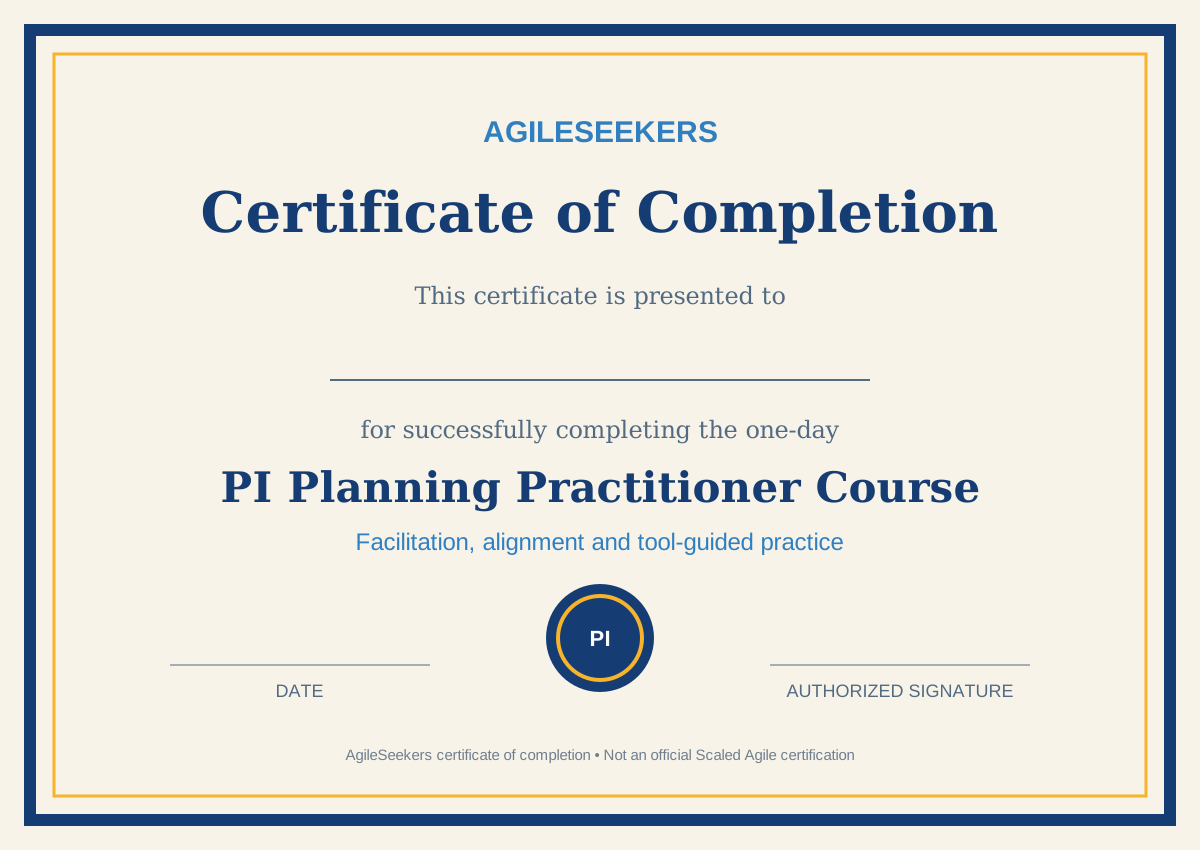
- AgileSeekers certificate
- Prerequisites
- None required
- Certification exam
- Not included
 +91-9143964396
PI Planning Course Highlights

Understand why PI Planning aligns an ART around a shared mission, vision, and plan
Learn the inputs, roles, readiness checks, agenda, outputs, and follow-up activities
Prepare business context, product vision, architecture guidance, prioritized features, and logistics
Facilitate team breakouts, draft and final plan reviews, risk resolution, and confidence voting
Write clear team PI Objectives and distinguish committed from uncommitted objectives
Identify, visualize, negotiate, and track cross-team and cross-ART dependencies
Use capacity, load, and allocation information to build achievable plans
Configure and navigate piplanning.io PI Sessions, Team Boards, ART Backlog Boards, and ART Planning Boards
Use Plan Mode, Execution Mode, search, timers, readouts, confidence votes, board history, and metrics
Understand how piplanning.io can synchronize work with Jira, Azure DevOps, and Rally
Career relevance
Why earn the Enterprise PI Planning Simulation Training for Scrum Masters & RTEs?
Strengthen practical capability for roles that value structured delivery, collaboration, and measurable business outcomes.
10th–90th percentile thresholds
Median pay$101,190
Projected U.S. employment growth, 2024–34
Closest related occupation: Management Analysts
- Scrum Masters
- Agile Team Leads
- Delivery Managers
- Change Agents
Labor-market benchmark for the closest related occupation, not a certification-specific salary or employment guarantee. Earnings vary by location, experience, role, and employer.
Source: U.S. Bureau of Labor StatisticsTrusted by teams
Organizations whose professionals we have trained






One-Day PI Planning Course Curriculum

Define PI Planning, the Agile Release Train, Planning Interval cadence, business outcomes, and the value of having the people who do the work plan the work.
Clarify the responsibilities of the RTE, Business Owners, Product Management, System Architect, Scrum Masters or Team Coaches, Product Owners, Agile Teams, and supporting stakeholders.
Assess ART readiness; prepare business context, product and solution vision, architecture guidance, prioritized features, team capacity, facilities, remote access, tooling, and working agreements.
Walk through the event from opening briefings to team breakouts, management review and problem solving, draft plan review, planning adjustments, final plan review, confidence vote, and retrospective.
Course Fee
Live online classroom
Learn in Expert-Led Live Sessions
One-day live online workshop
AgileSeekers certificate of completion
Hands-on piplanning.io walkthrough
PI Planning templates, checklists, and simulation
One full day of live, instructor-led learning
Upcoming Batches
New batches opening soon
View all schedule₹8,000
Enterprise Training
Upskill and Reskill Your Teams
Customized Corporate Training
Optional preparation and planning-readiness review
Customized remote, onsite, or hybrid delivery
Facilitation coaching for RTEs and team facilitators
Use your ART structure and real planning scenarios
About This PI Planning Training
A focused one-day practitioner workshop for professionals who need to prepare, participate in, or facilitate effective PI Planning and use piplanning.io with confidence.
A well-run event produces aligned team PI Objectives, an ART planning board showing feature delivery and dependencies, visible risks, capacity-aware team plans, and shared confidence in the plan.
Release Train Engineers, Scrum Masters, Team Coaches, Product Managers, Product Owners, Business Owners, System Architects, Agile Coaches, PMO and delivery leaders, and Agile Team members.
The course explains how piplanning.io supports preparation, real-time collaboration, dependency management, capacity decisions, objectives, risk visibility, plan readouts, confidence voting, and execution tracking.
What You Will Be Able to Do
Explain PI Planning
Describe its purpose, cadence, participants, inputs, agenda, outputs, and place in SAFe.
01

Prepare the Event
Use readiness checks to organize content, people, logistics, tools, and working agreements.
02
Facilitate the Agenda
Guide briefings, breakouts, reviews, problem solving, risk treatment, voting, and retrospective activities.
03
Build Achievable Plans
Balance demand with capacity and help teams create realistic iteration plans and PI Objectives.
04
Manage Dependencies
Find, negotiate, visualize, own, and track dependencies within and across ARTs.
05
Handle PI Risks
Facilitate risk conversations and use ROAM to make risk responses explicit.
06
Operate piplanning.io
Handle sessions and boards, configure planning structures, work with stickies, and use facilitation controls.
07
Use Planning Metrics
Interpret capacity, load, allocation, dependency, and progress information to support timely decisions.
08
Support PI Execution
Keep plans, objectives, dependencies, and risks current after the event using execution views and board history.
09
Improve the Next Event
Capture feedback, identify facilitation improvements, and create a reusable action plan for the next PI.
10
Prerequisites and Recommended Experience
No prior SAFe certification is required. Familiarity with Agile or Scrum concepts will make the exercises easier to follow.
Experience as an RTE, Scrum Master, Product Owner, Product Manager, Agile Coach, delivery lead, architect, or Agile Team member is helpful but not required.
Bring a laptop with a modern browser and reliable internet access. Login or trial access instructions, when used for a batch, will be shared by the instructor.
Where PI Planning Practitioner Skills Apply
 Guide an aligned planning event
PI Planning Facilitator
- Prepare the event and facilitation flow
- Guide breakouts, reviews, ROAM, and confidence voting
- Keep decisions, risks, and dependencies visible
Progression focus
Apply the templates in a real event, co-facilitate with an experienced RTE, and improve the next event using participant feedback.
 Enable ART alignment and execution
Release Train Engineer
- Align teams, leaders, and stakeholders
- Manage systemic impediments and cross-team coordination
- Connect planning outcomes with PI execution
Progression focus
Deepen ART-level facilitation, systems thinking, coaching, and flow-measurement capability.
 Connect vision, priorities, and outcomes
Product and Planning Leader
- Prepare vision and prioritized features
- Support achievable objectives and trade-off decisions
- Maintain alignment between value and capacity
Progression focus
Strengthen product strategy, feature readiness, objective quality, stakeholder alignment, and outcome measurement.
 Build planning capability across teams
ART Delivery Coach
- Coach teams and facilitators before the event
- Improve dependency and risk conversations
- Create reusable planning standards and working agreements
Progression focus
Use event observations and execution data to coach better planning habits across teams and ARTs.
PI Planning Course FAQs
PI Planning is a cadence-based event that aligns all teams and stakeholders on an Agile Release Train around a shared mission, vision, objectives, and delivery plan.
The course runs for one instructor-led day. The scheduled session includes concept learning, tool demonstrations, exercises, and a facilitated planning simulation.
The fee is Rs. 8,000 per participant. Any applicable taxes and payment terms will be shown during enrollment.
No. This is an AgileSeekers practitioner workshop and is not an official Scaled Agile certification course. It does not include a Scaled Agile exam or SAFe Studio membership.

Struggling to Find the
Perfect Schedule?
Independent learner reviews
What learners say about AgileSeekers
 5.0 out of 5View Google reviews
 4.7 out of 5View all 49 reviews
Google★★★★★
 Google
“The SAFe POPM training was well structured, interactive, and packed with practical real world examples.”
N
View on GoogleNishitha A.Jun 2026
Trustpilot★★★★★
“The training was informative, well structured, easy to follow, and supported by clear practical examples.”
A
View on TrustpilotArun KumarJun 2026
Trustpilot★★★★★
“Clear explanations, patient mentoring, and deep expertise made the SAFe certification journey insightful and achievable.”
N
View on TrustpilotNithin MJul 2026
Trustpilot★★★★★
“The PSPO trainer explained concepts clearly with practical examples, making product ownership easy to understand and apply.”
R
View on TrustpilotRajinikanth VarmaJul 2026
Trustpilot★★★★★
“The SAFe AI Empowered POPM course was well structured, relevant, practical, and aligned with current industry practices.”
A
View on TrustpilotAastik KumarJun 2026
Trustpilot★★★★★
“Surya makes complex concepts easy to grasp and ensures learners are well prepared for SAFe certification.”
N
View on TrustpilotNagbushan SriJul 2026
Take the next step
Ready to Start Enterprise PI Planning Simulation Training for Scrum Masters & RTEs?
Explore upcoming live batches or speak with a course advisor to find the right schedule for your goals.

