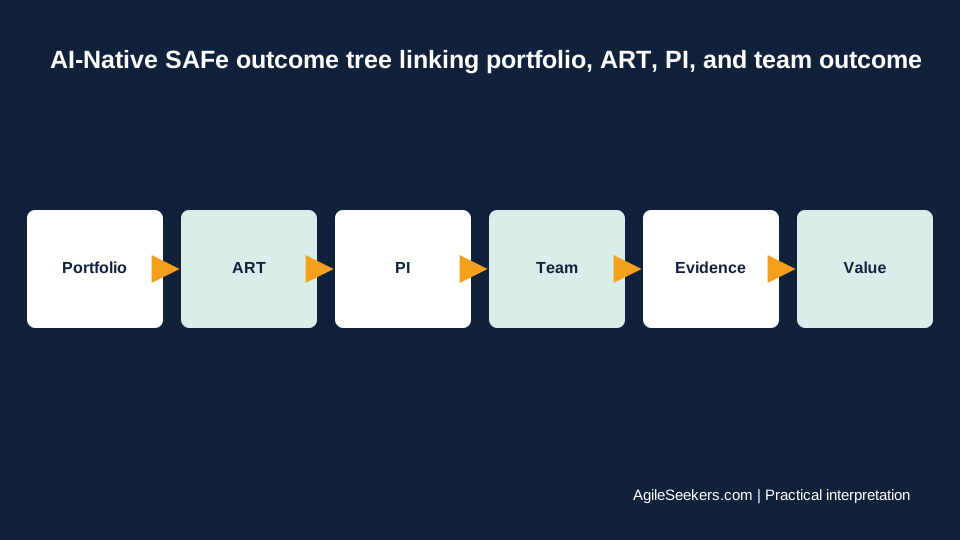
Fast autonomous teams need more context, not more task assignment. An outcome tree provides that context by connecting enterprise and portfolio intent to ART, PI, and team outcomes. The tree should make strategic contribution traceable without prescribing every feature a team must build.
Different levels answer different questions
| Level | Question | Typical horizon | Primary collaborators |
|---|---|---|---|
| Portfolio outcome | How will the portfolio advance enterprise strategy? | Annual or strategic investment cycle | Portfolio leadership and executives |
| ART outcome | What customer or business result will this ART advance? | Strategic investment cycle | ART leadership and Business Owners |
| PI outcome | What progress matters in the coming PI? | PI | Product Management, ART leadership, Business Owners |
| Team outcome | What contribution can this team validate? | PI or shorter | AI-Native team and stakeholders |
Connect contribution, not identical wording
A team outcome should not copy the portfolio OKR with a smaller number. It should describe the team's distinct contribution and measures. Several team outcomes may support one PI outcome, and several PI outcomes may contribute to an ART outcome. The connection must be plausible and evidence-bearing, not merely a colored line in a planning tool.
The approval boundary protects coherence
Scaled Agile's current ART outcomes guidance distinguishes who creates and approves outcomes at each level. Approval should test strategic alignment, measurable intent, and economic fit. It should not turn outcome design into centralized solution assignment. Teams need freedom to discover which outputs move the measure.
Balance growth with quality and risk
An outcome set dominated by growth can quietly consume reliability, security, trust, or team health. Review the tree for product creation, market growth, operational effectiveness, and quality or risk. A balanced set makes trade-offs discussable before a rapid experiment creates avoidable harm.
Traceability health checks
- Every active output names an outcome and the signal it should influence.
- Teams can explain why their measure contributes to the ART outcome.
- Portfolio leaders can see which investments are not producing evidence.
- Outcomes can change when customer, market, technology, or regulatory context changes.
- Stopping an output does not count as failure when it protects the outcome and frees capacity.
Do not convert the tree into a target cascade
Cascaded targets invite gaming when each layer is judged on local numbers. Preserve shared measures where appropriate, discuss confidence and counter-signals, and avoid using one metric as an individual performance score. The outcome tree is an alignment and learning structure, not a mechanism for pushing accountability downward.
SAFe POPM certification training supports product roles shaping ART and PI intent. SAFe RTE training helps ART leaders facilitate alignment, evidence, and adaptation without taking product accountability away from the appropriate roles.
Connect outcomes without forcing a perfect cascade
An outcome tree can show how portfolio intent may be influenced by ART, PI and team outcomes. It should preserve uncertainty and shared contribution; one team result rarely causes an enterprise outcome alone.
Build traceability
For each node, record the intended behaviour or result, evidence source, owner, review cadence and major assumptions. Mark enabling and balancing outcomes. AI can challenge gaps or duplicate wording, but leaders must decide whether the causal connection is credible.
Review measures that drive local optimization, outcomes with no evidence and branches that no team can influence. Update the tree when learning changes the strategy.