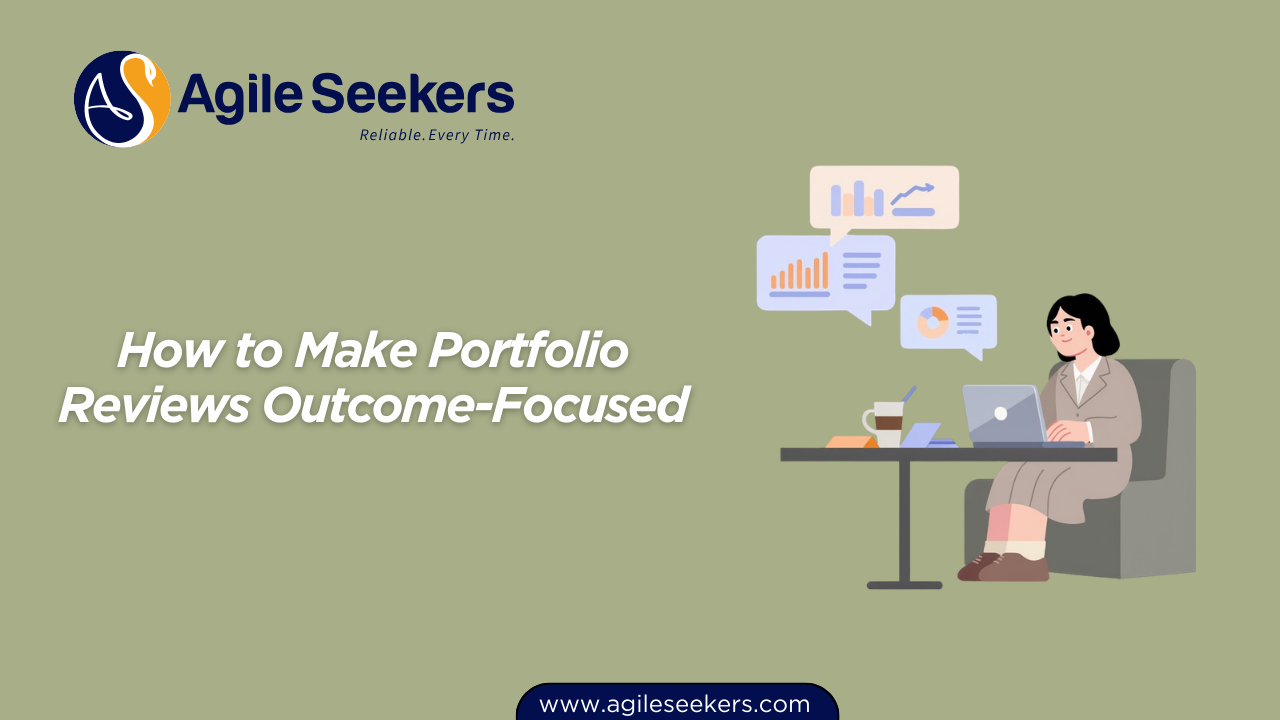
Portfolio reviews play a critical role in organizations that follow Agile and SAFe practices. Leaders use these reviews to evaluate investments, align initiatives with strategy, and decide where to focus resources. Yet many portfolio reviews drift toward status updates rather than meaningful discussions about value.
Teams present slides. Stakeholders review timelines. Executives ask whether work is on track. The meeting ends with very little discussion about outcomes, customer value, or business impact.
Outcome-focused portfolio reviews change that dynamic. Instead of asking “Are we delivering what we planned?”, leaders ask a more powerful question: “Are we achieving the results we expected?”
This shift sounds simple, but it requires deliberate changes in how organizations prepare for, structure, and facilitate portfolio reviews.
This guide explains how organizations can make portfolio reviews outcome-focused and why this shift strengthens strategic execution.
Why Portfolio Reviews Often Become Status Meetings
Many organizations begin with good intentions. Portfolio reviews exist to ensure that investments generate real value. Over time, however, the meetings gradually evolve into reporting sessions.
Several patterns cause this shift:
- Teams focus on activity rather than outcomes
- Executives request progress updates instead of impact metrics
- Presentations emphasize timelines and milestones
- Discussions center on delivery rather than results
When this happens, the portfolio review loses its strategic purpose.
Work may appear successful because milestones are completed, even though the initiative fails to produce measurable business value.
Outcome-focused portfolio reviews solve this problem by keeping attention on measurable impact.
Understanding the Difference Between Output and Outcome
The first step toward outcome-focused reviews involves understanding the difference between output and outcome.
Outputs represent the work delivered by teams. Examples include:
- Features released
- Stories completed
- System capabilities delivered
- Milestones achieved
Outcomes represent the results created by those outputs. Examples include:
- Customer adoption
- Revenue growth
- Reduced operational cost
- Improved user engagement
- Faster cycle time
An organization might release ten features in a quarter. That represents output. If those features increase user retention by 15 percent, that represents an outcome.
Outcome-focused portfolio reviews focus on the second category.
Linking Portfolio Work to Strategic Goals
Outcome-focused reviews begin with strategy. Every initiative in the portfolio should support a measurable business objective.
Organizations often use OKRs (Objectives and Key Results) or strategic themes to guide investment decisions. Portfolio reviews should evaluate progress against these goals.
For example:
- Strategic goal: Increase digital customer engagement
- Portfolio initiative: Mobile experience improvement
- Outcome metric: Daily active users
During the review, leaders evaluate whether the initiative moves the organization toward the strategic goal.
This approach aligns closely with the Lean Portfolio Management guidance described by Scaled Agile, where strategy connects directly to portfolio investments.
Designing Portfolio Reviews Around Value
Outcome-focused portfolio reviews require a different meeting structure. Instead of organizing presentations around project updates, the agenda should center on value delivery.
A typical outcome-focused portfolio review includes four discussion areas:
1. Strategic Alignment
The meeting begins by revisiting strategic goals. Leaders review the outcomes the organization wants to achieve during the current planning horizon.
This step reminds participants that the purpose of the portfolio is not simply delivery. The purpose is impact.
2. Outcome Metrics
Each initiative presents measurable results rather than activity updates.
Examples include:
- Customer adoption rates
- Revenue impact
- Operational efficiency improvements
- Flow metrics
- Customer satisfaction scores
Teams should present both expected outcomes and actual results.
3. Learning and Insight
Outcome-focused reviews encourage learning rather than judgment.
Instead of asking why a team missed a milestone, leaders ask:
- What did we learn from this initiative?
- What assumptions proved incorrect?
- What new opportunities emerged?
This approach encourages experimentation and transparency.
4. Investment Decisions
The final part of the review focuses on action.
Leaders decide whether to:
- Continue investing
- Adjust direction
- Scale the initiative
- Stop the work entirely
These decisions ensure that the portfolio continues to support strategic goals.
Using Flow Metrics to Evaluate Outcomes
Many organizations focus only on business metrics such as revenue or adoption. Those measures matter, but they do not tell the whole story.
Flow metrics help leaders understand how effectively value moves through the system.
Examples include:
- Flow time
- Flow efficiency
- Flow distribution
- Throughput
These metrics reveal whether the organization delivers value quickly and predictably.
The guidance from Scrum.org explains how flow metrics help organizations identify bottlenecks and improve delivery performance.
Portfolio reviews should combine business outcomes with flow metrics to create a complete picture of value delivery.
Making Product Managers Accountable for Outcomes
Product leaders play a key role in outcome-focused portfolio reviews.
In SAFe environments, Product Owners and Product Managers define features, prioritize backlogs, and guide value delivery across Agile Release Trains.
However, their responsibility does not end when features ship.
They must also evaluate whether the delivered functionality creates measurable business value.
Professionals who develop these skills often benefit from advanced training such as SAFe Product Owner Product Manager certification, which teaches value-driven backlog management and strategic alignment.
When product leaders track outcomes consistently, portfolio reviews naturally become more outcome-focused.
Strengthening Collaboration Between Portfolio and ART Leadership
Outcome-focused portfolio reviews depend on strong collaboration between portfolio leaders and Agile Release Train leadership.
Release Train Engineers, Product Management, and System Architects provide insight into delivery performance, technical risks, and operational constraints.
Portfolio leaders rely on these insights to make informed investment decisions.
Many organizations strengthen this collaboration by developing ART leadership capabilities through programs such as SAFe Release Train Engineer certification.
When ART leaders contribute outcome metrics and delivery insights, portfolio reviews become far more meaningful.
Encouraging Evidence-Based Decision Making
Outcome-focused portfolio reviews rely on evidence rather than opinion.
Instead of debating assumptions, leaders evaluate real data.
Examples include:
- Customer usage analytics
- Revenue impact measurements
- Customer feedback trends
- Operational performance metrics
Evidence-based discussions improve decision quality and reduce bias.
This principle also aligns with evidence-based management concepts promoted by Scrum.org.
Organizations that rely on measurable evidence consistently make better portfolio investment decisions.
The Role of Scrum Masters in Outcome-Focused Delivery
Scrum Masters contribute more to portfolio success than many leaders realize.
They help teams maintain focus on value delivery, remove impediments, and encourage transparency around performance.
During portfolio reviews, Scrum Masters provide insights about delivery flow, team capacity, and operational challenges.
Organizations often strengthen these capabilities through professional development programs such as SAFe Scrum Master certification.
When Scrum Masters understand the connection between team performance and strategic outcomes, they help align delivery work with portfolio goals.
Developing Advanced Coaching Capabilities
Outcome-focused organizations require strong coaching skills.
Agile leaders must help teams move beyond task completion and think about customer impact.
This shift often requires cultural change.
Teams must feel safe discussing results openly, even when outcomes fall short of expectations.
Advanced coaching skills support this transformation. Many leaders develop these capabilities through programs such as SAFe Advanced Scrum Master certification, which focuses on facilitation, coaching, and systems thinking.
Strong coaching helps organizations maintain an outcome mindset across teams and programs.
Connecting Portfolio Reviews to Organizational Learning
The most effective portfolio reviews function as learning systems.
Instead of evaluating success or failure, leaders ask:
- What did we learn about our customers?
- Which assumptions proved correct?
- Where did our strategy need adjustment?
- What opportunities should we explore next?
This mindset encourages continuous improvement.
Organizations that treat portfolio reviews as learning opportunities adapt faster and make better strategic decisions.
Leadership training such as SAFe agile training often emphasizes this principle by teaching leaders how to connect strategy, execution, and learning.
Practical Techniques to Make Portfolio Reviews Outcome-Focused
Organizations can apply several practical techniques to strengthen portfolio reviews.
Use Outcome Dashboards
Create dashboards that display key outcome metrics such as customer adoption, revenue growth, and delivery flow.
Visual dashboards help leaders understand performance quickly.
Replace Status Slides with Metrics
Ask teams to present measurable outcomes instead of lengthy status presentations.
This change keeps discussions focused on value.
Limit Presentation Time
Outcome-focused reviews emphasize discussion rather than presentation.
Teams should spend minimal time presenting information and more time analyzing results.
Encourage Cross-Team Dialogue
Portfolio reviews should encourage collaboration between teams, product leaders, and executives.
These conversations often reveal insights that isolated teams might miss.
Use Hypothesis-Driven Planning
Each initiative should begin with a hypothesis.
Example:
“If we implement capability X, we expect outcome Y.”
Portfolio reviews evaluate whether that hypothesis proved correct.
Common Pitfalls to Avoid
Organizations often encounter several challenges when shifting toward outcome-focused portfolio reviews.
Too Many Metrics
Tracking too many indicators creates confusion.
Focus on a small set of meaningful outcomes.
Blame-Oriented Reviews
If teams fear criticism, they will hide problems.
Outcome-focused reviews should encourage openness and learning.
Ignoring Customer Feedback
Customer insights provide valuable signals about whether initiatives create value.
Portfolio reviews should include this perspective.
Disconnect Between Strategy and Delivery
If teams cannot see how their work supports strategic goals, outcome discussions lose meaning.
Leadership must maintain clear strategic alignment.
Conclusion
Outcome-focused portfolio reviews help organizations evaluate what truly matters: the impact of their investments.
When leaders focus only on outputs, teams may deliver work that fails to create meaningful value. Outcome-focused reviews change the conversation.
They encourage evidence-based decisions, strategic alignment, and continuous learning.
Organizations that adopt this approach strengthen the connection between strategy and execution. They identify opportunities earlier, adjust investments faster, and ensure that every initiative contributes to measurable business outcomes.
Over time, portfolio reviews evolve from status meetings into strategic conversations about value creation.
That shift makes the entire Agile enterprise more effective.
Also read - Balancing Governance and Autonomy in SAFe
Also see - Why Strategic Initiatives Stall After Approval
A practical sequence to apply this guidance
- Why Portfolio Reviews Often Become Status Meetings: Clarify the decision, people affected and evidence needed before acting.
- Understanding the Difference Between Output and Outcome: Apply the guidance to one current example and record important constraints.
- Linking Portfolio Work to Strategic Goals: Choose one small action with an owner, boundary and review date.
- Designing Portfolio Reviews Around Value: Compare the result with the intended outcome and update the approach.
Use the sequence as a decision aid, not a rigid template. Preserve the article's context and adapt the steps when evidence, risk or authority differs.