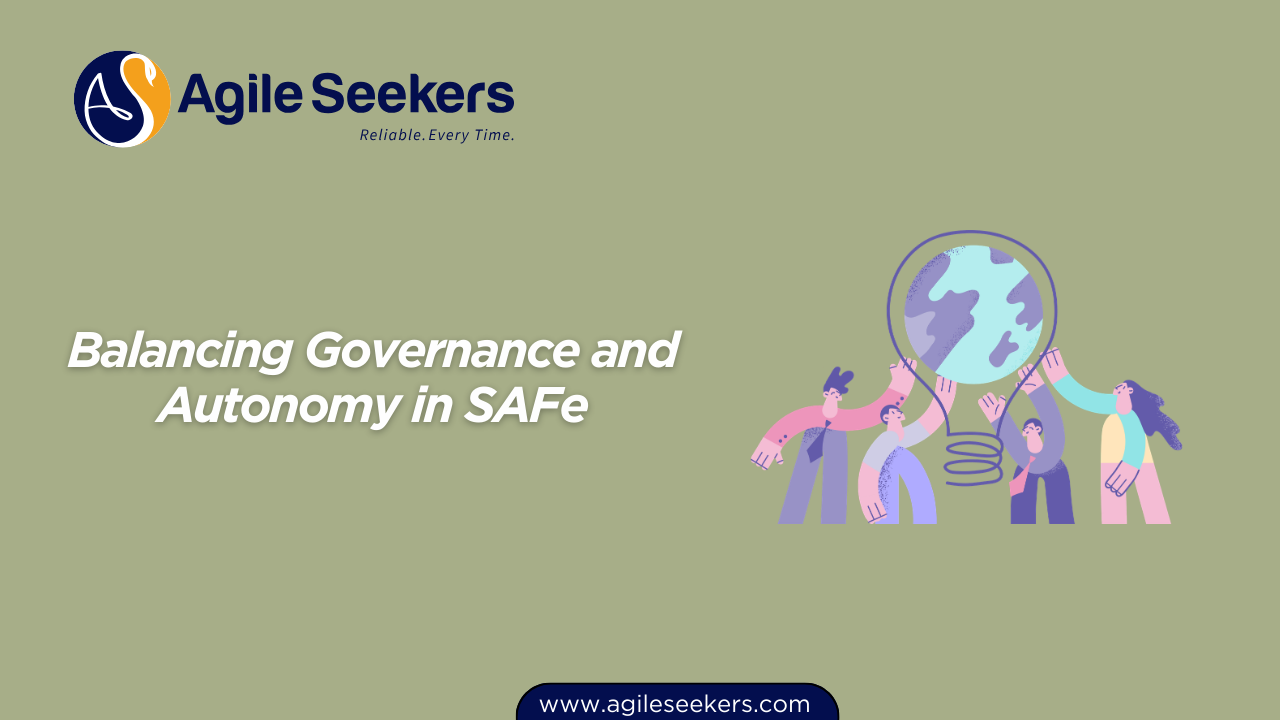
Large organizations face a recurring tension when they adopt scaled Agile frameworks. Leaders want visibility, compliance, and financial oversight. Teams want freedom to solve problems quickly and deliver value without layers of approvals slowing them down. Both sides have valid concerns.
This is where governance and autonomy must work together rather than compete. When organizations lean too far toward control, teams lose momentum. When they swing too far toward autonomy, alignment and accountability suffer.
The Scaled Agile Framework addresses this challenge by designing governance that supports flow while still protecting strategic priorities. Instead of rigid command structures, SAFe encourages guardrails that guide teams without restricting them.
Understanding how to balance governance and autonomy helps organizations scale Agile effectively. It allows leadership to maintain strategic oversight while empowering teams to innovate and respond to change.
Why Governance Matters in SAFe
Governance ensures that large initiatives remain aligned with organizational goals. In complex enterprises, hundreds of teams may contribute to shared solutions, products, and value streams. Without governance, coordination becomes difficult.
Governance provides clarity in areas such as:
- Strategic alignment with business priorities
- Investment and budget control
- Risk and compliance management
- Portfolio oversight and reporting
- Operational transparency
However, traditional governance often introduces heavy reporting structures and slow decision cycles. Agile transformations struggle when legacy governance models remain unchanged.
SAFe solves this by shifting governance from control-based management to outcome-based alignment.
Leaders who understand SAFe principles often strengthen these governance mechanisms through training such as Leading SAFe agilist certification, which helps executives and managers guide large-scale Agile transformations effectively.
The Importance of Team Autonomy
Autonomy is equally critical for successful Agile execution. Agile teams perform best when they have ownership of their work, the authority to make technical decisions, and the freedom to experiment.
Autonomous teams move faster because they avoid unnecessary approvals and bureaucratic delays. They also develop stronger accountability since they take full responsibility for outcomes.
In SAFe environments, autonomy allows teams to:
- Improve delivery speed
- Adapt solutions quickly
- Innovate through experimentation
- Resolve problems without escalation
- Continuously improve processes
But autonomy without alignment creates fragmentation. Teams may optimize locally while harming system-level outcomes.
SAFe addresses this through alignment mechanisms such as PI Planning, architectural runway, and shared program objectives.
The Governance–Autonomy Tension in Large Enterprises
Most organizations encounter friction between governance and autonomy during Agile transformation. The friction typically appears in three areas.
1. Decision Authority
Teams want control over backlog priorities, technical approaches, and delivery schedules. Leadership wants assurance that these decisions support strategic outcomes.
2. Budget Control
Finance departments often expect detailed upfront planning before funding initiatives. Agile teams work iteratively and adjust priorities frequently.
3. Compliance and Risk Management
Industries such as banking, healthcare, and government must maintain strict regulatory compliance. Governance structures ensure this compliance but sometimes slow delivery.
SAFe attempts to resolve these tensions by embedding governance into Agile workflows rather than imposing it from outside.
How SAFe Creates a Balance
The Scaled Agile Framework introduces several mechanisms that allow governance and autonomy to coexist.
Lean Portfolio Management
Lean Portfolio Management (LPM) replaces traditional project funding models with value stream funding. Instead of approving every project individually, organizations allocate budgets to value streams.
This approach provides governance at the portfolio level while allowing teams within the value stream to make delivery decisions.
The Lean Portfolio Management approach encourages leaders to focus on outcomes, not task-level supervision.
Lean Budget Guardrails
Lean Budget Guardrails provide governance boundaries without restricting team autonomy. These guardrails define how funding decisions should be made within value streams.
Examples include:
- Spending thresholds
- Investment categories
- Epic approval guidelines
- Participatory budgeting
Teams can operate independently within these boundaries while leadership retains strategic control over investments.
Program Increment (PI) Planning
PI Planning is one of the strongest alignment mechanisms in SAFe. It brings all teams within an Agile Release Train together to plan the next increment of work.
This event ensures that autonomous teams coordinate their plans with system-level objectives.
During PI Planning, governance appears in the form of:
- Business context and strategic direction
- Architectural guidance
- Capacity constraints
- Program risks
At the same time, teams create their own iteration plans and commit to achievable objectives.
Professionals who facilitate this coordination often pursue SAFe Release Train Engineer certification to strengthen their ability to guide large planning events and maintain alignment across teams.
Role-Based Governance in SAFe
Another reason SAFe balances governance and autonomy effectively is its clearly defined roles. Each role carries specific responsibilities that support alignment without limiting team independence.
Product Owners and Product Managers
Product Owners and Product Managers maintain backlog alignment with business strategy while still empowering teams to decide how work gets implemented.
They translate strategic goals into features and stories that guide team delivery. By maintaining a clear product vision, they prevent autonomous teams from drifting away from strategic objectives.
Professionals often deepen these skills through SAFe POPM certification, which focuses on value delivery, backlog prioritization, and product strategy within SAFe environments.
Scrum Masters
Scrum Masters protect team autonomy by removing impediments and preventing external interference from disrupting delivery.
They also help ensure that governance expectations are met through transparency, metrics, and structured ceremonies.
Training programs such as SAFe Scrum Master certification prepare Scrum Masters to balance servant leadership with program-level coordination.
Advanced Scrum Leadership
As organizations scale Agile across departments and value streams, governance details increase. Experienced Scrum Masters often expand their capabilities through SAFe Advanced Scrum Master certification training, which focuses on coaching teams, managing cross-team dependencies, and improving system-level flow.
Common Governance Mistakes in SAFe Transformations
Even with SAFe structures in place, organizations sometimes struggle to find the right balance. Several patterns appear frequently during large transformations.
Recreating Traditional Command Structures
Some leaders attempt to preserve traditional approval hierarchies while claiming to adopt Agile practices. Teams still require multiple approvals before making decisions, which slows delivery.
SAFe encourages decentralized decision-making instead.
Over-Reporting and Excessive Metrics
Governance sometimes introduces unnecessary reporting requirements. Teams spend more time preparing status reports than delivering value.
Effective governance focuses on a few meaningful metrics rather than large volumes of reports.
The flow metrics approach recommended in SAFe provides a better alternative by focusing on lead time, throughput, and flow efficiency.
Weak Strategic Alignment
Some organizations provide too much autonomy without clear strategic guidance. Teams make independent decisions that do not align with portfolio objectives.
This problem usually appears when product vision and portfolio strategy are not communicated clearly.
Creating Governance That Enables Teams
Governance should act as a support structure rather than a control mechanism. When designed well, governance accelerates delivery instead of slowing it down.
Organizations can achieve this balance through several practices.
Define Clear Strategic Themes
Strategic themes guide decision-making across the organization. When teams understand strategic priorities, they can make autonomous decisions that still align with business goals.
Use Transparent Metrics
Visibility should come from real delivery data rather than manual reporting.
Dashboards that track flow metrics, release frequency, and feature completion provide leadership with accurate insights without burdening teams.
Encourage Decentralized Decisions
SAFe promotes decentralized decision-making through the principle of applying decision authority at the lowest responsible level.
This approach ensures that teams closest to the work make the majority of operational decisions.
Limit Approval Layers
Excessive approval gates slow delivery significantly. Organizations should limit approvals to strategic decisions rather than operational ones.
Teams should have authority to manage iteration planning, technical solutions, and backlog execution.
The Leadership Mindset Shift
Balancing governance and autonomy requires a shift in leadership mindset. Leaders must move away from controlling work toward enabling value delivery.
Instead of asking, “How do we control teams?” leaders should ask, “How do we create an environment where teams succeed?”
This shift often includes:
- Trusting teams to solve problems
- Encouraging experimentation
- Supporting continuous improvement
- Providing clear strategic direction
- Removing systemic impediments
Leadership alignment is essential because governance structures ultimately reflect leadership philosophy.
Measuring the Balance Between Governance and Autonomy
Organizations can assess whether they have achieved the right balance by examining a few indicators.
Healthy SAFe environments typically show:
- Consistent delivery of PI objectives
- High team engagement and ownership
- Reduced dependency delays
- Clear visibility into portfolio progress
- Fast decision-making cycles
When governance becomes too restrictive, teams slow down and morale declines. When autonomy becomes excessive, alignment problems emerge.
The goal is not perfect balance but adaptive alignment that evolves as the organization grows.
Final Thoughts
Balancing governance and autonomy remains one of the most important challenges in large-scale Agile adoption. Enterprises must maintain strategic control while enabling teams to innovate and deliver value quickly.
The Scaled Agile Framework offers practical structures that support this balance. Lean Portfolio Management, PI Planning, role-based responsibilities, and decentralized decision-making allow organizations to maintain oversight without restricting agility.
When governance provides direction instead of control, teams gain the confidence to operate independently while staying aligned with business goals.
Organizations that master this balance unlock the full potential of SAFe. Teams move faster, leadership gains visibility, and the entire system delivers value more consistently.
That is the real goal of scaling Agile across the enterprise.
Also read - Designing Lean Guardrails That Encourage Innovation