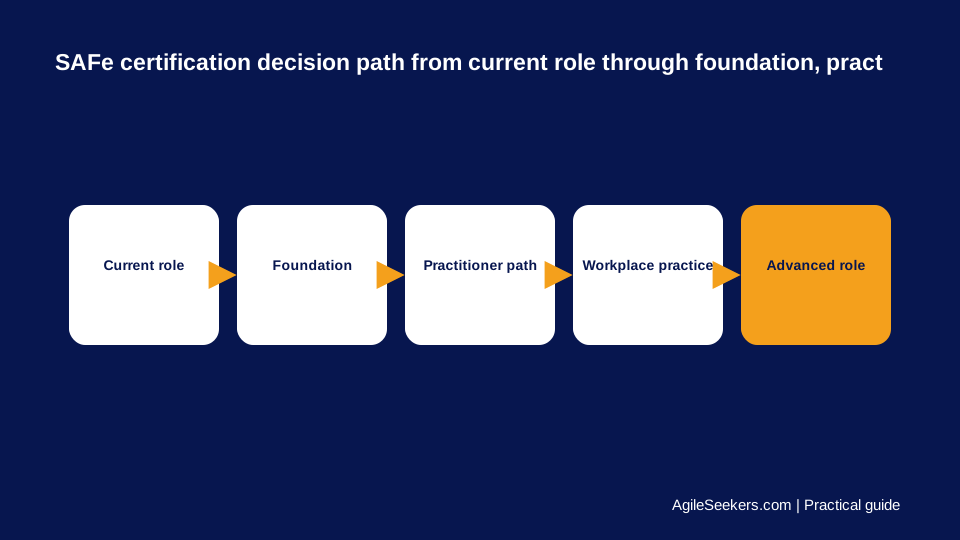
Reviewed for July 2026. The right SAFe certification is the one that matches the decisions you make at work, not simply the next badge in a sequence.
Choose a SAFe path from the work you already do
| Current responsibility | Useful starting route | Next depth |
|---|---|---|
| Leader or transformation sponsor | Leading SAFe | Portfolio, change, or advanced leadership practice |
| Scrum Master or team coach | SAFe Scrum Master | Advanced Scrum Master or RTE |
| Product Owner or Product Manager | SAFe POPM | Portfolio, discovery, or product leadership depth |
| ART facilitator or program lead | RTE | Enterprise coaching and transformation capability |
| New to scaled delivery | Leading SAFe or role-specific foundation | Apply the learning before stacking credentials |
A practical 2026 selection test
- Write the role you perform now and the role you want next.
- List the SAFe events, artifacts, or decisions you actually touch.
- Choose the course that closes the largest capability gap.
- Check exam, renewal, delivery format, and employer expectations.
- Plan a workplace application within thirty days of training.
Use job descriptions as evidence, but do not let a requested credential replace a capability check. If target roles repeatedly ask for facilitation, portfolio economics, product discovery, or train-level coordination, select learning that lets you demonstrate that work through examples and measurable results.
Avoid collecting overlapping credentials
A Scrum Master comparing paths should start with the SAFe Scrum Master certification guide. Product professionals can use the SAFe POPM beginner guide and the SAFe POPM versus CSPO comparison to separate framework scale from general product ownership.
Training routes from AgileSeekers
Leading SAFe certification training builds the framework and leadership foundation. SAFe Scrum Master training and SAFe POPM training provide role-specific practice for team coaching and product delivery.
The Scaled Agile Framework (SAFe) stands out as the most widely adopted approach for scaling Agile across large enterprises. If you’re planning to build a career in Agile or expand your leadership in enterprise agility, you’ll need a clear understanding of the SAFe Agile certification roadmap.
This blog breaks down the different SAFe certification paths and helps you decide which course to take first, based on your experience, role, and career aspirations.
Why Follow a SAFe Agile Certification Roadmap?
SAFe certifications aren’t just badges, they validate your ability to implement Agile principles at scale. Whether you’re a Scrum Master, Product Owner, Project Manager, or senior leader, choosing the right SAFe course can accelerate your career growth. A structured certification roadmap helps you:
- Build foundational knowledge before examining complex roles
- Align training with your job responsibilities
- Plan your long-term Agile career journey
Where to Start: Leading SAFe Certification (SAFe Agilist)
For most professionals, the first step on the SAFe Agile certification roadmap is the SAFe agile certification. This foundational course is designed for individuals looking to understand the full SAFe framework and lead Agile transformations at the enterprise level.
Upon completing the training, participants earn the SAFe Agilist Certification, which proves your ability to apply Lean-Agile principles, drive alignment, and participate in PI Planning.
Who should take Leading SAFe first?
- Project Managers and Program Managers
- Scrum Masters and Agile Coaches
- Product Owners and Product Managers
- Business Analysts and Consultants
- Senior Executives and Change Agents
Why start here?
- It covers all core SAFe principles, roles, and events
- It’s a prerequisite for many advanced SAFe certifications
- It equips you with the skills to lead Agile at scale
Next Step: Role-Based SAFe Certifications
Once you’ve earned your SAFe Agilist Certification, the roadmap expands into specialized tracks based on your career role. Here’s how to progress:
1. SAFe Scrum Master (SSM)
Ideal for Scrum Masters working in a SAFe environment. It goes beyond the traditional Scrum Master role by exploring how to facilitate Agile teams, enable team-level events, and drive Program Increment success.
2. SAFe Advanced Scrum Master (SASM)
Designed for experienced Scrum Masters looking to take on enterprise-level responsibilities. This certification emphasizes cross-team interactions, scaling practices, and servant leadership at the program level.
3. SAFe Product Owner/Product Manager (POPM)
For those responsible for defining features, managing backlogs, and aligning product vision with ART execution. SAFe POPM certification helps you connect strategy to delivery.
4. SAFe DevOps Practitioner (SDP)
If you’re in development, QA, or release engineering, this course helps you implement a continuous delivery pipeline and foster a culture of DevOps.
5. SAFe Release Train Engineer (RTE)
This is an advanced certification meant for experienced SAFe professionals. It focuses on facilitating ARTs, removing impediments, and optimizing value flow across teams.
6. SAFe for Architects
Targeted at System Architects, Solution Architects, and Enterprise Architects who need to align architecture with business value delivery.
SAFe Agile Certification Roadmap by Experience Level
Here’s a suggested roadmap based on where you are in your Agile journey:
🔹 Beginner (0–2 Years of Experience)
-
SAFe agilist certification(Start Here)
-
SAFe Scrum Master (SSM)
🔹 Intermediate (2–5 Years)
-
SAFe Advanced Scrum Master (SASM)
-
SAFe DevOps Practitioner (SDP)
🔹 Advanced (5+ Years / Leadership Roles)
-
SAFe Release Train Engineer (RTE)
-
SAFe for Architects
By following this roadmap, you build your capabilities from foundational knowledge to leading enterprise-level transformations.
Benefits of Following the SAFe Agile Certification Roadmap
-
Structured Learning Path: Progress logically from general knowledge to deep specialization
-
Career Clarity: Know what certification aligns best with your current role or next career goal
-
Higher Impact: Certifications tied to real-world roles help you contribute more effectively to Agile initiatives
-
Credibility: SAFe is trusted by enterprises worldwide, including Fortune 500 companies
FAQs About SAFe Certifications
Q: Can I skip Leading SAFe and go directly to role-based certifications?
A: While possible, it’s not recommended. Leading SAFe builds the core understanding needed to succeed in advanced roles.
Q: Are SAFe certifications valid globally?
A: Yes. SAFe certifications are recognized worldwide and are especially in demand in IT services, consulting, and enterprise organizations.
Q: How long is each certification valid?
A: Certifications are valid for one year and can be renewed annually via the SAFe community platform.
Final Thoughts: Start Strong, Scale Smart
The SAFe Agile certification roadmap gives you a clear path to grow from Agile enthusiast to transformation leader. Start with the Leading SAFe training, earn your SAFe Agilist Certification, and then branch into the role that best fits your career goals.
With the right guidance and training, you’ll not only gain a globally respected credential but also the practical knowledge to lead Agile at scale.
Ready to begin your journey?
Leading SAFe agilist certification and take the first step toward becoming a certified change leader in 2025.
Also check the SAFe Agile Certification cost