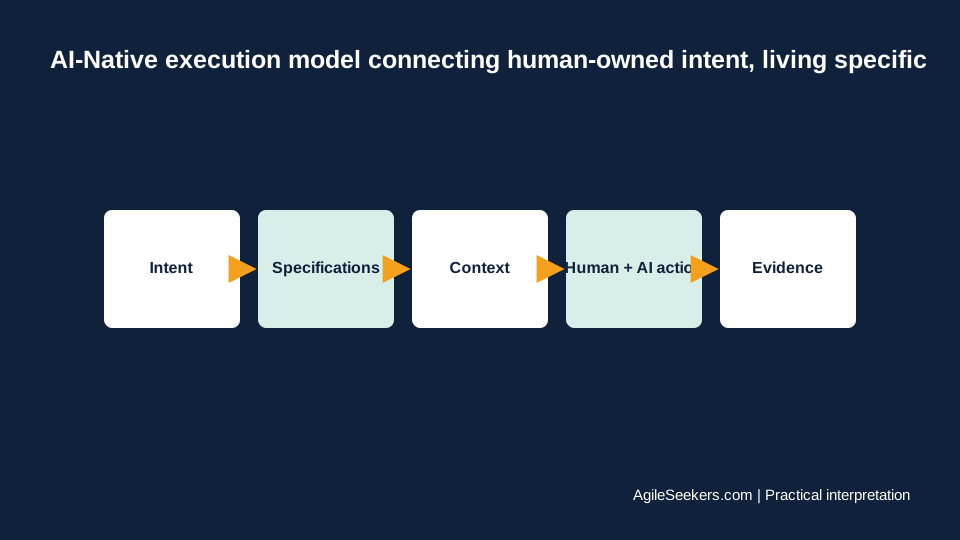
An AI agent can execute a detailed instruction and still create the wrong result when it lacks purpose or operating context. AI-Native SAFe connects intent, specifications, and context so humans and machines understand why a product exists, what acceptable behavior means, and where the solution must work.
Intent keeps purpose in human hands
Intent explains the customer problem, desired outcome, strategic reason, and boundaries. It gives teams room to choose outputs while making the reason for the work explicit. Humans remain accountable for value, safety, purpose, and consequential trade-offs even when AI contributes analysis or execution.
Specifications become living boundaries
Specifications describe required behavior and constraints in a form that people and tools can use. They may include examples, models, policies, interfaces, tests, NFRs, data contracts, regulatory rules, and acceptance evidence. They should evolve with learning and remain traceable to intent.
Context is the changing environment
Context covers customers, markets, regulation, operating conditions, architecture, data, and surrounding systems. The official intent, specifications, and context guidance treats these as a connected information environment. A technically correct output can still fail when a customer segment, jurisdiction, channel, or operational condition has changed.
| Failure | Missing element | Correction |
|---|---|---|
| Agent optimizes clicks with manipulative prompts | Intent and ethical boundary | State trust outcome and prohibited behavior |
| Generated interface breaks an integration | Specification | Provide contract, version, tests, and compatibility policy |
| Recommendation violates local regulation | Context | Supply jurisdiction, current rule, owner, and validation date |
| Team cannot explain why work exists | Connected stack | Trace output to outcome, intent, and evidence |
Build a maintained context service
- Inventory sources that shape product and agent decisions.
- Name an owner and review condition for each critical source.
- Control access to sensitive data and record permitted uses.
- Make policies, specifications, and examples retrievable in the work environment.
- Monitor decisions for stale context, hallucination, bias, and unintended effects.
- Feed operational evidence back into intent and specifications.
A prompt is not the information architecture
Long prompts copied between tools are difficult to govern and quickly become stale. Treat curated data, policy, specifications, and context as product infrastructure. Use retrieval, versioning, access control, evaluation, and human review appropriate to the risk. The goal is not perfect documentation; it is reliable action with known boundaries.
Leading SAFe training helps leaders connect strategy, architecture, governance, and value streams. SAFe POPM training helps product roles turn customer and business intent into ART-level decisions while keeping evidence and context current.
Make intent testable
An intent specification should state the outcome, constraints, assumptions, decision rights and evidence required without prescribing every implementation detail. AI can help identify ambiguity or conflicting terms, but it cannot decide what the enterprise is willing to risk.
Context to include
- Customer or mission outcome
- Operational environment and affected users
- Safety, security, legal and architecture constraints
- Known unknowns and evidence owners
- Review triggers and escalation path
Test the specification with product, engineering, operations and assurance participants. If each group interprets a critical constraint differently, resolve that decision before using the document to generate plans or backlog items.