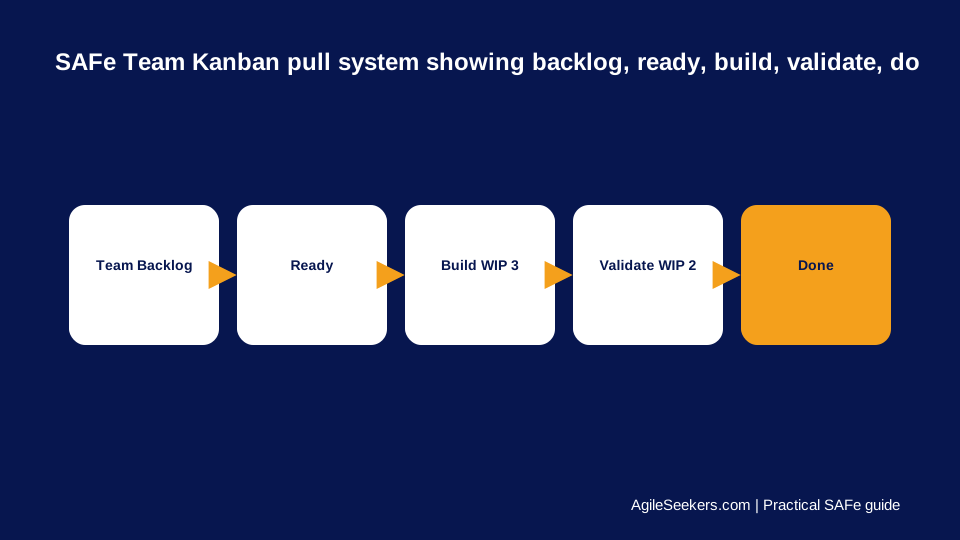
Team Kanban is a management system, not board decoration
SAFe Team Kanban helps an Agile Team visualize work, limit Work in Process, pull according to capacity, manage flow, and improve explicit policies. It can support teams with continuous arrival, operational responsibilities, variable work types, or a flow-oriented preference. The board should represent how value actually moves, including waiting and validation.
Begin with work-item types and boundaries
Identify stories, defects, enablers, service requests, and other material work. Define when each item enters and leaves the measured system. If one board mixes tiny requests with large stories without classification, throughput and Flow Time will mislead decisions.
Design states around changed knowledge
| State | Entry policy | Exit evidence |
|---|---|---|
| Ready | Need, acceptance criteria, and dependencies understood enough | Team pulls the item |
| Build | Capacity exists and required skills are available | Implementation and local checks complete |
| Validate | Integrated environment and acceptance path available | Acceptance and quality evidence obtained |
| Done | Team Definition of Done satisfied | No hidden completion work remains |
Set WIP limits against the constraint
A limit should cause a useful conversation before overload grows. Start from current observations, reduce cautiously, and watch blocked age, quality, and service risk. When a downstream state reaches its limit, people help finish, remove a blocker, or improve the policy before pulling more work.
Make pull and expedite rules explicit
- Who may pull and from which queue.
- How priority is resolved among ready items.
- What qualifies for an expedite class.
- How blocked work affects the WIP limit.
- When an ageing item triggers attention.
- How dependencies and shared services are represented.
Use replenishment and flow review for different decisions
Replenishment selects work based on capacity, priority, readiness, and service expectations. A flow review examines ageing, blockers, WIP, completion patterns, and policy effects. A Team Sync can use the board to coordinate immediate work, but it should not replace deeper analysis of recurring delay.
Improve with balanced evidence
Inspect Flow Time percentiles, throughput, WIP, work-item age, blocked time, defect patterns, predictability, and customer outcome. Do not reward individuals for moving more cards or compare teams with different item definitions. The purpose is a healthier system and faster learning.
SAFe Advanced Scrum Master training supports flow coaching and facilitation across teams. SAFe RTE training connects Team Kanban evidence to ART flow and systemic impediments.
Worked board redesign: validation is the real queue
A team initially uses To Do, Doing, and Done. Most cards remain in Doing because security review, product acceptance, and environment access occur at different times. The team adds Build and Validate states, sets a validation WIP limit of two, and records blocked age. Developers begin helping with test data and automation before pulling new work. Product and security agree scheduled availability and an expedite rule for material incidents. The team finishes fewer items in the first week but then reduces ageing and produces a more stable completion distribution.
When Scrum and Team Kanban practices coexist
A team may retain Iteration Planning, goals, reviews, and retrospectives while managing execution through pull and WIP limits. The iteration provides a learning and alignment cadence; the Kanban system exposes flow continuously. Do not force all work to start on the first day or wait until the final day for acceptance. Likewise, do not use continuous flow as a reason to abandon a meaningful goal or stakeholder feedback.
Policy experiment checklist
- State the observed problem and baseline evidence.
- Change one limit, state, class, or pull rule at a time when possible.
- Protect quality and service guardrails.
- Choose a review date long enough to observe several items.
- Ask the people doing and receiving the work about side effects.
- Adopt, adapt, or reverse the policy using evidence.