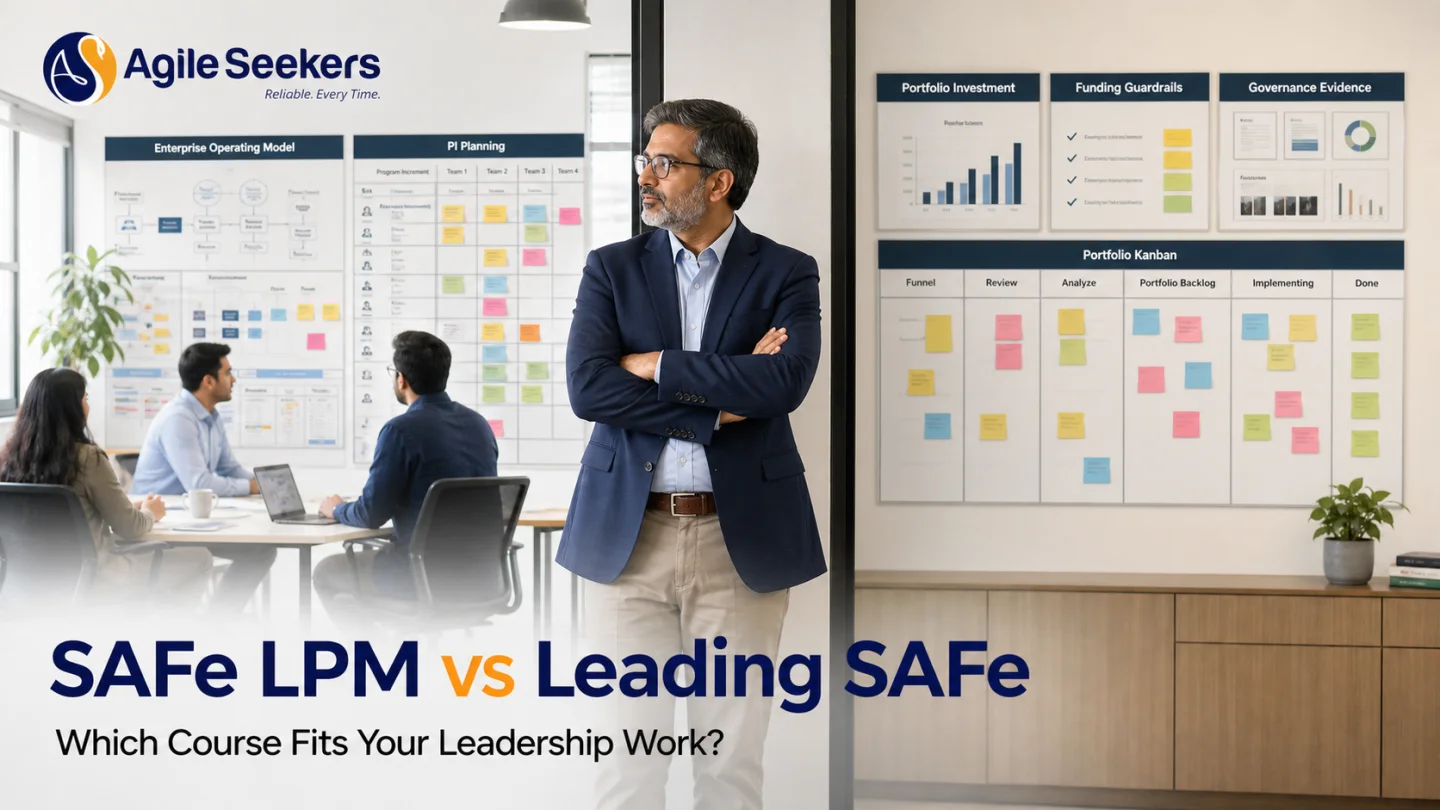
Leading SAFe and SAFe Lean Portfolio Management both address enterprise agility, but they operate at different depth. Leading SAFe builds a broad view of the framework. LPM focuses on portfolio strategy, funding, operations, flow, and governance.
The best choice depends on the decisions you make. A leader preparing to sponsor an ART needs different depth from a portfolio executive redesigning investment governance.
A side-by-side decision view
| Question | Leading SAFe | SAFe LPM |
|---|---|---|
| Primary scope | Enterprise agility, Lean-Agile leadership, ARTs, PI Planning | Portfolio strategy, funding, operations, flow, governance |
| Typical learner | Manager, leader, product or delivery professional, change agent | Executive, PMO or VMO leader, portfolio or product leader, architect, coach |
| Starting knowledge | Suitable as a broad SAFe entry point | Advanced course; familiarity with Agile at scale is useful |
| Workplace focus | Understand and support the SAFe operating model | Change portfolio investment and governance decisions |
| Credential | SAFe Agilist | SAFe Lean Portfolio Manager |
Choose Leading SAFe when the system is still unfamiliar
Choose Leading SAFe certification training when you need to understand Lean-Agile leadership, value streams, Agile Release Trains, PI Planning, Lean Portfolio Management concepts, and how teams connect to enterprise strategy.
This route works well for managers taking responsibility in a SAFe environment, product and delivery professionals moving beyond one team, and leaders who need a common language before sponsoring change.
A broad course cannot settle every portfolio design question. It should help you see the system and identify where deeper work is needed.
Choose LPM when funding and governance are already on your desk
Choose SAFe LPM certification training when your work includes strategic themes, value-stream funding, portfolio epics, guardrails, portfolio Kanban, governance, VMO or PMO evolution, and portfolio measures.
LPM assumes that the learner can work with enterprise trade-offs. The conversation is not only how an ART runs. It is how leaders decide which value streams receive investment, how major initiatives are tested, and how governance responds when evidence changes.
Five scenarios that make the choice clearer
You are sponsoring your first ART
Start with Leading SAFe. You need the wider operating model and PI Planning context before portfolio depth.
You lead a PMO moving away from project funding
LPM is the closer match. Bring current funding, approval, and governance practices into the learning.
You are a Product Manager working mainly with features and PI execution
Leading SAFe may give useful context, while SAFe POPM is often closer to daily product work. Choose LPM when your authority extends into portfolio investment.
You are an Agile coach supporting portfolio adoption
LPM fits if you already understand team and ART mechanics and now need to work with budgeting, governance, portfolio flow, and leadership decisions.
You hold a SAFe Agilist credential and portfolio work is increasing
LPM is a logical depth move when the next problems involve investment, portfolio WIP, guardrails, or strategy execution.
Price should follow application access
AgileSeekers currently lists Leading SAFe at ₹35,400 and LPM at ₹80,000, plus applicable taxes. The higher LPM investment makes sense when the learner can apply the work at portfolio level and has sponsor access.
Before paying, name one decision that should change after the course. For Leading SAFe, it may be how leadership prepares for PI Planning or explains priorities. For LPM, it may be how an epic receives funding, how portfolio WIP is limited, or how governance reviews outcome evidence.
A sensible learning sequence
- Build a broad SAFe foundation through experience or Leading SAFe.
- Participate in ART and value-stream decisions long enough to see system constraints.
- Move to LPM when portfolio funding, flow, or governance becomes part of the role.
- Apply one policy or decision change before collecting another credential.
There is no rule that everyone must take both. Choose the course whose exercises match decisions you can influence now or in the next role.
The short answer
Leading SAFe explains the enterprise operating model. LPM develops deeper portfolio management capability. Start broad when SAFe is new; choose portfolio depth when investment and governance are already part of your work.
SAFe LPM Portfolio Readiness Assessment
Score six connected portfolio capabilities and prepare one evidence-based improvement decision.