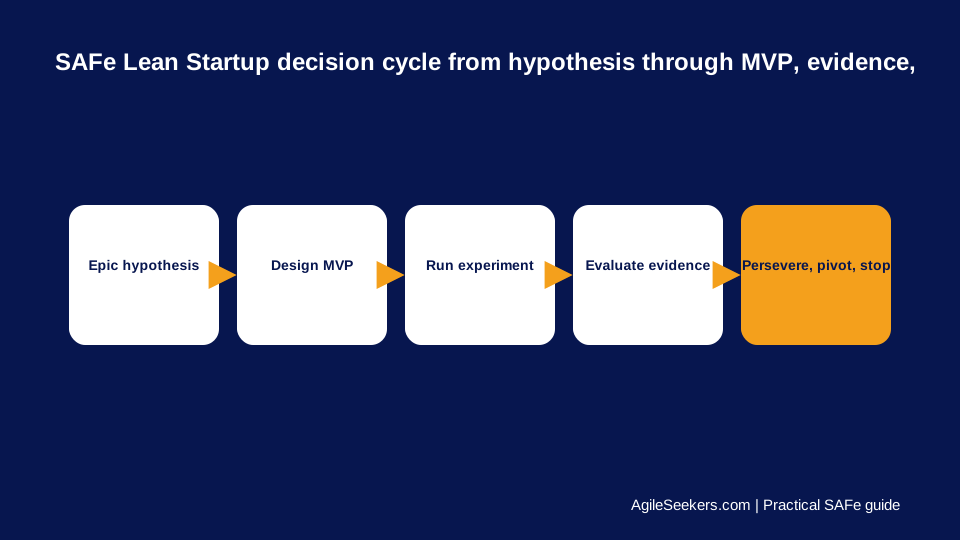
The cycle exists to reduce investment uncertainty
The SAFe Lean Startup Cycle applies build-measure-learn thinking to portfolio Epics and other significant investments. It turns a proposed benefit into testable assumptions, creates a Minimum Viable Product or other experiment, evaluates business and technical evidence, and makes an explicit decision to persevere, pivot, pause, or stop.
Write a hypothesis that can lose
Name the target customer or stakeholder, problem, proposed outcome, leading behavior, economic benefit, and critical assumptions. A statement that can be confirmed by any activity is not a useful hypothesis. Include evidence that would weaken the case and a time or investment boundary for the next decision.
Choose the minimum evidence vehicle
| Uncertainty | Possible experiment | Evidence |
|---|---|---|
| Desirability | Prototype, concierge test, or limited offer | Behavior, willingness, and qualitative explanation |
| Feasibility | Spike, architectural experiment, or thin integration | Performance, risk, and implementation learning |
| Viability | Pricing, process, or operating-model test | Economics, adoption, and organizational capability |
| Compliance or safety | Controlled scenario and expert review | Constraint satisfaction and residual risk |
Do not confuse an MVP with the first release
An MVP is designed to test the epic hypothesis using the least responsible investment. It may be a service, prototype, partial solution, operational experiment, or production capability. The form depends on the uncertainty and evidence needed, not on a rule that every MVP must be small software.
Hold a decision review, not a success presentation
- Restate the hypothesis and decision threshold.
- Show actual evidence and data limitations.
- Separate customer, technical, operational, and economic findings.
- Identify assumptions that remain untested.
- Compare persevere, pivot, pause, and stop options.
- Record the decision, funding consequence, and next review.
Portfolio signals of a weak cycle
- Every MVP becomes full implementation.
- Vanity metrics replace behavior or outcome evidence.
- Teams are asked to validate a decision already made.
- Pivot means adding scope rather than changing the hypothesis.
- Stopping has no mechanism to release capacity.
- Large batches of Epics remain in analysis without experiments.
Measure the learning system
Track time and investment from hypothesis to material evidence, assumptions retired, decisions made, WIP in analysis, stopped investment, and realized benefit after scaling. The objective is not maximum experiment volume; it is better economic decisions with less avoidable exposure.
SAFe POPM certification training develops hypothesis and MVP practices for product roles. Leading SAFe training provides the portfolio economics and decision context for responsible investment.
Worked epic example: assisted renewal
A portfolio believes that an AI-assisted renewal experience will reduce customer effort and improve retention. Instead of funding a full platform, the Epic Owner tests the riskiest desirability assumption with a limited concierge service and a small eligible segment. The MVP measures completion, repeat contact, acceptance of recommendations, operating effort, and harmful errors. Evidence shows better completion but unacceptable review cost. The portfolio pivots toward narrow recommendation types, funds one architectural enabler, and schedules another decision before expanding the audience.
Set funding boundaries before enthusiasm grows
Define the people and capacity available, maximum spend, latest decision date, protected compliance and quality constraints, and who can stop or redirect work. Without boundaries, a series of individually small experiments can accumulate into a large unreviewed investment. Funding should increase only when evidence reduces a material uncertainty or justifies access to the next option.
Avoid evidence theatre
- Pre-register the main measure and decision threshold where practical.
- Keep negative and mixed findings visible.
- Distinguish observed behavior from stakeholder opinion.
- Document selection bias and data limitations.
- Invite operations, architecture, risk, and customer perspectives.
- Do not change the hypothesis after results arrive without recording the change.