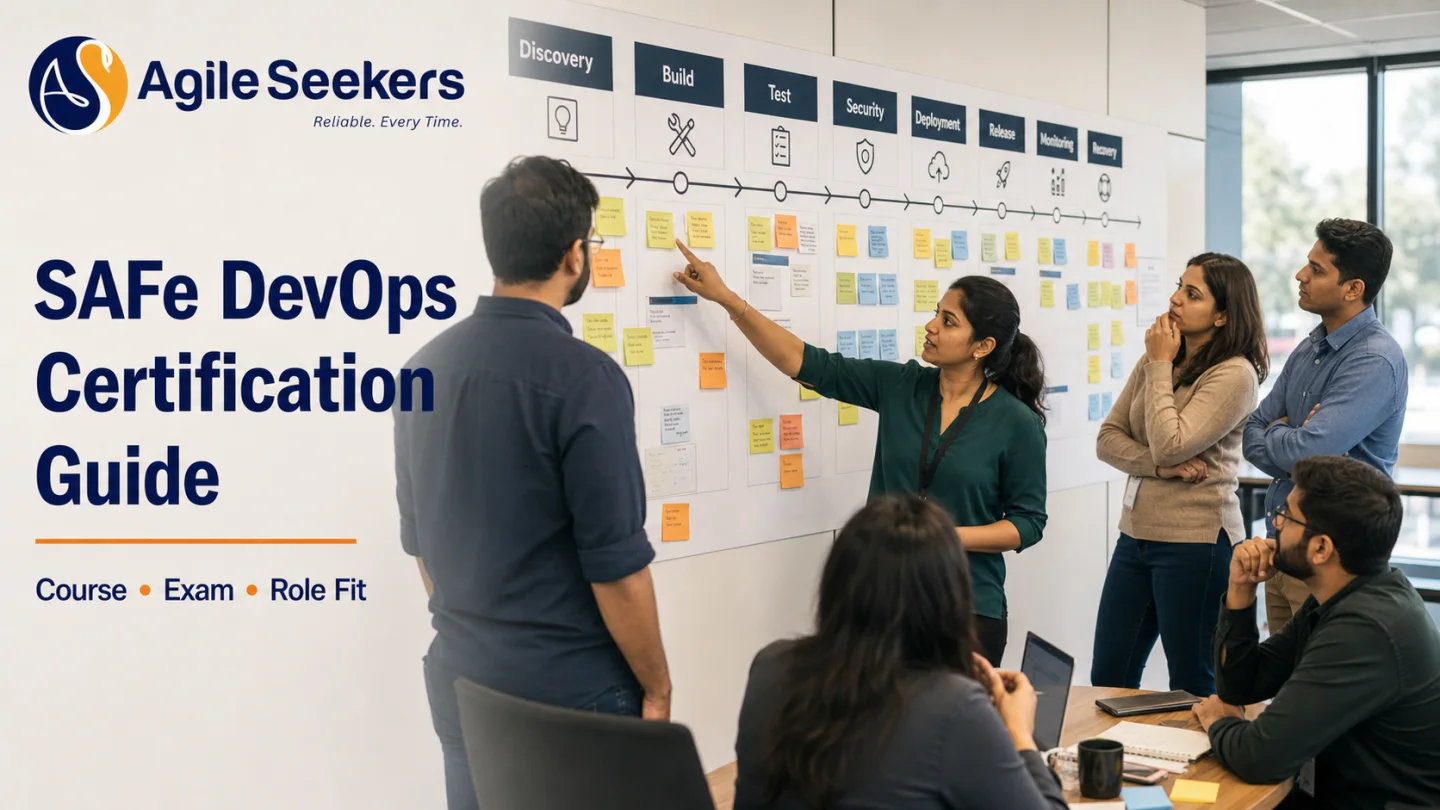
SAFe DevOps certification is not a tool-specific credential. It asks learners to examine how value moves from an idea to a released product, including the queues and decisions between product, development, testing, security, operations, and support.
That distinction matters. A team can automate builds and still wait days for an environment, approval, test result, or release decision. SAFe DevOps certification training focuses on the whole delivery value stream rather than one technical function.
The credential starts with a delivery-system question
Before choosing the course, identify the delay you want to understand. Is work waiting before development starts? Does testing arrive late? Are releases technically ready but held for business approval? Do incidents expose weak recovery and ownership? A specific problem gives the course material somewhere to land.
Scaled Agile positions SAFe DevOps as an advanced, instructor-led course for people familiar with engineering, systems, architecture, or infrastructure. The standard course duration is two days. AgileSeekers may divide the same learning time across shorter live sessions when a weekday cohort needs to fit around work.
What the course teaches across the pipeline
| Learning area | Question it helps answer | Workplace evidence |
|---|---|---|
| CALMR | Which cultural or operating condition limits improvement? | Ownership, handoffs, automation, flow, measures, and recovery |
| Value stream mapping | Where does elapsed time accumulate? | Wait time, active time, rework, approval, and queue data |
| Continuous Exploration | How does product learning enter delivery? | Hypotheses, feedback, feature readiness, and decision latency |
| Continuous Integration and Deployment | How quickly can a change become releasable? | Build, test, security, deployment, and environment signals |
| Release on Demand | Can the business release safely when value is ready? | Release policy, feature controls, customer evidence, and recovery options |
Current assessment and certification facts
Scaled Agile currently describes the certification process as a timed, multiple-choice exam with 45 questions and a coaching report. The SAFe DevOps credential is renewed yearly. The learning package also includes a practice test with question-level feedback, course materials, and access to related learning resources. Candidates should verify the exam window, passing score, retake terms, and renewal fee inside their current SAFe learning plan before testing because account policies can change.
The course and the exam test connected ideas. Memorising CALMR terms without being able to trace a bottleneck through the pipeline leaves a gap. Preparation works better when each concept is attached to one observed delay or failure pattern.
Who can use the certification at work
- Software engineers who need to understand dependencies beyond code and build automation.
- QA, security, infrastructure, and operations professionals working on shared delivery constraints.
- Release and development managers responsible for flow across several teams.
- Scrum Masters who see recurring delays that no single team can remove.
- Product Owners who need to connect discovery, release decisions, and customer feedback.
The certification does not turn a non-technical role into a DevOps engineer. It gives people across the value stream a shared model for examining delay, quality, security, release, and recovery.
A preparation plan built around one release
- Choose a recent feature or change and trace it from request to customer availability.
- Mark every wait, approval, handoff, failed test, environment issue, and release decision.
- Separate active work time from elapsed time.
- Use CALMR to classify possible causes without assuming that automation is the answer.
- Write one improvement hypothesis and the evidence that would support or reject it.
Bring this map into the class with confidential details removed. It will help you ask better questions and reduce the temptation to treat the course as a vocabulary exercise.
When enrollment makes sense
Choose SAFe DevOps training when your work touches a delivery pipeline or you are expected to improve flow across roles. If you first need the wider SAFe operating model, Leading SAFe may be a better starting point. If your immediate work is team facilitation and PI execution, review SAFe Scrum Master training.
A useful outcome is not a new badge alone. It is the ability to show where time is lost, involve the people who own that part of the system, and run a measured improvement without weakening security or stability.
SAFe DevOps Value Stream Mapping Workbook
Map one change from concept to release, locate the system constraint, and prepare a measured 30-day experiment.