A benefit hypothesis must be able to lose
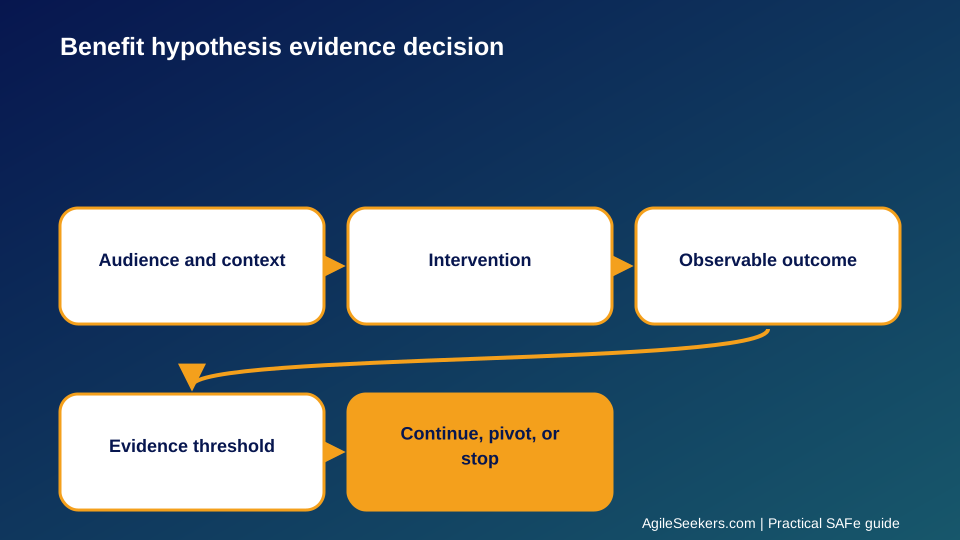
A feature benefit hypothesis states the expected measurable benefit to the customer or business. If every possible result can be described as success, it is a slogan. A decision-ready hypothesis identifies who should experience a change, which behavior or condition should move, why the feature may cause it, over what period, and what evidence would weaken the claim.
Use a five-part hypothesis card
| Field | Prompt | Illustration |
|---|---|---|
| Audience and context | For whom, doing what? | New small-business administrators inviting their first user |
| Intervention | What capability or policy changes? | Guided invitation with role explanation |
| Outcome | What observable condition should change? | More accounts activate a second user within seven days |
| Mechanism | Why should this cause the outcome? | Less uncertainty about permissions reduces abandonment |
| Guardrails | What must not worsen? | Support demand, access errors, or unauthorized privileges |
Set thresholds before seeing results
Define a baseline, minimum worthwhile effect, measurement window, sample or qualitative sufficiency, and guardrail limit. Use ranges where noise is high. The threshold should connect to a decision: continue investment, pivot the solution, gather more evidence, or stop. Selecting the threshold after seeing results rewards motivated interpretation.
Match the experiment to the uncertainty
- Problem uncertainty: interviews, observation, demand tests, or current-behavior analysis.
- Usability uncertainty: prototype tasks with representative participants.
- Behavior uncertainty: controlled release, cohort comparison, or staged pilot.
- Technical uncertainty: spike, benchmark, shadow mode, or walking skeleton.
- Economic uncertainty: concierge test, price or cost model, and operational measurement.
The smallest experiment is not automatically the cheapest artifact. It is the least costly way to obtain evidence credible enough for the pending decision.
Read mixed results without averaging away risk
An experiment may improve the main outcome while harming a guardrail or excluding a segment. Break down results by relevant context and inspect unintended behaviors. A small average lift may hide a strong benefit for one segment and harm for another. The product decision can narrow eligibility, redesign controls, or reject the feature rather than forcing a universal conclusion.
Connect the hypothesis to SAFe artifacts
Place the hypothesis and leading measure in the feature, reference it from relevant PI Objectives, identify enabling work, and show evidence in System Demos or product reviews. After release, compare actual outcomes with the claim. Update the roadmap and ART backlog when the benefit does not materialize; completion is not validation.
A review conversation that permits stopping
- Restate the original claim and thresholds without editing them.
- Review data quality, customer context, and contrary evidence.
- Check guardrails and affected segments.
- Compare remaining opportunity with the cost of another iteration.
- Record continue, pivot, pause, or stop and the evidence trigger for reconsideration.
Writing and refining feature benefit hypotheses is central to SAFe POPM certification training. Leading SAFe training helps leaders create funding and governance conditions where evidence can genuinely stop an initiative.
Quality test for the next feature
Ask three people to read the hypothesis and independently name what result would disprove it. If their answers differ materially, the claim or threshold needs revision before the ART invests further.
Finally, specify who owns measurement after release and when the outcome will be reviewed. A feature can clear acceptance criteria while its intended benefit remains unknown. Reserving explicit ART capacity for instrumentation, analysis, and stakeholder review prevents the benefit hypothesis from disappearing once implementation begins.