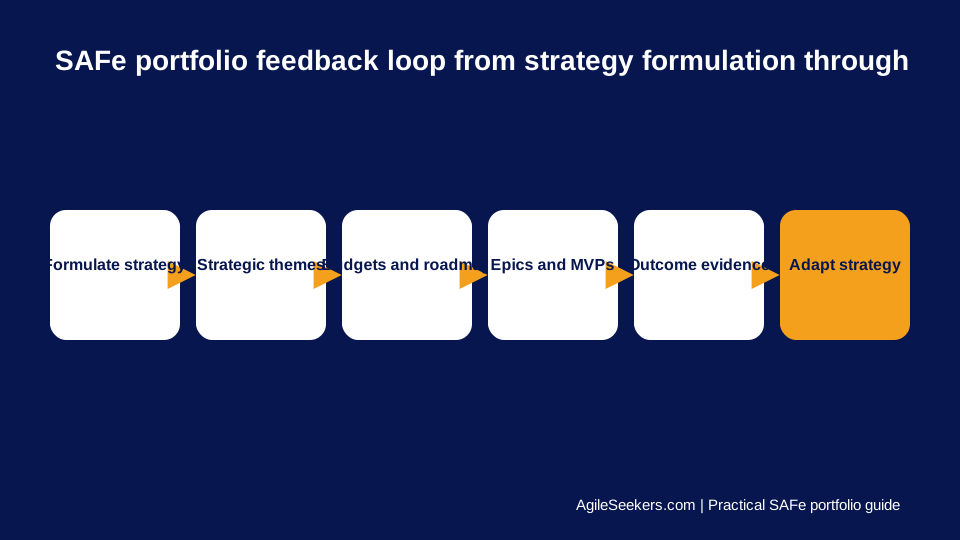
Strategy is a testable set of choices
Strategy formulation interprets the enterprise direction, customer and market conditions, portfolio context, capabilities, and constraints to choose where the portfolio will compete and how it expects to create advantage. Strategy implementation turns those choices into strategic themes, Portfolio Vision, budgets, roadmaps, epics, and value-stream action. Treating formulation as an annual executive activity and implementation as delivery creates a long feedback delay.
Create traceability without cascading task trees
| Strategy element | Implementation connection | Feedback |
|---|---|---|
| Strategic theme or OKR | Portfolio outcome and decision guardrail | Leading and lagging result |
| Portfolio Vision | Future value streams and solutions | Customer, market and capability evidence |
| Value-stream budget | Capacity to pursue outcomes | Spend, flow, solution health and opportunity |
| Epic hypothesis | MVP and leading indicators | Persevere, pivot or stop |
| Portfolio roadmap | Sequence and learning milestones | Changed assumptions and dependencies |
Use two portfolio cadences
Portfolio Sync handles implementation flow, dependencies, impediments, guardrail exceptions, and decisions that should not wait. Strategic Portfolio Review examines whether strategy, implementation, outcomes, and budgets still align. The review should occur early enough for value streams to prepare for subsequent PI Planning rather than announce a new direction after plans harden.
Make adaptation an explicit decision
- State which strategic assumption changed.
- Identify affected themes, epics, budgets, roadmaps and value streams.
- Compare options and transition consequences.
- Decide what stops, continues, or receives new learning investment.
- Communicate boundaries and update artifacts consistently.
Signals of strategy drift
- Active epics cannot name a strategic outcome.
- Budgets remain fixed after priorities change.
- OKRs improve while customer or portfolio performance declines.
- MVP evidence changes scope but never investment.
- Teams receive several priorities with no trade-off.
Leading SAFe certification training develops the portfolio strategy and investment perspective. SAFe RTE training helps connect portfolio adaptation with ART execution and planning.
The loop is healthy when implementation evidence can change strategy without turning every short-term variance into a strategic pivot. Leaders need stable intent, fast learning, and the discipline to distinguish a failed assumption from ordinary execution noise.
Worked portfolio example: retention strategy
A portfolio formulates a strategy to improve retention among regulated small-business customers. A theme sets a measurable retention and trust objective. Participatory Budgeting protects capacity in the relevant value stream, while Portfolio Kanban tests an onboarding epic and a service-recovery epic. MVP evidence shows onboarding improves activation but does not affect renewal; service recovery strongly affects renewal for one segment. Leaders shift budget and roadmap emphasis toward recovery, narrow onboarding investment, and update the strategic assumption about the primary retention mechanism.
Keep artifacts synchronized after a strategic choice
A changed strategy should not live only in review minutes. Update strategic themes or key results, Portfolio Vision where the future state changed, roadmap learning milestones, affected epic hypotheses, value-stream budgets, and communication into upcoming PI Planning. Name one accountable owner for coherence. Conflicting artifacts force ARTs to guess which direction is real and create false local failure.
Evidence discipline for portfolio leaders
- Use ranges and source dates for forecasts.
- Preserve contrary customer and operational evidence.
- Distinguish a strategic assumption from an implementation estimate.
- Set a review trigger before results are known.
- Document why current evidence justifies stability or adaptation.