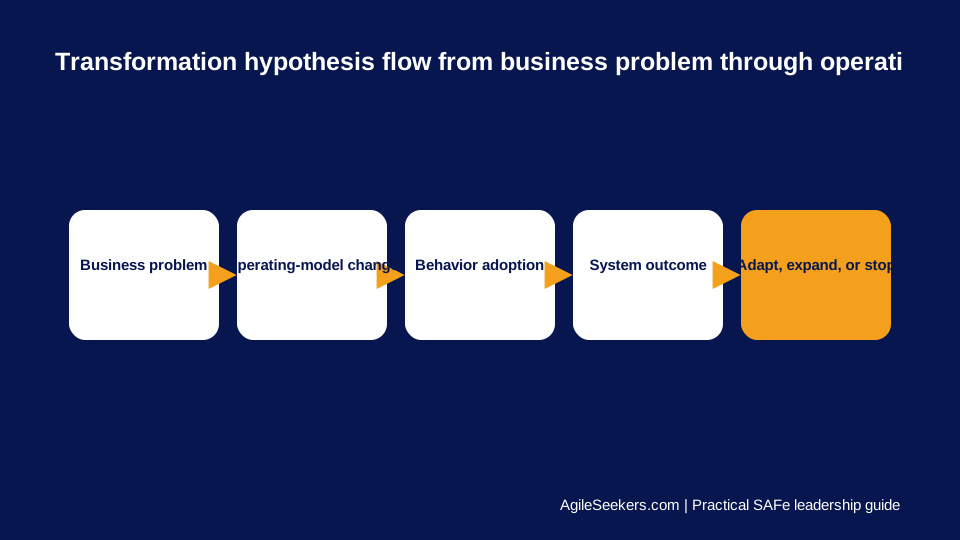
A transformation is a portfolio of uncertain changes
Organizations adopt SAFe to solve business problems, not to maximize framework activity. Every major change rests on assumptions: organizing around value will reduce handoffs, Lean budgets will speed priority shifts, or integrated demos will expose risk earlier. A transformation hypothesis makes the causal claim and evidence visible before adoption becomes an irreversible program identity.
Write a five-part change hypothesis
| Part | Question |
|---|---|
| Problem | Which customer, business, flow, quality, or people condition matters? |
| Intervention | Which policy, structure, capability, or behavior will change? |
| Mechanism | Why should the intervention affect the condition? |
| Evidence | Which leading behavior and system outcome will move? |
| Decision | What causes adaptation, expansion, pause, or stop? |
Separate exposure, adoption, proficiency, and outcome
Training exposes people to ideas. Adoption means they apply a practice in real work. Proficiency means they apply it effectively across relevant conditions. Outcomes show whether the system improved. A high completion rate can coexist with unchanged approvals, large batches, poor customer learning, or unsafe reporting.
Example: decentralizing product decisions
The hypothesis predicts that explicit product guardrails and coaching will reduce routine escalation time without increasing compliance exceptions or customer harm. Evidence includes decisions made locally, age distribution, exception patterns, product outcomes, and interviews. If decision time falls only because teams quietly accept risk, the intervention fails its guardrail.
Manage the transformation backlog economically
- Limit change WIP to what leaders and value streams can absorb.
- Prioritize barriers affecting business outcomes.
- Fund learning, coaching, tooling, and legacy-work removal.
- Preserve contrary evidence and dissent.
- Stop initiatives protected only by sunk cost or visibility.
Leading SAFe certification training connects change leadership to business agility. ICP-ACC Agile Coaching training develops the skills needed to support behavior change without forcing compliance.
Review hypotheses through the LACE and guiding coalition, but keep evidence visible to the people experiencing the change. Transformation credibility grows when feedback can alter the plan.
Worked hypothesis: organizing around value
The organization predicts that moving product, operations, risk, and technology contributors into a value-stream-aligned ART will reduce handoffs and time to customer feedback. Leading evidence includes team stability, decision location, dependency age, and integrated demonstration frequency. Outcome evidence includes lead-time distribution, customer behavior, quality, and employee experience. Guardrails monitor regulatory exceptions and operational load. If reporting lines change but shared-service queues remain, leaders adapt team boundaries and funding rather than declaring the structure complete.
Evidence review questions for the guiding coalition
- Did the intended behavior occur in real work?
- Which legacy policy contradicted the intervention?
- Who experienced improvement, delay, or harm?
- Did a proxy improve while the business problem remained?
- What evidence supports expansion to another value stream?
- Which change should stop to protect transformation WIP?
Publish the learning in plain language. People asked to change need to see that their feedback affects the implementation. When every experiment is announced as a success, employees learn that transformation evidence is communications material rather than a basis for decisions.