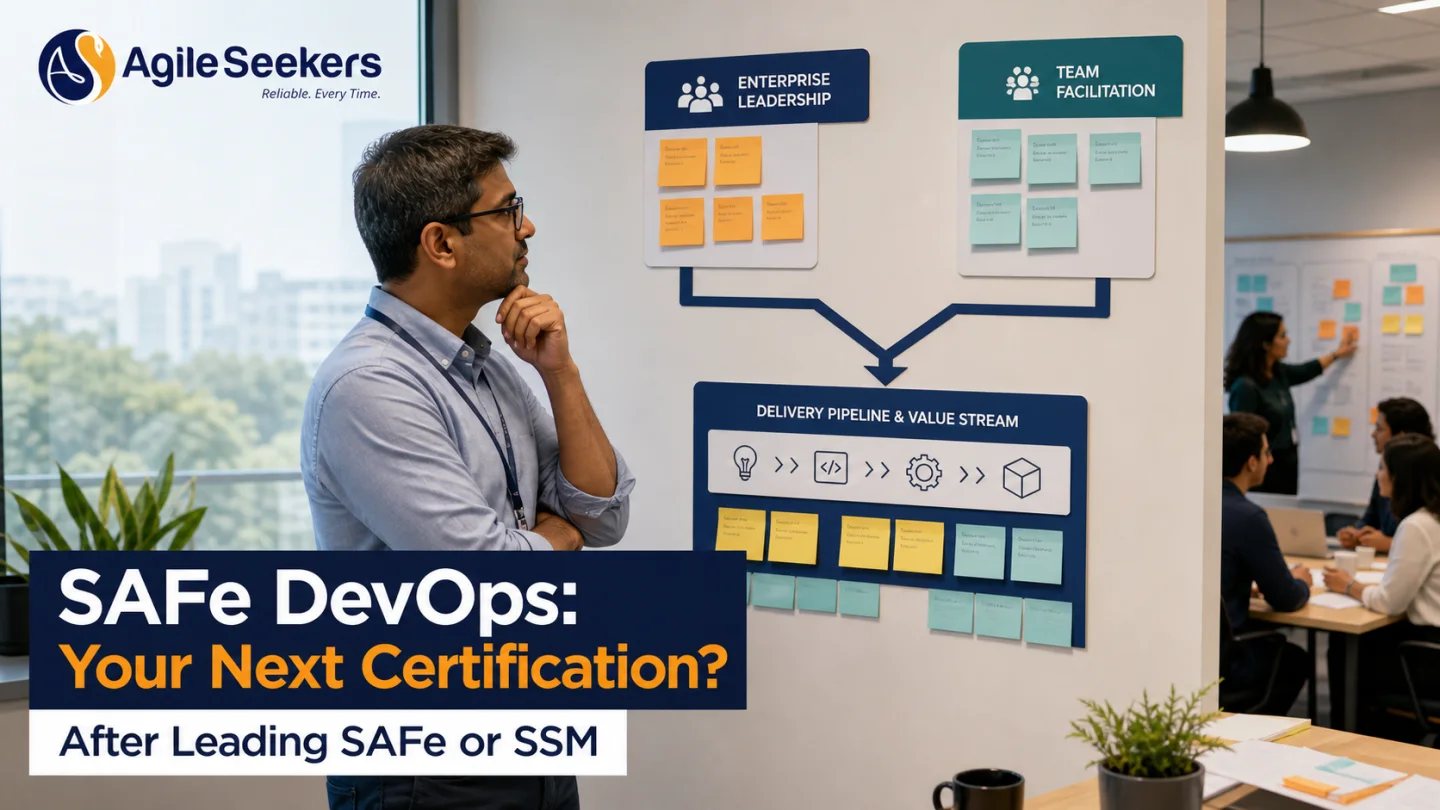
Leading SAFe and SAFe Scrum Master give practitioners useful views of enterprise agility, PI Planning, team execution, and improvement. Neither course is designed to examine the delivery pipeline in the same depth as SAFe DevOps.
The right next course depends less on the badge already earned and more on the problems now appearing in your work. A Scrum Master facing environment queues has a different learning need from a manager who wants a broad SAFe overview.
Start with the constraint, not the sequence
Certification paths are often drawn as ladders. Work rarely arrives in that order. Look at the last three delivery problems you helped solve. If they involved release coordination, test delay, security late in the process, unstable deployments, weak monitoring, or slow recovery, the pipeline has become part of your role.
That is the point where SAFe DevOps certification can add useful depth. The course studies CALMR, value stream mapping, the Continuous Delivery Pipeline, security, measurement, recovery, and a plan for change.
Three starting points and what each learner may be missing
| Current background | Knowledge already present | Gap SAFe DevOps can address |
|---|---|---|
| Leading SAFe | Lean-Agile leadership, value streams, ARTs, PI Planning | Detailed flow from concept through release and recovery |
| SAFe Scrum Master | Team facilitation, iteration execution, ART events, improvement | Cross-role pipeline constraints outside one team's control |
| Engineering or operations | Technical delivery, platforms, reliability, tooling | Shared product-to-operations model and enterprise flow language |
A Scrum Master should take it when impediments leave the team
A team may repeatedly miss goals because test environments are scarce, security review starts late, release windows create large batches, or production feedback does not reach planning. These are not problems a stronger retrospective agenda can fix.
The SAFe Scrum Master learning remains useful, but SAFe DevOps helps the practitioner trace the wider path and involve product, architecture, security, operations, and release roles. It can support a move toward system-level facilitation without pretending the Scrum Master owns every solution.
A leader should take it when transformation stops at planning
Some organisations improve planning cadence but keep the same release queues and approval model. Features are prioritised differently, yet customers do not receive value sooner. Leaders then need evidence from the pipeline, not another transformation slogan.
After Leading SAFe training, the DevOps course can help a leader connect value-stream thinking to deployment, release, measurement, security, and recovery. The leader's job is to remove policy and funding constraints, not choose tools for teams.
Questions that expose whether you are ready
- Can you name one customer-facing value stream and its main delivery delay?
- Do you work with people from product, engineering, testing, security, operations, or release?
- Are you expected to improve more than one team's local workflow?
- Can you access enough evidence to map a recent change without exposing confidential data?
- Will a manager or sponsor support one improvement after training?
Three or more clear yes answers usually indicate that the course can be applied soon. If every answer is uncertain, build a stronger SAFe or team-level foundation first.
Use the next 90 days to prove transfer
Days 1 to 15: observe
Map one change and interview people who receive work from each other. Ask where information is incomplete, what waits, and which failure is detected too late.
Days 16 to 45: test one change
Choose a bounded improvement such as earlier security involvement, a smaller release batch, a clearer environment policy, or a recovery rehearsal. Record the expected effect and a guardrail.
Days 46 to 90: inspect the result
Compare elapsed time, failure, rework, and the experience of people doing the work. Keep the change, adjust it, or stop it based on evidence.
Choose depth where your work has moved
Take SAFe DevOps next when your role now crosses the path from idea to release. Keep building team or framework fundamentals when the immediate challenge remains Scrum practice, role clarity, or basic ART participation.
Review the SAFe DevOps curriculum, certification support, and current cohort before enrolling. The course is strongest when you arrive with a real pipeline question and leave with an owned experiment.
SAFe DevOps Value Stream Mapping Workbook
Map one change from concept to release, locate the system constraint, and prepare a measured 30-day experiment.