Two events with different risk
Deployment moves a solution change into a target environment. Release makes functionality available for use and value realization. Combining them into one large event forces technical movement and customer exposure to share the same timing, approvals, and failure domain. SAFe Release on Demand explicitly supports releasing when business and customer conditions warrant, after deployment capability has made the change available safely.
Why decoupling improves learning
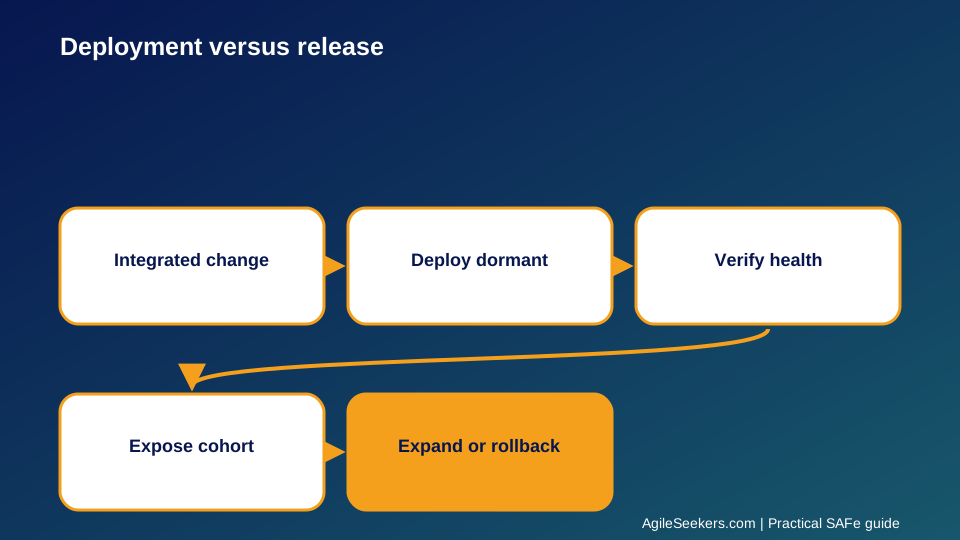
Teams can deploy small changes frequently, verify production configuration and operational health, and expose behavior gradually. Product roles can choose cohorts and timing based on market, support, compliance, and customer evidence. Decoupling does not remove governance; it places technical and business decisions at the point where each has useful information.
Build the separation with multiple controls
| Control | Purpose | Risk to manage |
|---|---|---|
| Feature flag | Enable behavior for selected users | State complexity and authorization |
| Dark deployment | Run code without visible behavior | Hidden cost or unintended side effects |
| Progressive delivery | Increase exposure in stages | Biased cohorts and weak guardrails |
| API or configuration versioning | Allow consumers to migrate | Compatibility and indefinite old versions |
| Rollback or roll-forward | Restore safe service quickly | Data changes and untested recovery |
Define a release decision record
- Target customer or user group and expected benefit.
- Technical health, security, and operational evidence.
- Outcome and guardrail thresholds for expansion.
- Business decision owner and authorized operators.
- Pause, rollback, support, and communication path.
- Date or evidence trigger for full exposure and control removal.
Progressive exposure is an experiment
Begin with the smallest representative cohort that can produce credible evidence without unfairly transferring risk. Compare behavior with a meaningful baseline, inspect reliability and customer outcomes, and expand only when predefined thresholds hold. Internal users may find technical defects but rarely prove external customer value.
Cases where physical coupling remains
Hardware, irreversible data migration, tightly regulated activation, and coordinated ecosystem changes may limit separation. Look for components that can still be decoupled: simulation, software configuration, web services, documentation, training, or operational rehearsal. Make the true constraint explicit rather than assuming the entire solution must share one release batch.
Do not confuse frequency with value
Track deployment frequency and release frequency separately, along with change lead time, failed-change rate, recovery, exposure size, feature adoption, and realized benefit. More deployments can improve technical capability; more releases are useful only when they produce learning or value at acceptable risk.
SAFe POPM training supports customer exposure and benefit decisions. SAFe RTE certification training helps coordinate the pipeline, dependencies, and recovery capability across the ART.
The practical test is whether the ART can place a small change in production safely, decide independently when and for whom it becomes usable, observe the result, and reverse course without a high-drama release event.
For a redesigned search experience, deployment may place dormant code and telemetry in production on Tuesday. Product Management may expose it to employees on Wednesday, one customer segment on Friday, and wider users after outcome and reliability review. Each transition has different evidence and authority without rebuilding the package. The release record preserves who experienced which behavior so support, analytics, and recovery actions remain coherent.
Agree terminology across product, engineering, operations, risk, and support. If one group says released when it means deployed, dashboards and incident communication become unreliable. Define state transitions in the delivery workflow and connect each to its decision owner, evidence, and customer population so everyone can interpret progress consistently.