Coordinate and Deliver connects intent to outcomes
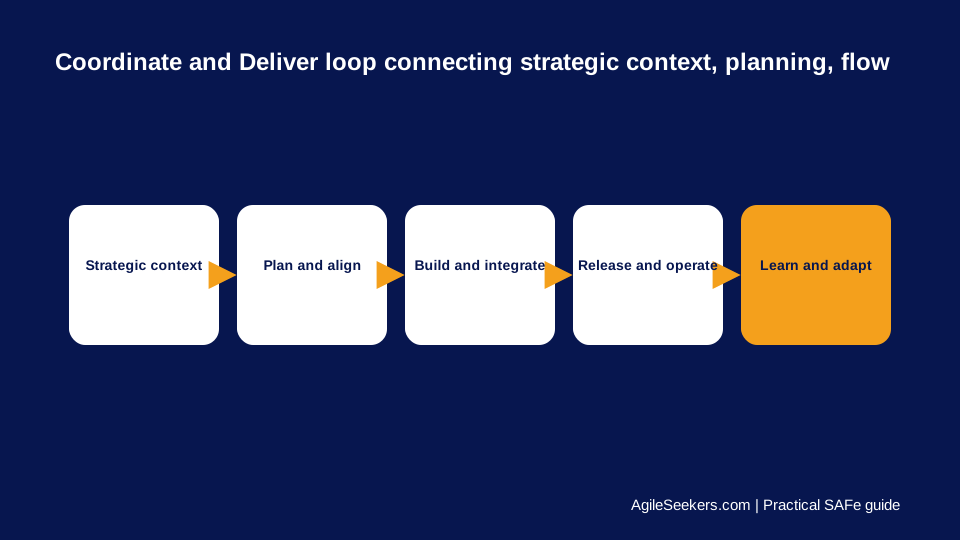
Coordinate and Deliver is the SAFe discipline concerned with aligning people and work, building solutions, integrating frequently, releasing when appropriate, operating reliably, and learning from results. It spans more than PI Planning or team execution. The discipline connects portfolios, value streams, ARTs, Solution Trains, suppliers, business functions, and technology around the flow of value.
See one delivery system across boundaries
| Layer | Coordination question | Delivery evidence |
|---|---|---|
| Portfolio | Which investments and value streams advance strategy? | Epic and value-stream outcomes |
| Solution Train | How will ARTs and suppliers create integrated evidence? | Capabilities, NFRs, and Solution Demos |
| ART | How will teams achieve PI Objectives together? | Feature flow, System Demos, and released value |
| Team | How will stories and enablers finish with quality? | Working integrated increments |
| Operations | How does value perform in use? | Adoption, reliability, recovery, and feedback |
Coordinate only where interdependence requires it
Shared cadence, planning, synchronization, and demonstrations reduce uncertainty when work genuinely interacts. They become overhead when every local choice waits for a central forum. Publish decision guardrails, identify cross-boundary needed-by dates, and keep reversible execution decisions close to the people with current knowledge.
Deliver means usable and operable value
Completion inside a backlog is not the finish. Integrated solution behavior, security, compliance, support readiness, deployment, release decisions, and customer or operational response determine whether value was delivered. Business-enabled ARTs and Agile Business Functions may be necessary when value depends on policy, sales, legal, operations, or service change as well as software.
Build an evidence cadence
- Connect work to an outcome and explicit hypothesis.
- Plan the smallest integrated evidence across affected groups.
- Limit WIP and make dependencies and decisions visible.
- Demonstrate the actual integrated system frequently.
- Release according to demand and operational readiness.
- Review outcome, flow, quality, and learning evidence.
Diagnose a coordination failure
- A meeting reports status but cannot make a decision.
- Dependencies have owners but no needed-by dates.
- Teams complete work that cannot be integrated.
- Business change begins after technology completion.
- Release waits for a calendar rather than readiness or demand.
- Feedback arrives but does not change priorities or policy.
Measures that reveal the whole path
Use Flow Time, Flow Load, Flow Velocity, Flow Distribution, and Flow Predictability alongside PI Objective outcomes, release frequency, defect escape, MTTR, customer behavior, employee experience, and business results. Segment the evidence to find the system condition rather than ranking teams.
Leading SAFe certification training explains how strategy, value streams, and leadership enable this discipline. SAFe RTE certification training develops the coordination and flow capabilities used across an ART.
Worked example: a release that needs business change
An ART builds a new self-service claims capability, but value depends on revised policy, contact-center scripts, legal approval, analytics, and operational staffing. The PI plan therefore includes technology features, business work, integrated scenarios, training evidence, and a staged release. A weekly cross-boundary review focuses on ageing decisions and the next integrated evidence, while teams retain authority over local implementation. The first release exposes a policy exception that would have blocked adoption. Leaders change the policy before expanding traffic, and the outcome review combines customer completion, call volume, defect escape, and Flow Time.
A monthly discipline health check
- Which strategy or outcome currently lacks an executable delivery path?
- Where does coordination reduce uncertainty, and where does it only add waiting?
- Which completed work is not yet usable, operable, or adopted?
- Are business and technology contributions visible in the same outcome model?
- Which recurring dependency should be removed through team design, platform capability, or policy?
- What feedback changed a backlog, guardrail, budget, or roadmap this month?
Coordinate and Deliver should become simpler as capability improves. Stable teams, clearer interfaces, automated evidence, shared platforms, and decentralized guardrails reduce the need for manual synchronization. If the number of coordination events grows while decision and integration age remain unchanged, redesign the system instead of expanding the calendar.