Current AI Product Management course fee and schedule
Current listed price: ₹15,000. AgileSeekers currently lists the AI-Powered Product Manager course at ₹15,000 plus applicable tax. The fee covers live training, structured course material, practice support and a completion certificate. Check the live schedule for current cohorts and the final payable amount.
Review the current AgileSeekers course page and inclusions. Check current schedule and enrollment.
Price checked 10 August 2026. Course fees, taxes, offers and availability can change; the live course page and final invoice govern the amount payable.
An AI product management course should teach product judgment with AI—not simply provide a list of prompts. Before comparing fees, identify the decisions you want to improve: discovery synthesis, opportunity framing, prioritization, PRD quality, backlog readiness, analytics, experimentation, or stakeholder communication. Then evaluate whether the course includes practice, review, and responsible-use boundaries for those decisions.
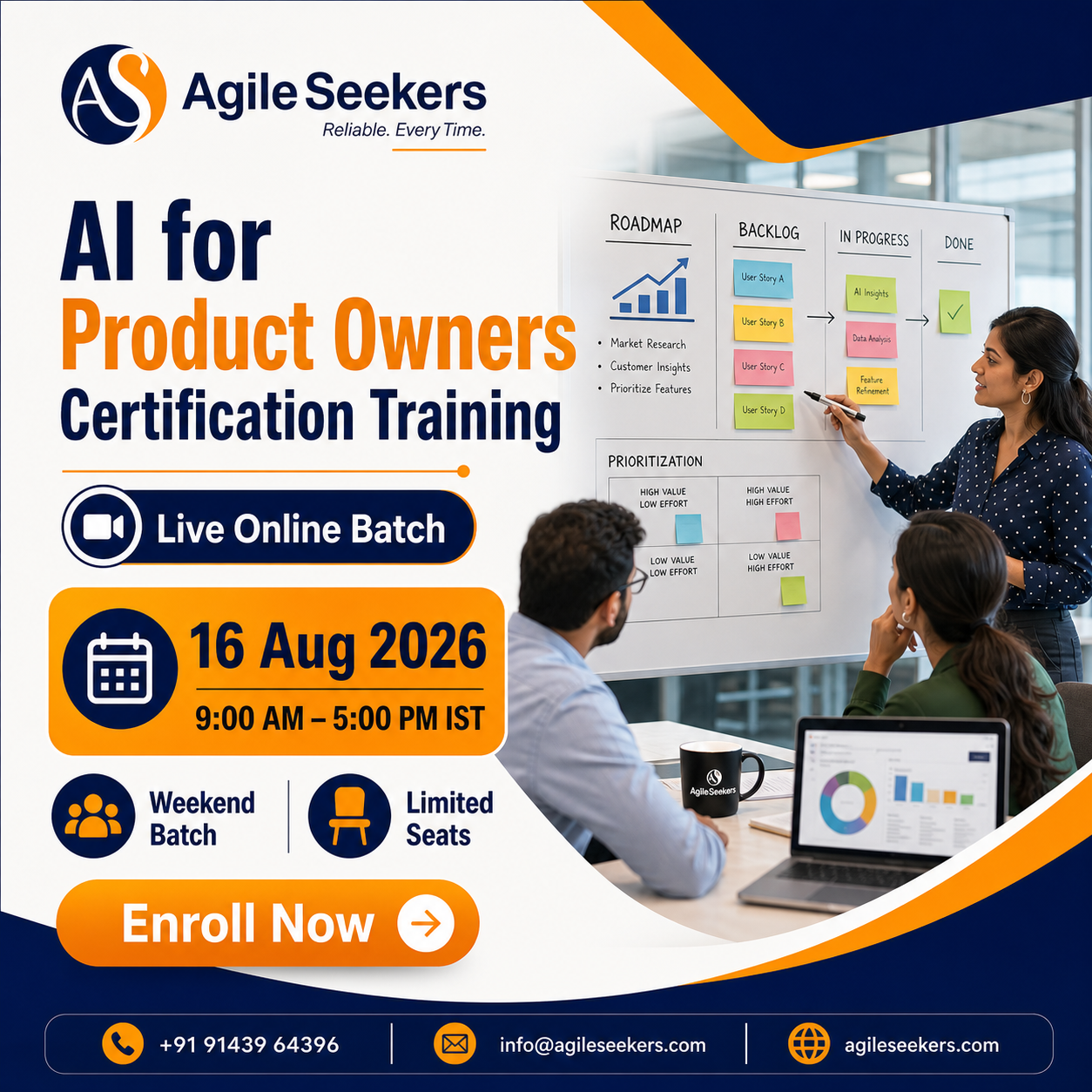
AgileSeekers offers two related paths: AI Powered Product Manager for broader product workflows and AI for Product Owners for backlog, refinement, discovery, and Scrum-related product ownership. Current dates appear on the AI Product Manager schedule and AI Product Owners schedule.
Which AI product course should you choose?
| Your main need | Path to review | Typical practice |
|---|---|---|
| Product strategy and discovery | AI Powered Product Manager | Research synthesis, opportunity framing, assumptions, positioning, and roadmap decisions |
| PRDs and cross-functional clarity | AI Powered Product Manager | Requirements, edge cases, risks, metrics, and engineering questions |
| Backlog refinement and acceptance criteria | AI for Product Owners | Story preparation, criteria, splitting, risks, and review |
| Product Owner discovery and stakeholders | AI for Product Owners | Interview synthesis, stakeholder communication, and evidence-based ordering |
What affects the course fee?
Fees can vary with duration, trainer, cohort size, live project depth, tool access, support, and taxes. Some courses require learners to bring their own subscriptions to external AI tools; others use free tiers or demonstrations. Ask before payment so the total learning cost is clear.
| Fee factor | What to verify |
|---|---|
| Live instruction | Hours, trainer background, interaction, and feedback |
| Projects | Whether you will create and review real product artifacts |
| AI tools | Which tools are required, who pays, and whether alternatives are supported |
| Data safety | How sensitive company or customer information should be handled |
| Tax and billing | Final GST-inclusive total, invoice, and payment method |
| Post-class support | Templates, practice, community, office hours, or doubt support if offered |
What useful AI product training should cover
The course should combine workflow design, prompting, evaluation, and human decision-making. Generating more text is not the objective. The objective is better evidence, faster exploration, clearer artifacts, and explicit review before a decision affects customers or delivery teams.
Discovery and research
AI can help organize interview notes, identify themes, generate questions, compare segments, and expose missing evidence. Learners should also understand hallucination, sampling bias, privacy, and the danger of treating generated patterns as customer truth.
Prioritization and roadmaps
AI can structure options and challenge assumptions, but it does not own product strategy. A good exercise separates facts, assumptions, constraints, and preferences, then asks the product professional to make and explain the final trade-off.
PRDs and backlog readiness
AI can draft structure, edge cases, acceptance criteria, risks, and stakeholder questions. Every artifact still needs domain review, technical review, and alignment with the Product Goal. Generated detail should not become false certainty.
Analytics and communication
AI can help formulate metric questions, interpret data summaries, prepare decision narratives, and adapt communication for different audiences. Learners must verify calculations and avoid sending confidential data to unapproved tools.
Responsible AI boundaries for product teams
- Do not paste personal, customer, financial, source-code, or confidential business data into unapproved tools.
- Verify claims, calculations, citations, and generated market information.
- Keep a human accountable for prioritization, requirements, and release decisions.
- Document where AI materially influenced an artifact or recommendation when governance requires it.
- Test outputs for exclusion, bias, unsafe assumptions, and missing edge cases.
- Use enterprise controls and approved models when organizational policy requires them.
How to compare course schedules
A compact weekend course is convenient, while sessions spread across several days may create more time for practice between classes. Ask whether projects happen during the live session or must be completed afterward, and whether feedback is included. Confirm the time zone and tool setup early.
- Are dates, trainer, live hours, and time zone confirmed?
- Will I build complete artifacts or only watch demonstrations?
- Which AI accounts or subscriptions must I arrange?
- Can I use a sanitized workplace problem as my project?
- What happens if a tool changes during or after the course?
Who will benefit—and who may not
Product managers, Product Owners, business analysts, founders, and delivery professionals can benefit when they already understand basic product or delivery work and want a safe, repeatable AI workflow. The course may not be the right first step if you need fundamental product management education, deep machine-learning engineering, or organization-wide AI governance design.
How to prepare
- Choose one product problem you can describe without confidential data.
- Collect sanitized inputs such as sample feedback, a roadmap question, or a draft PRD.
- Define what a high-quality output would look like before using AI.
- Review your employer's approved-tool and data-handling policy.
- After class, create one documented workflow with human review checkpoints.
How to measure whether the course helped
Measure improvements in the workflow, not the volume of generated text. Useful signals include less time spent organizing research, fewer missing edge cases in a PRD, faster stakeholder preparation, clearer assumptions, and better-quality questions for engineering or customers. Pair speed with a quality check so automation does not simply create more rework.
Keep a small before-and-after example using sanitized content. Document the task, inputs, prompt or workflow, review criteria, corrections, time saved, and remaining risks. This becomes reusable evidence for your team and helps governance discussions stay grounded in actual work.
AI product course enrollment checklist
- The course path matches my role: Product Manager or Product Owner.
- Projects and feedback are substantial enough to build practical skill.
- Required AI tools, subscriptions, and data-safety rules are clear.
- The final fee, GST, schedule, trainer, and invoice details are confirmed.
- Transfer, cancellation, and reschedule terms are documented.
Frequently asked questions
Do I need coding skills?
Not for most product workflow exercises. Technical curiosity helps, but the focus is applying AI to product decisions and artifacts. A course should state clearly if any module requires code or API access.
Will the course make AI decisions for me?
It should not. Product accountability remains human. The best use of AI is to expand options, structure information, identify gaps, and accelerate drafts while a professional verifies and decides.
Can I use company data in class?
Only if your organization explicitly permits it and the tools and setting meet its security rules. In most public classes, sanitized or synthetic examples are the safer default.
Next step
Choose the AI product path that matches your work
Compare the two curricula, then select a live batch with practical projects, responsible-use guidance, and clear enrollment terms.