Hidden dependencies are one of the quietest reasons Agile Release Trains miss commitments. Everything looks fine on the surface. Backlogs feel ready. Teams sound confident. Then a feature stalls because another team was waiting on an API, a data change, a legal review, or a platform upgrade no one surfaced early enough.
For Product Owners and Product Managers working in SAFe, dependency blind spots are not a process failure. They are a visibility problem. This is where AI has started to change the game in a very practical way.
Let’s break down how AI helps POPMs uncover dependencies that usually stay invisible until it’s too late, and how this shifts the way teams plan, sequence, and deliver value across an ART.
Why Dependencies Stay Hidden in the First Place
Dependencies rarely hide because people don’t care. They hide because modern Agile systems generate more signals than humans can reasonably track.
- Backlogs span hundreds of stories across multiple teams
- Dependencies cut across architecture, data, security, compliance, and vendors
- Work happens in tools that don’t naturally talk to each other
- Teams describe work differently even when solving related problems
A POPM might review features and stories and still miss the fact that two teams depend on the same service upgrade, or that a single Enabler carries risk across three upcoming PIs.
What this really means is that dependency management has outgrown manual tracking boards and spreadsheet-based mapping.
What AI Actually Does Differently
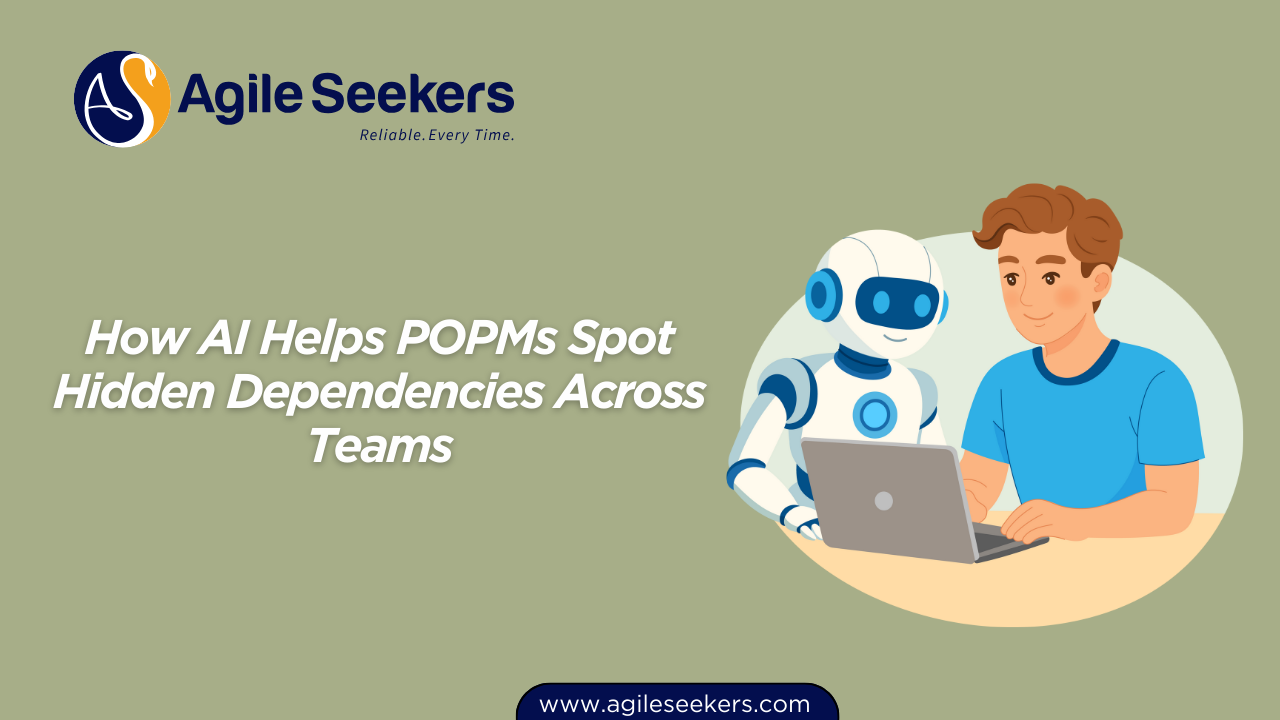
AI does not replace conversations or planning sessions. It does something far more specific and useful. It connects signals across systems, language, and patterns that humans don’t easily see.
Modern AI systems help POPMs by:
- Reading large volumes of backlog data continuously
- Identifying relationships across teams, not just within them
- Spotting patterns based on historical delivery behavior
- Flagging risks before teams feel the impact
This shifts dependency discovery from reactive to proactive.
Using AI to Read Between Backlog Lines
One of AI’s strongest advantages is natural language understanding. Teams describe work in different ways, but the underlying intent often overlaps.
For example:
- Team A writes a story about “enhancing user profile storage”
- Team B writes a story about “GDPR compliance updates”
- Team C adds a feature that needs new customer attributes
To a human skimming the backlog, these may feel unrelated. AI can detect that all three reference the same data entity and infrastructure layer.
This allows POPMs to surface questions early:
- Are these teams coordinating on the same schema changes?
- Is there a shared Enabler that should move up the backlog?
- Does sequencing need adjustment before PI Planning?
Instead of discovering conflicts during integration, teams resolve them during refinement.
Dependency Mapping Beyond Team Boundaries
Traditional dependency tracking often stops at team-to-team handoffs. AI extends this view across the entire value stream.
AI systems can correlate:
- Feature dependencies on architectural runway
- Stories tied to shared services or APIs
- Backlog items blocked by external vendors
- Compliance or security checkpoints tied to delivery timelines
For POPMs working in complex ARTs, this wider lens matters. It prevents optimistic sequencing that assumes dependencies will “work themselves out.”
This is also where skills from the SAFe agile certification become critical, because AI insights still need Lean-Agile leadership judgment to drive action.
Learning from Past Delivery Patterns
AI does not only look at what teams plan. It learns from how teams actually deliver.
Over time, AI models identify patterns such as:
- Dependencies that historically cause spillover
- Teams that frequently block or get blocked by others
- Types of Enablers that tend to arrive too late
- Features that underestimate integration effort
This allows POPMs to ask better questions during backlog prioritization. Instead of relying on gut feel, they can see evidence-backed risk signals.
This capability aligns closely with what POPMs learn in the SAFe Product Owner Product Manager certification, especially when balancing value, risk, and flow.
AI During PI Planning: From Static Boards to Living Maps
PI Planning often reveals dependencies, but only the obvious ones. AI enhances this moment by working alongside planning artifacts.
During PI Planning, AI tools can:
- Analyze draft plans in real time
- Highlight conflicting assumptions between teams
- Flag features that depend on unplanned Enablers
- Suggest alternative sequencing options
Instead of discovering issues in System Demos or Inspect and Adapt workshops, teams adjust while there is still room to negotiate scope.
For Release Train Engineers, this creates stronger facilitation signals, a capability deeply reinforced in the SAFe Release Train Engineer certification.
Reducing Dependency Risk During Execution
Dependencies don’t disappear after planning. They evolve.
AI helps POPMs during execution by continuously monitoring:
- Blocked stories and recurring wait states
- Changes in delivery forecasts
- Signals from DevOps pipelines and test failures
- Cross-team rework patterns
When AI detects a growing risk, POPMs can intervene early. That might mean adjusting scope, renegotiating priorities, or pulling forward an Enabler.
This supports Scrum Masters as well, especially those trained through the SAFe Scrum Master certification, who rely on timely signals to remove impediments at scale.
AI and Architectural Dependencies
Some of the most dangerous dependencies sit below the feature level.
Architectural runway, platform upgrades, and infrastructure work often span multiple PIs. AI helps by connecting feature demand to technical readiness.
Examples include:
- Features that rely on incomplete API versions
- Performance risks tied to growing data volumes
- Security requirements that affect multiple teams
AI can alert POPMs when business demand is running ahead of technical capability. This creates stronger collaboration with architects and system teams.
This systems-level awareness aligns well with advanced facilitation and coaching skills taught in the SAFe Advanced Scrum Master certification.
Improving Conversations, Not Replacing Them
AI does not replace refinement, PI Planning, or team discussions. It improves the quality of those conversations.
Instead of asking:
“Does anyone see any dependencies?”
POPMs can ask:
- “AI flagged a shared dependency on the customer data service. How do we want to handle sequencing?”
- “These two features touch the same compliance workflow. Who should own the Enabler?”
- “Last PI, this type of dependency caused delays. What can we change this time?”
This shifts discussions from speculation to informed decision-making.
Tooling Examples in Practice
Several Agile and DevOps platforms are already embedding AI-driven dependency analysis.
For example, Atlassian has been expanding intelligence across Jira and Jira Align to surface cross-team signals and planning risks, as outlined in their product updates on agile planning and alignment.
Similarly, Scaled Agile continues to emphasize flow, visibility, and systems thinking as core principles across SAFe, which aligns well with AI-enabled insights across ARTs.
AI works best when integrated into existing workflows, not bolted on as a separate reporting layer.
What POPMs Need to Develop Alongside AI
AI surfaces insights. POPMs still decide what to do with them.
To use AI effectively, POPMs need:
- Strong domain understanding to interpret signals
- The confidence to challenge sequencing assumptions
- Facilitation skills to align multiple stakeholders
- A focus on flow rather than local optimization
AI amplifies good product thinking. It does not compensate for unclear vision or weak prioritization.
The Real Payoff: Fewer Surprises, Better Flow
When POPMs use AI to uncover hidden dependencies, the impact shows up quickly:
- Fewer last-minute scope cuts
- More predictable PI outcomes
- Healthier cross-team collaboration
- Less stress during integration and release
What this really means is that teams spend less time firefighting and more time delivering value.
AI does not make Agile simpler. It makes complexity visible. And for POPMs operating in scaled environments, that visibility is often the difference between hoping a plan works and knowing where it might break.
Final Thoughts
Hidden dependencies will never disappear completely. But they no longer need to surprise teams.
AI gives POPMs a sharper lens into how work actually connects across teams, systems, and time. When combined with strong SAFe practices, it enables smarter planning, better conversations, and smoother delivery.
The POPMs who learn to work with AI now will not just manage backlogs better. They will shape how value flows across the enterprise.
Also read - AI Techniques for Identifying Weak Backlog Items Early
Also see - AI-Assisted Story Splitting for Large Features in SAFe