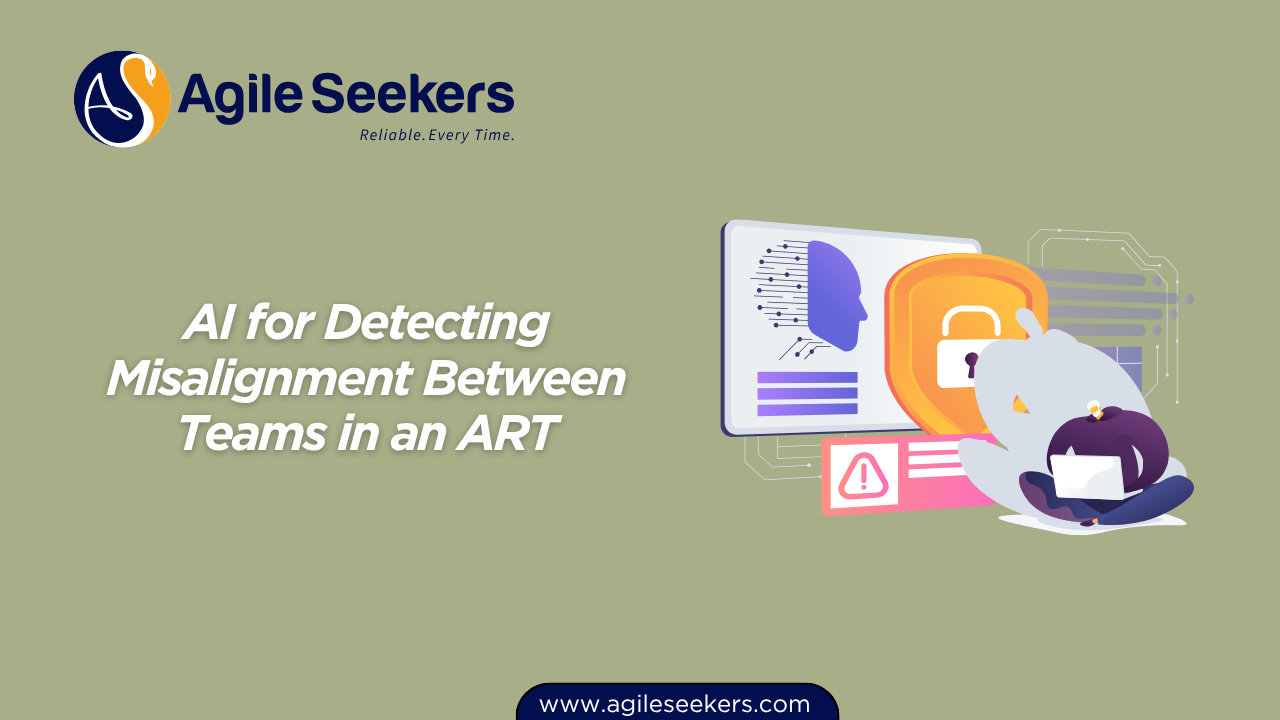
Misalignment inside an Agile Release Train (ART) rarely shows up as a loud failure. It creeps in quietly. Teams think they are moving forward, but they are actually drifting apart.
One team optimizes for speed. Another optimizes for stability. A third is chasing a shifting business priority. Everything looks productive on the surface, yet outcomes don’t connect.
This is where AI changes the game. Not by replacing people, but by exposing patterns that humans miss when they are too close to the work.
Let’s break down how AI helps detect misalignment early, what signals to watch, and how leaders can turn those insights into better alignment across the ART.
What Misalignment Looks Like Inside an ART
Before jumping into AI, it helps to understand the problem clearly.
Misalignment in an ART doesn’t always mean teams are doing the wrong work. It usually means they are doing the right work in isolation.
Here’s what that looks like in practice:
- Teams deliver features that don’t connect into a usable end-to-end experience
- Dependencies keep shifting between sprints
- PI objectives look aligned, but execution tells a different story
- Velocity is stable, but value delivery is inconsistent
- Stakeholders keep asking for rework
Most of this becomes visible only after damage is done. That’s the real issue.
What teams need is earlier visibility. That’s where AI steps in.
Why Traditional Methods Fall Short
Most ARTs rely on ceremonies and human observation to detect misalignment:
- PI Planning
- Scrum of Scrums
- System demos
- Inspect and Adapt workshops
These are valuable. But they depend heavily on what people choose to share.
Here’s the thing: teams don’t always see misalignment clearly while they are in the middle of execution. Even when they do, they may not communicate it effectively.
By the time it surfaces in a system demo, it’s already expensive to fix.
AI doesn’t replace these events. It strengthens them by adding data-driven visibility.
How AI Detects Misalignment Across Teams
AI works best when it connects signals across tools, teams, and timelines.
Let’s look at how it actually detects misalignment inside an ART.
1. Pattern Analysis Across Backlogs
AI can scan multiple team backlogs and identify inconsistencies:
- Stories that don’t align with higher-level features
- Features that lack supporting stories across teams
- Duplicate efforts across different teams
Instead of manually reviewing backlog hierarchies, AI highlights gaps instantly.
This becomes especially powerful for Product Owners working toward POPM certification, where alignment between strategy and execution is critical.
2. Dependency Mapping and Risk Prediction
Dependencies are one of the biggest sources of misalignment.
AI can:
- Map dependencies across teams automatically
- Detect delays in upstream work
- Predict risk based on past patterns
Instead of reacting to blocked work, teams get early warnings.
3. Communication Signal Analysis
AI can analyze communication patterns across tools like Slack, Jira, or Teams.
- Reduced cross-team conversations
- Delayed responses on critical threads
- Repeated clarification questions
These are subtle signals of misalignment.
For deeper insights into how AI transforms teamwork and decision-making, you can explore perspectives shared by McKinsey’s AI research.
4. Sprint Outcome vs Objective Tracking
AI compares what teams planned versus what they actually delivered.
- Did the outcome match the PI objective?
- Did teams deliver isolated outputs instead of integrated value?
When multiple teams show this pattern, it signals alignment issues at the ART level.
5. Flow Metrics and Bottleneck Detection
AI analyzes flow metrics such as:
- Cycle time
- Lead time
- Work-in-progress trends
When different teams show inconsistent flow patterns, it often points to misalignment in priorities or dependencies.
Teams focusing on advanced facilitation and flow improvement often gain this perspective through SAFe Advanced Scrum Master certification.
Where AI Gets Its Data From
AI doesn’t create insight out of thin air. It relies on existing data.
Typical sources include:
- Agile tools like Jira or Azure DevOps
- Version control systems
- Communication platforms
- CI/CD pipelines
- Roadmaps and PI objectives
The more connected your ecosystem, the more accurate the insights.
Real Signals of Misalignment AI Can Catch Early
Let’s make this practical. Here are signals AI can detect before humans notice:
Mismatch Between Features and Stories
Stories getting completed that don’t contribute to any active feature.
Unbalanced Work Distribution
One team overloaded while another has idle capacity.
Recurring Blockers Across Teams
The same dependency causing delays repeatedly.
Drifting Sprint Goals
Teams completing work but missing the intended outcome.
Late Integration Issues
Features that only break during system demos.
Each of these signals tells a story. AI connects them.
How Leaders Can Act on AI Insights
AI insights are only useful if leaders know how to act on them.
Here’s how to turn detection into alignment.
1. Reframe Conversations Around Outcomes
When AI shows misalignment, don’t focus on tasks. Focus on outcomes.
Ask:
- What value are we trying to deliver?
- Are teams working toward the same result?
This shift alone fixes many alignment issues.
2. Adjust Dependencies Early
AI highlights dependency risks before they explode.
Use that visibility during Scrum of Scrums to:
- Re-sequence work
- Remove unnecessary dependencies
- Assign clear ownership
Release Train Engineers trained through SAFe Release Train Engineer certification often drive this level of coordination effectively.
3. Improve PI Planning Quality
AI insights from previous PIs can improve the next one.
- Identify recurring misalignment patterns
- Adjust team commitments
- Clarify objectives
This makes PI Planning more grounded and realistic.
4. Strengthen Cross-Team Collaboration
If AI shows weak communication signals, fix that directly.
- Encourage direct conversations
- Reduce handoffs
- Increase visibility across teams
Scrum Masters trained through SAFe Scrum Master certification often play a key role here.
5. Align Backlogs Continuously
Don’t wait for PI Planning to fix alignment.
Use AI insights during backlog refinement to:
- Align stories with features
- Remove redundant work
- Clarify acceptance criteria
Common Mistakes When Using AI for Alignment
AI is powerful, but it’s easy to misuse it.
Over-relying on Data Without Context
AI shows patterns, not intent. Always combine insights with team conversations.
Using AI as a Policing Tool
If teams feel monitored instead of supported, alignment will get worse.
Ignoring Small Signals
Misalignment rarely starts big. Pay attention to early indicators.
Trying to Fix Everything at Once
Focus on the biggest alignment gaps first.
The Role of Leadership in AI-Driven Alignment
AI doesn’t create alignment. Leaders do.
What AI does is remove blind spots.
Leaders still need to:
- Set clear direction
- Define meaningful outcomes
- Create an environment where teams collaborate openly
When leadership is unclear, AI will simply highlight chaos faster.
When leadership is clear, AI accelerates alignment.
Where This Is Heading
AI in ARTs is still evolving. But a few trends are becoming clear:
- Real-time alignment dashboards across teams
- Predictive PI risk modeling
- Automated backlog alignment suggestions
- AI-assisted PI Planning simulations
Organizations that adopt this early will move faster with less friction.
Those who don’t will keep solving alignment issues after they become problems.
For leaders looking to understand how alignment works at scale, Leading SAFe certification provides a strong foundation.
Final Thoughts
Misalignment in an ART doesn’t come from bad intentions. It comes from limited visibility.
Teams focus on their work. Leaders focus on outcomes. Somewhere in between, gaps appear.
AI closes those gaps by making the invisible visible.
It shows patterns across teams, highlights risks early, and connects execution back to strategy.
But the real value comes from what you do with those insights.
Use AI to guide conversations. Use it to ask better questions. Use it to align teams around outcomes instead of outputs.
That’s where real progress happens.
Also read - How to Use AI to Identify Patterns in Failed Features
Also see - How AI Helps POPMs Spot Hidden Dependencies Across Teams