Large features look impressive on roadmaps. In real delivery, they often become the biggest source of delay, confusion, and rework. Teams struggle to understand scope, Product Owners wrestle with dependencies, and PI objectives start slipping before the first iteration even ends.
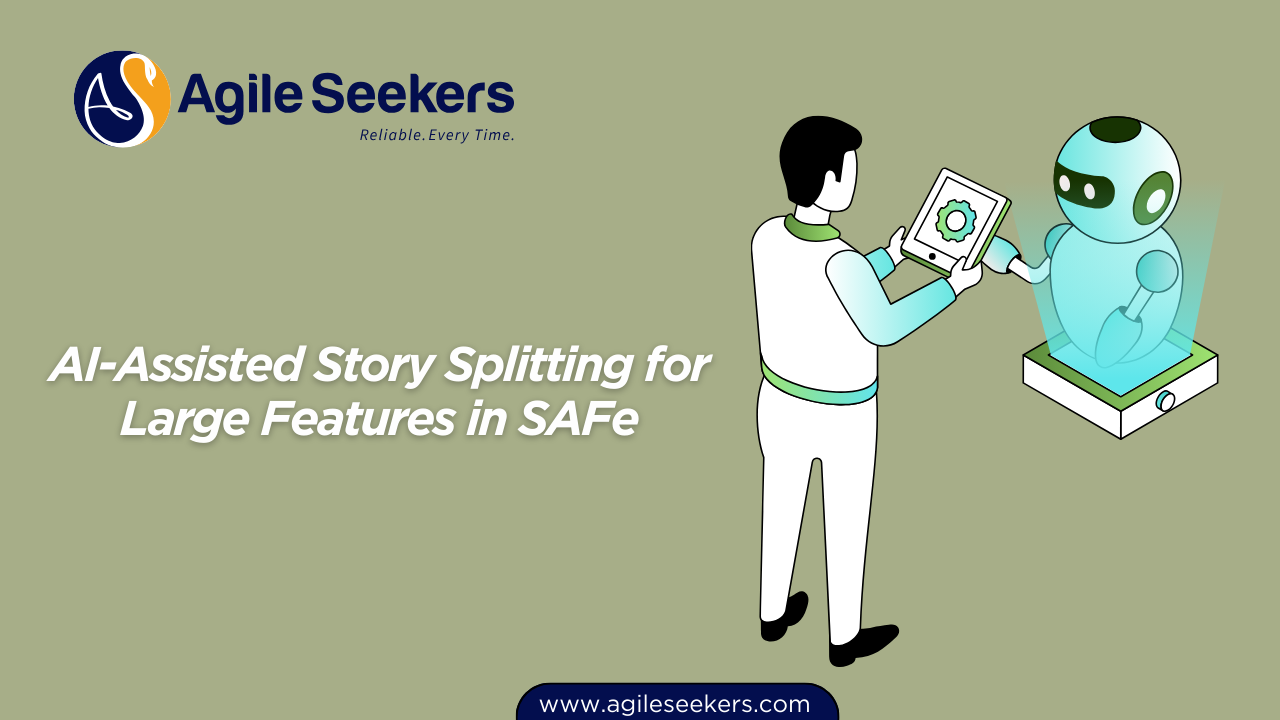
Story splitting has always been the antidote. What’s changed is how AI can now support that process without taking control away from teams. Used well, AI doesn’t replace human judgment. It sharpens it.
This article breaks down how AI-assisted story splitting works in a SAFe context, where it helps, where it can mislead, and how roles across the Agile Release Train can use it responsibly.
Why Large Features Are So Hard to Break Down
In SAFe, a Feature represents a service or capability that delivers value to the business. On paper, it sits neatly between Epics and Stories. In practice, many Features arrive at the ART already bloated.
Common reasons:
- Business stakeholders describe outcomes, not slices of value
- Technical complexity hides behind simple user language
- Dependencies across teams remain implicit
- Non-functional work gets bundled into functional stories
The result is predictable. Teams create oversized stories, estimation becomes guesswork, and iteration goals turn into wish lists.
AI doesn’t magically fix this. What it does well is pattern recognition at scale. That makes it useful during the early stages of splitting.
What AI Actually Contributes to Story Splitting
Let’s get one thing clear. AI should not be the one deciding how a Feature gets split. That responsibility still sits with Product Owners, Product Managers, and teams.
What AI can do is accelerate thinking by surfacing options that humans might miss or take longer to uncover.
Used correctly, AI helps by:
- Highlighting hidden complexity in Feature descriptions
- Suggesting alternative slicing dimensions
- Detecting dependency clusters across stories
- Flagging stories that are likely too large for one iteration
Think of AI as a fast-thinking assistant that never gets tired of reading long Feature descriptions.
Story Splitting Patterns AI Is Good At Spotting
Most experienced agile practitioners already know classic story splitting techniques. AI becomes powerful when it applies those patterns consistently across hundreds of backlog items.
Workflow and Process Steps
AI can scan Feature descriptions and suggest splits based on workflow stages. For example, onboarding might split into registration, verification, profile setup, and activation.
This is especially useful when Features are described in business language but implemented across multiple systems.
Data Variations
AI models excel at spotting different data scenarios embedded in requirements. They can suggest separate stories for standard cases, edge cases, and exception handling.
Teams still decide priority. AI just makes the options visible.
Business Rules and Policies
When Features contain multiple rules, thresholds, or conditions, AI can isolate them and recommend separate stories. This prevents teams from bundling unrelated logic into one oversized item.
Operational vs User-Facing Work
Large Features often mix UI changes, backend processing, monitoring, and compliance work. AI can help separate operational enablement from user-visible value, making planning cleaner.
How This Fits Inside a SAFe Backlog Hierarchy
Story splitting doesn’t happen in isolation. It must align with SAFe’s backlog structure.
AI can help Product Managers refine Features before they reach PI Planning, which reduces chaos downstream. Product Owners can then focus on splitting into Stories that teams can deliver within an iteration.
This upstream clarity is one of the reasons Leading SAFe practitioners emphasize backlog hygiene early, something covered in depth during Leading SAFe certification.
AI-Assisted Story Splitting During PI Planning
PI Planning compresses a lot of decisions into a short time window. Large Features arriving half-baked create stress across the ART.
AI tools can assist before PI Planning by:
- Pre-splitting Features into candidate stories
- Estimating relative size using historical data
- Flagging cross-team dependencies early
During planning, teams review and adjust. They accept or reject AI suggestions based on reality. This keeps the event focused on alignment rather than backlog cleanup.
Product Owners who want to master this balance between automation and judgment often deepen these skills through the SAFe Product Owner Product Manager (POPM) certification.
Keeping Stories Small Enough Without Losing Value
A common fear is that AI will push teams to over-split, creating too many tiny stories with little standalone value.
This only happens when teams treat AI output as final.
Good practice looks like this:
- AI suggests multiple split options
- Teams validate value boundaries
- Stories still deliver testable outcomes
AI accelerates analysis. Humans preserve intent.
The Role of Scrum Masters in AI-Assisted Splitting
Scrum Masters play a critical facilitation role here. AI can surface insights, but teams still need structured conversations.
Scrum Masters help by:
- Ensuring AI output doesn’t replace team discussion
- Challenging stories that remain too large
- Protecting teams from unrealistic iteration commitments
As AI becomes part of backlog refinement, facilitation skills matter more, not less. These dynamics are explored deeply in the SAFe Scrum Master certification and further expanded in the SAFe Advanced Scrum Master training.
Handling Dependencies Without Creating Dependency Hell
Large Features often span multiple teams. Story splitting without dependency awareness just moves the problem around.
AI can analyze backlog relationships, past delivery patterns, and architectural touchpoints to highlight dependency clusters. This helps teams sequence stories intentionally instead of discovering blockers mid-iteration.
Release Train Engineers benefit from this visibility when coordinating across teams, a skillset central to the SAFe Release Train Engineer certification.
Common Mistakes Teams Make with AI Story Splitting
AI can amplify bad habits if teams aren’t careful.
- Accepting AI-generated stories without refinement
- Splitting by technical layers instead of user value
- Ignoring non-functional requirements
- Using AI to justify over-commitment
The fix is simple but not easy. Treat AI as a starting point, not an authority.
External Perspectives Useful to examine
Story splitting is not new. AI simply adds a new lens.
If you want to deepen your understanding of effective splitting patterns, resources like Mountain Goat Software’s guide to story splitting offer timeless principles that still apply.
For broader context on SAFe backlog hierarchy and flow, the official guidance from Scaled Agile Framework documentation remains a solid reference.
What This Means for Teams Moving Forward
AI-assisted story splitting is not about speed for its own sake. It’s about clarity.
Clear stories lead to better estimation. Better estimation leads to realistic PI Objectives. Realistic objectives build trust across the ART.
Teams that use AI thoughtfully reduce cognitive load and spend more time solving real problems. Teams that use it blindly create noise.
The difference comes down to mindset.
Closing Thoughts
Large Features aren’t going away. Business complexity isn’t shrinking. What can change is how teams approach the work.
AI gives SAFe practitioners a powerful assistant for story splitting, dependency discovery, and backlog hygiene. The human side still defines value, sequencing, and commitment.
When those two work together, Features stop being delivery risks and start becoming predictable units of value.
Also read - How AI Helps POPMs Spot Hidden Dependencies Across Teams
Also see - Using AI to Analyze Customer Feedback at Scale for POPMs