Customer feedback has never been scarce. What’s scarce is clarity.
Product Owners and Product Managers working in SAFe environments sit on top of huge volumes of signals: support tickets, NPS comments, app reviews, sales notes, usability studies, social chatter, internal demos, and stakeholder opinions. Individually, each signal feels manageable. At scale, they turn into noise.
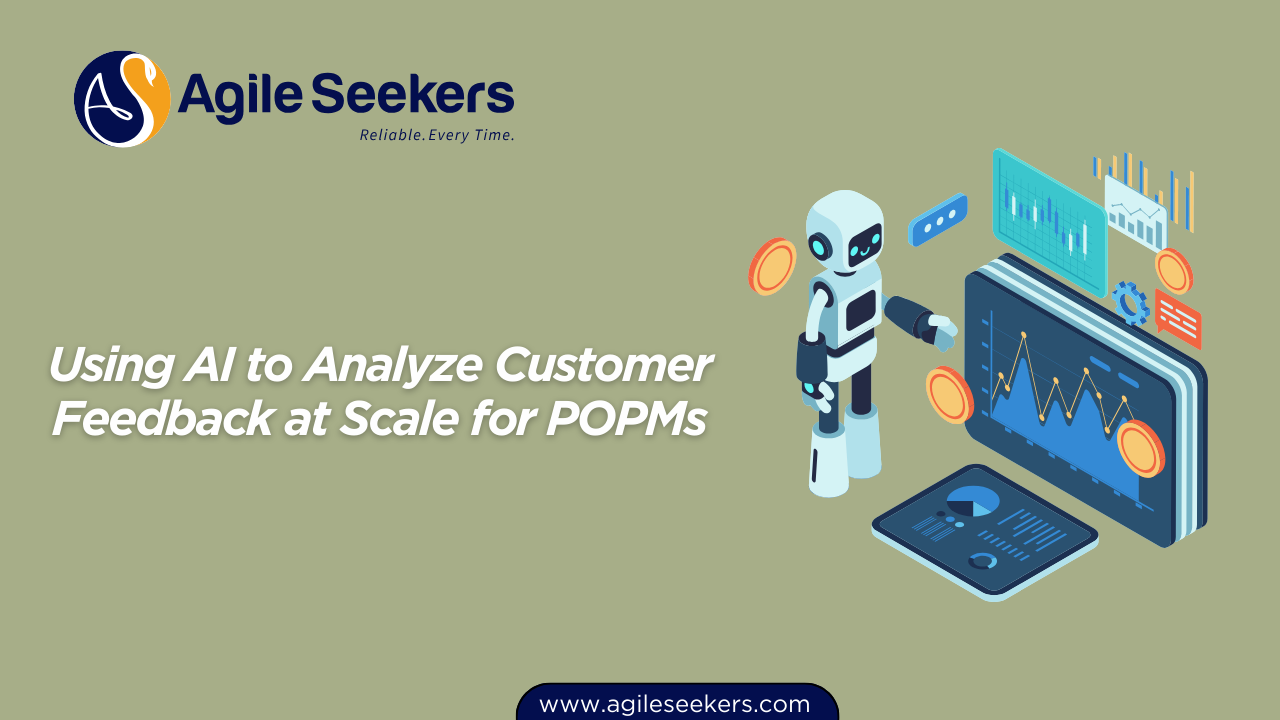
This is where AI earns its place in the POPM toolkit. Not as a replacement for judgment, but as a force multiplier. Used well, AI helps POPMs see patterns earlier, prioritize with confidence, and connect real customer pain to the backlog without drowning in spreadsheets.
Let’s break down how AI-driven feedback analysis actually works in practice, how POPMs can apply it inside a SAFe Agile Release Train, and where human judgment still matters most.
Why Customer Feedback Becomes a Bottleneck at Scale
In small teams, feedback flows through conversations. In large enterprises, feedback arrives fragmented.
A single PI can generate:
- Thousands of support tickets across regions
- Hundreds of qualitative survey responses
- Dozens of stakeholder inputs from sales, marketing, and operations
- Continuous app store and platform reviews
POPMs feel the pressure to “listen to the customer,” but manual analysis doesn’t scale. Common failure modes show up quickly:
- Teams overreact to the loudest feedback instead of the most representative
- Important patterns get buried under anecdotal comments
- Backlogs drift away from real customer pain
- PI planning decisions rely on intuition rather than evidence
AI changes this equation by turning raw feedback into structured insight, without stripping away context.
What AI Really Does When Analyzing Feedback
Forget buzzwords for a moment. AI helps POPMs do three things faster and more consistently.
1. Classify feedback at scale
AI models can read unstructured text and tag it by theme, sentiment, product area, persona, or journey stage. A thousand comments stop being a wall of text and start becoming clusters.
For example:
- Performance issues
- Usability friction
- Missing capabilities
- Integration pain
- Onboarding confusion
This classification happens across languages, regions, and channels, something manual analysis struggles with.
2. Detect patterns humans miss
POPMs often spot obvious issues. AI spots subtle correlations.
It can surface insights like:
- Complaints that spike after a specific release
- Features praised by one persona but criticized by another
- Low-volume feedback that consistently predicts churn
These patterns help teams act earlier, before problems escalate.
3. Quantify qualitative data
Qualitative feedback often loses out during prioritization because it feels “soft.” AI assigns weight and frequency without flattening meaning.
This makes customer voice easier to bring into backlog refinement, WSJF discussions, and PI planning conversations.
How POPMs Can Apply AI Feedback Analysis Inside SAFe
AI becomes valuable only when it fits into existing SAFe ceremonies and artifacts. Here’s how experienced POPMs integrate it without adding overhead.
Connecting feedback to Features and Enablers
AI-generated themes help POPMs validate whether proposed Features actually address real customer problems.
Before finalizing a Feature for the Program Backlog, POPMs can ask:
- Which feedback clusters does this Feature reduce?
- Is the problem growing, shrinking, or stable?
- Which customer segments are affected?
This strengthens alignment between customer reality and ART-level priorities, a core expectation in SAFe agilist certification programs.
Improving backlog refinement quality
Weak backlog items often trace back to vague problem statements.
AI summaries help POPMs sharpen stories by grounding them in actual customer language. Instead of abstract descriptions, backlog items reflect:
- Common phrases customers use
- Specific scenarios where pain occurs
- Frequency and impact of the issue
This leads to better conversations with teams and fewer rework cycles later.
Supporting PI Planning with evidence
During PI Planning, opinions multiply quickly.
AI-backed feedback insights give POPMs a neutral reference point. When trade-offs arise, POPMs can point to:
- Trends across thousands of inputs
- Customer impact by persona or market
- Emerging risks linked to unmet needs
This shifts discussions from “who feels strongest” to “what evidence suggests.”
Common AI Techniques Used for Feedback Analysis
You don’t need to become a data scientist to use AI effectively. Still, understanding the basics helps POPMs ask better questions.
Natural Language Processing (NLP)
NLP allows machines to interpret text the way humans roughly do. It powers:
- Theme extraction
- Keyword clustering
- Entity recognition
This technique turns free-text feedback into structured insight.
Sentiment and emotion analysis
Beyond positive or negative labels, advanced models detect frustration, confusion, urgency, or delight.
For POPMs, this helps distinguish between:
- Mild annoyances
- Severe blockers
- Nice-to-have suggestions
Trend and anomaly detection
AI models track how feedback evolves over time.
This helps POPMs spot:
- Regressions after releases
- Silent issues that suddenly spike
- Early signals before churn or escalation
Many product teams reference research from sources like Nielsen Norman Group to combine qualitative insight with behavioral data.
Where Human Judgment Still Matters
AI doesn’t replace POPMs. It changes where they spend their energy.
Critical decisions still require human context:
- Interpreting feedback against business strategy
- Balancing short-term pain with long-term vision
- Navigating political and regulatory constraints
AI might tell you that a feature frustrates users. Only a POPM can decide whether to fix it now, defer it, or redesign the approach entirely.
This balance between data and judgment sits at the heart of modern product leadership, and it’s a recurring theme in the SAFe POPM certification.
Using AI Feedback Insights Across Roles in the ART
Customer insight shouldn’t live only with POPMs.
Scrum Masters
Scrum Masters use AI insights to understand where teams struggle to deliver customer value. Feedback patterns often reveal:
- Quality issues linked to flow problems
- Misalignment between acceptance criteria and expectations
This supports continuous improvement efforts emphasized in SAFe Scrum Master certification programs.
Advanced Scrum Masters
At scale, systemic issues emerge across teams.
AI helps Advanced Scrum Masters identify recurring friction points across ARTs, supporting coaching conversations aligned with SAFe Advanced Scrum Master training.
Release Train Engineers
RTEs use aggregated customer insight to spot delivery risks and improvement opportunities at the train level.
Patterns in feedback often correlate with dependency breakdowns, integration delays, or governance gaps, areas explored deeply in SAFe RTE certification.
Ethical and Practical Considerations
Analyzing customer feedback with AI comes with responsibility.
- Respect data privacy and consent
- Avoid over-automating sensitive interpretation
- Validate insights with real conversations
Many organizations follow guidance from research bodies like Gartner when designing responsible feedback systems.
AI should amplify customer voice, not distort it.
Practical First Steps for POPMs
If you’re starting small, focus on impact, not tooling.
- Aggregate feedback sources into one view
- Start with basic theme and sentiment analysis
- Review insights alongside qualitative interviews
- Use findings in one PI cycle before expanding
The goal isn’t perfect insight. It’s better decisions, made earlier.
Final Thoughts
Customer feedback already exists at scale. Ignoring it is no longer an option.
AI gives POPMs the ability to listen widely without losing depth. It turns noise into patterns, opinions into evidence, and scattered signals into practical insight.
Teams that combine AI-powered analysis with strong product judgment don’t just react faster. They build products that reflect real customer needs, PI after PI.
And that, ultimately, is what great POPMs do best.
Also read - AI-Assisted Story Splitting for Large Features in SAFe
Also see - How POPMs Can Use AI to Prepare Better WSJF Inputs