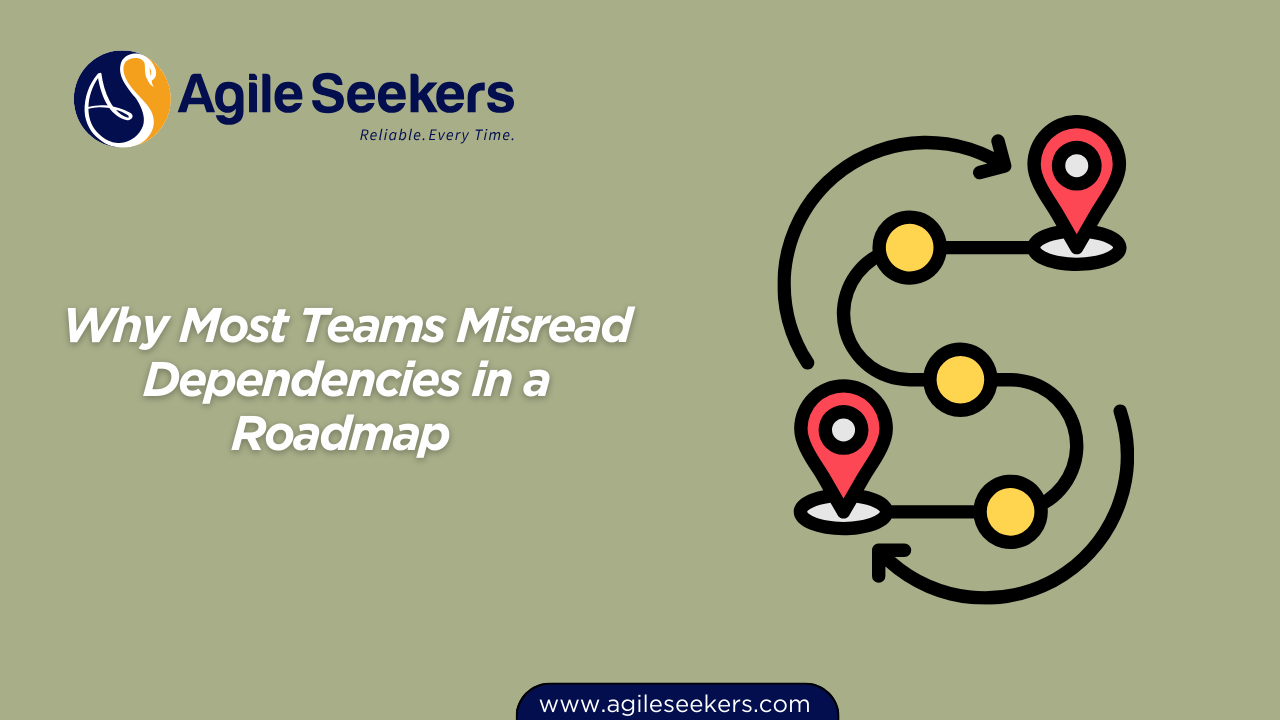
Roadmaps look simple on the surface. Boxes arranged in neat rows. Color-coded themes. A timeline running across the top. And yet, the moment a team tries to build or deliver anything against that roadmap, hidden dependencies jump out like tripwires. Work stalls. Sequencing breaks. Everyone starts debating priorities that were never unclear until the work actually started.
Here’s the thing: misreading dependencies isn’t just a planning mistake. It’s a signal that the team is seeing the roadmap as a list of commitments instead of a system of relationships.
This post explains why teams fall into this trap, what they usually overlook, and how to fix it before your next release plan or PI Planning session turns chaotic.
The Root Problem: Teams Treat the Roadmap Like a Checklist
A roadmap isn’t a task list. It’s a picture of how value moves across many parts of the system.
Most teams misread dependencies because they read the roadmap vertically, one item at a time, instead of horizontally, where user journeys, data flows, and platform constraints intersect.
If the team only sees a set of features, they’ll assume everything is independent unless stated otherwise. But systems rarely work that way. Even a basic customer flow relies on:
- shared data
- shared authentication paths
- shared infrastructure
- shared APIs
- shared knowledge or roles
- shared environments
When teams don’t view the roadmap as a system map, they fall into the default assumption: if nothing mentions a dependency, no dependency exists.
This shift in thinking is something leaders often pick up in a Leading SAFe training, where roadmaps are treated as dynamic systems, not static lists.
Dependency Blind Spots Start Before Roadmapping
By the time the roadmap is created, many dependency risks are already baked in. Here’s where teams slip before work even reaches the planning board.
User journeys aren’t mapped clearly
Functional dependencies hide inside the user journey. If the journey is unclear, the dependencies stay invisible.
Teams skip capability-level thinking
Roadmaps built from features create siloed thinking. Roadmaps built from capabilities reveal flow. This is one reason many POs benefit from a SAFe POPM certification, it trains them to build plans from value streams, not standalone items.
Architecture is treated as optional
When architects aren’t involved early, teams miss cross-system dependencies that only surface months later.
Nobody maps real-world constraints
Every system has bottlenecks:
- overloaded teams
- fragile APIs
- slow or inconsistent environments
- vendors with long lead times
If constraints aren’t visible, roadmaps will assume they don’t matter, until they do.
Planning feels rushed
Speed breeds optimism. Optimism hides dependencies. Structured facilitation, like what’s taught in a SAFe Scrum Master certification, helps teams slow down just enough to think systematically.
The Hidden Types of Dependencies Most Teams Miss
Teams usually look for one kind of dependency: “We need X before we can build Y.” But dependencies come in many forms.
Data dependencies
A feature may require data that doesn’t exist yet, needs migration, or needs cleansing.
User experience dependencies
UI changes often depend on backend restructuring, legal reviews, or customer communication.
Cross-team dependencies
Classic example: “Team A depends on Team B’s API.” This is where leaders with SAFe Advanced Scrum Master certification shine, they’re trained to navigate inter-team coordination.
Environment & testing dependencies
One unstable integration environment can derail an entire quarter.
Capacity dependencies
One overloaded specialist can block multiple work streams.
Why Dependencies Get Misread During Roadmapping
Here are the psychological and structural reasons teams misinterpret dependencies.
- They confuse sequencing with dependency.
- They assume items placed near each other are related.
- Leaders underestimate the importance of dependency discussions.
- Roadmaps hide uncertainty instead of exposing it.
- Everyone assumes someone else validated the dependencies.
The Real Cost of Misreading Dependencies
Late-discovered dependencies don’t just delay delivery. They break trust, disrupt flow, and inflate rework.
Teams in large-scale programs feel this the most during PI Planning. This is where the orchestration skills from a SAFe Release Train Engineer certification make a real difference.
- sprint goals become unstable
- rework multiplies
- technical debt increases silently
- stakeholders lose confidence in the roadmap
What Misread Dependencies Reveal About the Team
- There’s no shared understanding of the system.
- Team boundaries don’t match product architecture.
- Roles are stretched thin.
- The roadmap isn’t built around user value.
How to Spot Dependencies Before They Hurt Your Roadmap
1. Work through user journeys
Ask: What must be true for this step to work?
2. Use event-based sequencing
Plan work based on triggers, not arbitrary dates.
3. Align work with value streams
Teams trained through Leading SAFe agilist certification often surface dependencies earlier.
4. Include architects from day one
5. Run a dependency discovery workshop
6. Validate each dependency with the right owner
7. Track dependencies like risks
Dependencies need visibility, owners, and outcomes.
Why Dependency Issues Grow as Organizations Scale
Small teams can rely on intuition. Larger organizations cannot. As programs grow, dependency complexity increases exponentially.
A SAFe Scrum Master certification gives Scrum Masters the tools to handle this complexity at scale.
Techniques That Improve Dependency Clarity
- Story mapping early
- Capability mapping
- Constraint mapping
- Flow-based planning
- Weekly dependency syncs
- Transparency rituals
These practices become even more effective when guided by the system thinking taught in the SAFe Advanced Scrum Master certification.
Common Myths About Dependencies
- Good communication removes dependencies, it doesn’t.
- More detail in the roadmap doesn’t reduce risk, clarity does.
- Dependencies aren’t always technical.
- You can’t resolve all dependencies later without cost.
- Dependencies aren’t always bad, hidden ones are.
External Resources Useful to examine
What a Healthy Dependency Approach Looks Like
- Teams flag uncertainty early.
- Sequencing feels grounded, not speculative.
- Architecture guides roadmapping decisions.
- Stakeholders trust commitments more.
Organizations that invest in capability development, through programs like the SAFe POPM certification, SAFe agile training, SAFe Release Train Engineer certification, and SAFe Scrum Master certification, usually see dependency clarity improve quickly because people start thinking at the system level instead of the feature level.
Final Thought
Most teams misread dependencies not because they lack talent, but because the roadmap is treated as a static diagram instead of a living representation of how the system behaves. Once teams read the roadmap as a map of relationships, constraints, and flows, dependency risks become clearer, sequencing becomes smoother, and delivery becomes far more predictable.
Also read - Turning Large Story Maps Into Practical Delivery Plans
Also see - How to Turn Quarterly Themes Into Practical Roadmap Items
A practical sequence to apply this guidance
- The Root Problem: Teams Treat the Roadmap Like a Checklist: Clarify the decision, people affected and evidence needed before acting.
- Dependency Blind Spots Start Before Roadmapping: Apply the guidance to one current example and record important constraints.
- User journeys aren t mapped clearly: Choose one small action with an owner, boundary and review date.
- Teams skip capability-level thinking: Compare the result with the intended outcome and update the approach.
Use the sequence as a decision aid, not a rigid template. Preserve the article's context and adapt the steps when evidence, risk or authority differs.