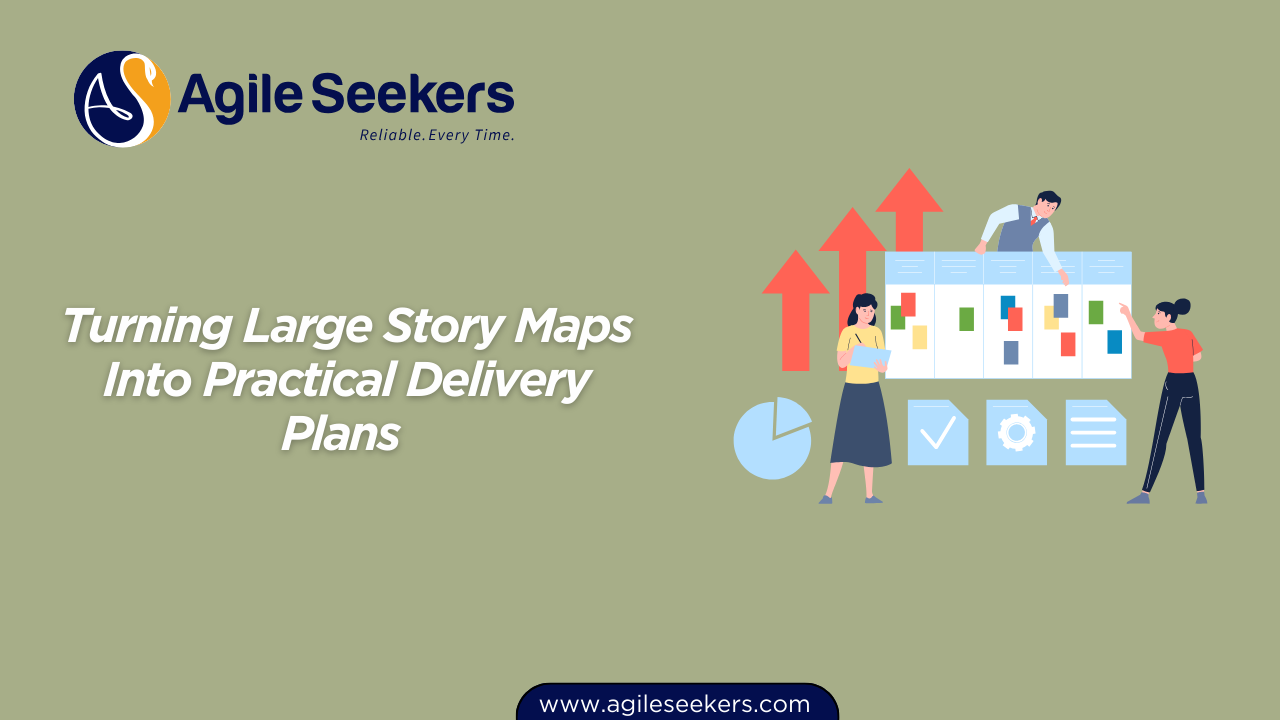
Large story maps look inspiring on a wall. Sticky notes, color codes, swimlanes, user journeys, everything feels clear and aligned. But here’s the thing: a story map is only useful if it turns into an actual delivery plan your teams can execute without confusion or debate. And that’s where many teams struggle.
Teams map the journey, outline slices, define the MVP, but when they convert that huge visual into sprints, releases, or ART-level increments, clarity suddenly disappears. Work feels too big. Priorities shift. Dependencies pop up from nowhere. And the team ends up managing the map instead of using it.
This guide breaks down how to turn a large story map into a practical, grounded delivery plan your teams can actually work with. No theatrics. No jargon. Just real steps that make the map useful during execution.
Why Large Story Maps Feel Hard to Convert Into Delivery Plans
Most teams hit similar friction points:
- The map feels too high-level: Epic-level steps look neat, but they’re too big for sprint planning.
- The map becomes a static artifact: Teams forget it’s meant to evolve.
- Hidden dependencies appear late: Thin slices reveal workflow gaps.
- Stakeholders push everything into the early slice: And prioritization gets messy.
- The map isn’t tied to team capacity: A beautiful map doesn’t show the actual effort required.
To fix this, you need a structured way to move from a large visual to a practical delivery plan.
1. Start With the Outcome, Not the Activities
Don’t jump straight into breaking down tasks. Start with the outcome for the first release. Ask:
- What must users accomplish?
- What behavior should change?
- What problem are we solving end-to-end?
Leaders trained through SAFe agile certification know how to anchor delivery around outcomes instead of outputs.
2. Re-Slice the Map Into Realistic Value Increments
The first version of your story map usually contains wide slices like MVP or MMP. But to create a delivery plan, you need thinner, more workable slices.
Focus on:
- The walking skeleton: The simplest working version of the experience.
- Vertical slices: Deliver actual user value, not modules.
- Value checks: Ask, “If we ship only this slice, is value delivered?”
Product Owners and Product Managers sharpen these slicing habits through the SAFe POPM certification.
3. Break Critical Steps Into Ready Stories
Don’t break down the entire story map. Only refine the next few increments. This keeps the backlog clean and reduces waste.
Ensure your stories:
- Describe user behavior
- Have crisp acceptance criteria
- Expose dependencies early
- Include spikes for risky or unclear areas
A strong refinement process becomes easier with facilitation skills from SAFe Scrum Master certification.
4. Connect the Map to Real Team Capacity
A delivery plan shouldn’t rely on wishful thinking. Align the slices with:
- Velocity
- Required skills
- Dependencies
- Technical readiness
- ART timelines and constraints
Release Train Engineers coordinate this beautifully, and the SAFe Release Train Engineer training reinforces these skills.
5. Sequence and Visualize the First 2–3 Increments
Once you know your slices and capacity, shape your early increments clearly:
- Increment 1: Core workflow (walking skeleton)
- Increment 2: Secondary flows and key variations
- Increment 3: Enhancements and analytics
- Future increments: Deferred or optional work
Teams guided by SAFe Advanced Scrum Master training manage this planning with more stability and confidence.
6. Turn Slices Into Sprint-Level Plans
Now translate each increment into meaningful sprint plans. Focus on:
- Assigning stories by skill, not preference
- Ensuring every story contributes to the increment goal
- Making dependencies visible before sprint commitment
- Keeping feedback loops tight through real demos
Scrum Masters with SAFe Scrum Master certification help teams avoid bloated or misaligned sprint plans.
7. Update the Story Map Continuously
A delivery plan evolves as clarity grows. Treat the story map as a living model of value.
Update it using insights from:
- Sprint demos
- User feedback
- Technical discoveries
- Architectural decisions
- Dependency shifts
This mindset ties directly to the habits reinforced in Leading SAFe certification.
8. Keep Stakeholders Inside the Story Map Narrative
If stakeholders only see the map once, they lose context fast. Use the story map to anchor every major conversation.
Walk them through:
- Which slices are done
- What’s coming next
- Where feedback shaped direction
- Why certain items are deferred
- What constraints shaped the plan
External reference materials like the Atlassian guide on story mapping or Jeff Patton’s discussions on value slicing help reinforce the narrative.
9. Use the Map To Shape Better Release Forecasts
Once the first few increments are underway, patterns emerge:
- Reliable velocity
- Known dependencies
- System constraints
- Risk areas
Use these to tune forecasts and communicate realistic timelines. Product Owners applying lessons from SAFe POPM certification usually excel here.
10. Anchor Everything on Real Value, Not Map Completion
Large story maps can mislead teams into thinking success equals “finishing the map.” Value-driven delivery means shipping the smallest slices that create meaningful change.
So keep asking:
- Is this the simplest version of value?
- Are we focused on user behavior?
- Is every slice leading us toward the outcome?
Bringing It All Together
Turning a large story map into a delivery plan isn’t about perfection. It’s about clarity, flow, and value. When done well, teams gain:
- Alignment
- Stakeholder confidence
- Predictable increments
- Better prioritization
- Smoother flow across sprints and releases
And when teams layer these practices with skills gained from SAFe agilist certification, SAFe POPM, SAFe Scrum Master, SAFe Advanced Scrum Master, and SAFe RTE certification, the transition from a massive story map to a reliable delivery plan becomes much smoother.
The map gives direction. The plan brings it to life. And the team’s discipline turns vision into value.
Also read - How Story Mapping Helps Prioritize Outcomes Over Outputs