Many SAFe implementations start with a single Agile Release Train. That makes sense. One ART is easier to launch, easier to coach, and easier to stabilize. But as products grow, systems expand, and dependencies multiply, teams often reach a point where one ART is no longer enough.
Here’s the thing. This shift rarely announces itself clearly. There is no calendar reminder saying “time to move to a Solution Train.” Instead, you see symptoms. Delivery slows. Coordination costs rise. Teams start solving the same problems in parallel. Architecture decisions bounce between trains with no clear owner.
This post breaks down when evolving from one ART to a Solution Train becomes the right move. We will look at practical signals, organizational readiness factors, and what to validate before making the leap. The goal is not to scale for the sake of scale, but to support real system-level flow.
Understanding the Difference Between an ART and a Solution Train
An Agile Release Train aligns multiple teams around a shared mission, cadence, and PI objectives. It works well when teams can deliver meaningful value within a single train boundary.
A Solution Train exists when one ART cannot independently deliver a complete solution. Instead, multiple ARTs must collaborate to build, integrate, and release a large system or portfolio of systems. The Solution Train provides structure for that coordination.
What this really means is that a Solution Train is not about adding hierarchy. It is about managing complexity that already exists but has outgrown a single ART.
Scaled Agile explains this distinction clearly in its guidance on large solution development, where multiple ARTs contribute to a single operational or customer-facing solution.
Why Organizations Delay the Move to a Solution Train
Many leaders hesitate to introduce a Solution Train because they worry about bureaucracy. Others believe coordination issues can be solved with better ceremonies or stronger facilitation inside the ART.
That works for a while. Eventually, the system pushes back.
Common reasons for delay include:
- Fear of overengineering the framework
- Lack of experienced Solution-level roles
- Pressure to keep structures simple for leadership reporting
- Misunderstanding what a Solution Train actually does
The cost of waiting too long is often invisible at first. It shows up as missed dependencies, late integrations, and constant replanning across PI boundaries.
Key Signs One ART Is No Longer Enough
1. Your ART Cannot Deliver End-to-End Value Independently
If your ART consistently depends on other ARTs to complete features, you are already operating in Solution Train territory. When no single train can release value on its own, coordination must move up a level.
This is especially common in large platforms, regulated systems, and customer-facing products with deep technical stacks.
2. Dependencies Are Dominating PI Planning
Some dependency management is normal. When dependency negotiation consumes PI Planning, that is a warning sign.
Teams start focusing more on sequencing work across trains than on achieving outcomes. Objectives become conditional. Commitments feel fragile.
At this point, a Solution Train can provide shared planning, visibility, and integration ownership.
3. Integration Happens Too Late or Too Often
If integration issues surface late in the PI or only during system demos, the system is signaling stress. Multiple ARTs may be building parts of the same solution without a shared integration strategy.
A Solution Train introduces Solution-level integration events and roles that address this directly.
4. Architectural Decisions Lack a Clear Owner
When architecture decisions bounce between ARTs, or when each train optimizes locally, systemic issues emerge. Performance, security, and scalability suffer.
Solution-level architectural ownership becomes essential when design decisions span multiple ARTs.
5. Leadership Conversations Drift Away from Teams
As systems grow, leaders start discussing delivery at a level that no single ART can represent accurately. Roadmaps feel disconnected from team realities.
A Solution Train creates a space where strategy, architecture, and execution meet without bypassing teams.
Organizational Readiness Factors to Assess
Seeing the signs is only half the equation. Readiness matters just as much. Moving too early can create overhead. Moving too late creates chaos.
1. Stable ARTs with Predictable Cadence
Before introducing a Solution Train, individual ARTs should already operate with a consistent cadence and clear roles. If ART-level fundamentals are unstable, scaling will amplify the problems.
Many leaders build this foundation by investing in strong SAFe leadership capabilities through programs like Leading SAFe certification, which helps align decision-making at scale.
2. Clear Product and Value Ownership
Solution Trains require clarity on who owns what. Product Managers and Product Owners must already collaborate effectively within and across ARTs.
If product ownership is fragmented or reactive, adding a Solution layer will not fix it. It will only expose the gaps.
Strengthening product leadership skills through SAFe Product Owner Product Manager certification often becomes a prerequisite at this stage.
3. Strong Scrum Master and Coach Capability
As coordination complexity increases, facilitation and flow become more critical. Scrum Masters must operate beyond team-level mechanics and help resolve systemic impediments.
This is where advanced coaching skills matter. Many organizations invest in both SAFe Scrum Master certification and SAFe Advanced Scrum Master training to prepare their people for this shift.
4. Willingness to Fund and Support Solution-Level Roles
Solution Trains introduce roles such as Solution Train Engineer and Solution Management. These are not ceremonial positions. They require time, authority, and trust.
If leadership is unwilling to invest in these roles, the Solution Train will exist only on paper.
Developing capable RTEs through SAFe Release Train Engineer certification often lays the groundwork for successful Solution-level facilitation.
Technical and System-Level Indicators
1. Shared Platforms and Core Services
When multiple ARTs depend on shared platforms, APIs, or infrastructure, coordination must move beyond informal agreements. A Solution Train provides governance without central control.
2. Regulatory or Compliance Constraints
Industries such as healthcare, finance, and aerospace often require system-level validation, traceability, and compliance. Managing this at the ART level becomes impractical as the solution grows.
A Solution Train allows compliance activities to integrate into the delivery flow instead of sitting outside it.
3. Long-Lived Solutions with Evolving Scope
Products that evolve over many years rarely fit neatly into one ART. New capabilities, markets, and integrations emerge.
Solution Trains provide continuity when the solution outlives individual team or ART structures.
Common Anti-Patterns to Avoid
- Creating a Solution Train without clear value flow
- Adding Solution roles while keeping decision-making centralized
- Using the Solution Train to bypass ART-level accountability
- Scaling ceremonies without scaling outcomes
If any of these appear, pause and reassess. Scaling should reduce friction, not formalize it.
How to Transition Without Disrupting Flow
The transition does not have to be abrupt. Many organizations pilot Solution-level coordination alongside existing ARTs before formalizing the structure.
Practical steps include:
- Running joint PI Planning for dependent ARTs
- Introducing Solution-level demos and integration reviews
- Clarifying solution vision and roadmap ownership
- Gradually assigning Solution Train responsibilities
The focus should remain on improving flow, not enforcing structure.
What Success Looks Like After the Transition
When the move is done well, teams notice the difference quickly. Dependencies become visible earlier. Integration surprises decline. Objectives align more naturally across trains.
Leaders gain clearer insight into system health without micromanaging teams. Most importantly, customers experience more coherent and reliable outcomes.
Final Thoughts
Evolving from one ART to a Solution Train is not a maturity badge. It is a response to real complexity.
The right time is when your system demands it and your organization is ready to support it. Pay attention to the signals. Invest in people before structures. And remember that the purpose of scaling is not control, but flow.
When done with intent, a Solution Train becomes less about managing trains and more about delivering complete solutions with confidence.
Also read - Using generative AI to improve backlog refinement in SAFe
Also see - Dealing with variance in velocity across teams in the same ART
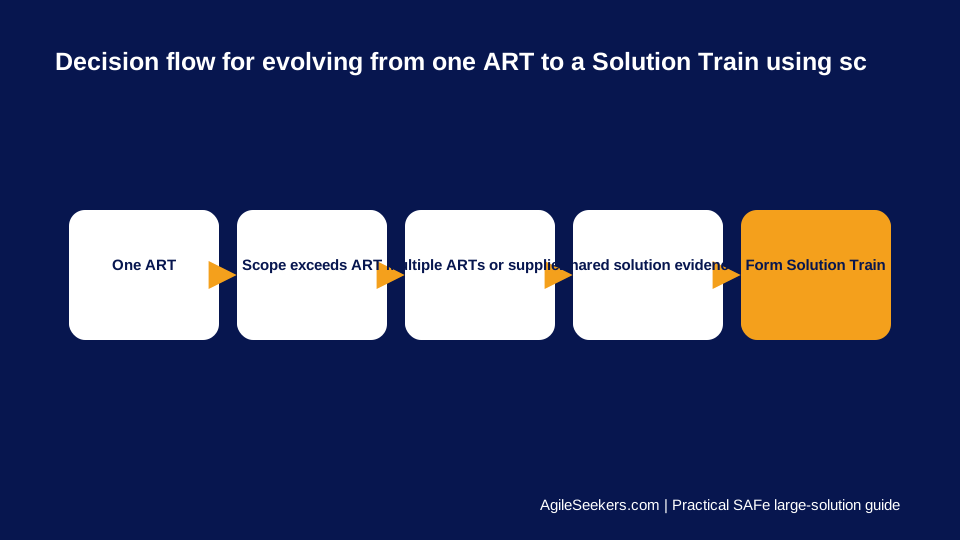
Scale the coordination system only when the solution demands it
A Solution Train coordinates multiple ARTs and suppliers building one large solution. Adding it because headcount grew or leaders want another reporting level creates overhead without solving a system constraint. Evidence should show that one ART cannot contain the required skills, capacity, solution scope, supplier contributions, or acceptable failure risk.
Readiness evidence before restructuring
| Signal | Question |
|---|---|
| Solution boundary | Is there one integrated customer or mission outcome? |
| ART design | Can each ART own a coherent portion of value? |
| Dependencies | Are cross-ART interactions persistent and consequential? |
| Integration | Can the solution produce objective evidence frequently? |
| Leadership | Are Solution Management, architecture and STE accountabilities real? |
| Backlog | Can capabilities and enablers flow before teams wait? |
Run a bounded forming period
Create the Solution Vision, initial backlog, roadmap, role triad, integration approach, and supplier cadence. Test Pre-Plan, Solution Train Sync, and Solution Demo against live work. Remove ceremonies that do not change a decision. A mature ART should not lose autonomy merely because a coordinating construct exists.
Decision check after the first PI
- Did dependency and decision age fall?
- Did integrated evidence arrive earlier?
- Can ARTs still release independently where appropriate?
- Did suppliers receive clearer interfaces and feedback?
- Which coordination problem remained structural?
SAFe RTE certification training develops train-level facilitation foundations. Leading SAFe training supports leaders organizing around value and setting decision boundaries.