
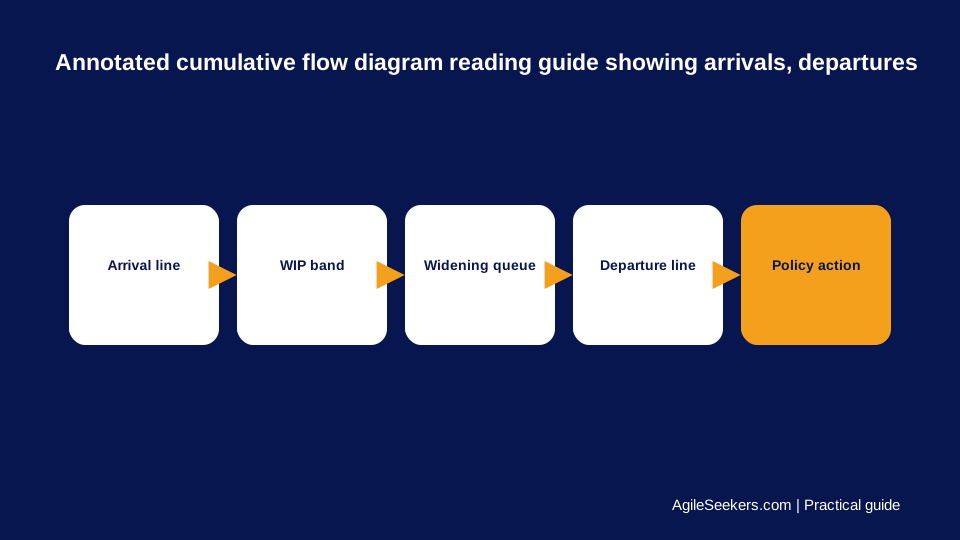
A Cumulative Flow Diagram shows the cumulative number of work items in each workflow state over time. The vertical distance between boundaries represents Work in Process; the horizontal distance approximates elapsed time for a chosen item. The slope of the completion boundary represents throughput.
Read the CFD in a fixed sequence
- Confirm the time window, item type, and workflow states.
- Check whether arrival and departure slopes are broadly balanced.
- Look for a band that widens over time.
- Inspect blocked and ageing items inside that state.
- Connect the pattern to a policy, capacity, dependency, or quality condition.
Translate common CFD shapes into questions
| Pattern | Question |
|---|---|
| One band widens | Is downstream capacity, policy, or quality constraining flow? |
| All bands widen | Is demand exceeding system capability? |
| Sharp vertical jump | Did scope, migration, or data policy change? |
| Flat completion line | Is delivery blocked or completion data missing? |
| Bands narrow suddenly | Was work completed, cancelled, or reclassified? |
Avoid diagnosing from the picture alone
A CFD shows where to investigate, not why the condition exists. Pair it with work-item ageing, blocked reasons, service demand, quality evidence, and conversations at the Gemba. Use lead and cycle time boundaries and Little's Law to keep the measures consistent.
Actions that respect the system
- Stop starting and help finish at the constrained state.
- Reduce batch size or split work earlier.
- Clarify entry and exit policies.
- Improve a shared service or automation path.
- Change replenishment when demand overwhelms capacity.
Kanban System Design training teaches visualization and system design. Kanban Systems Improvement training develops deeper analysis of delay, variability, and connected systems.
Large organizations often struggle with one simple question: Where is work really getting stuck? Teams may track velocity, completion rates, or sprint goals, yet leaders still lack a clear picture of how work moves through the system. Delivery delays appear suddenly, priorities shift, and leaders respond with more meetings, more reporting, or more pressure.
None of those actions solve the underlying issue. The real problem is visibility. When organizations cannot see how work flows, they cannot make good decisions about capacity, priorities, or investments.
This is where Cumulative Flow Diagrams (CFDs) become extremely useful. A CFD shows how work moves through a workflow over time. It highlights bottlenecks, queue buildup, flow stability, and delivery patterns in a way that simple metrics cannot.
Teams often use CFDs to monitor sprint or Kanban progress. However, their real power appears when leaders apply them to enterprise decision making. When used correctly, CFDs reveal how value moves across Agile Release Trains, portfolios, and product organizations.
Examine how cumulative flow diagrams work and how enterprises can use them to make smarter delivery decisions.
Understanding the Basics of a Cumulative Flow Diagram
A cumulative flow diagram visualizes work items as they move across different workflow stages. Each stage appears as a colored band on the chart. Over time, the chart expands horizontally as new work enters the system and vertically as work accumulates.
The typical workflow stages include:
- Backlog
- Ready
- In Progress
- Review or Testing
- Done
Each band represents the number of items in that stage at any given time. When work flows smoothly, the bands remain relatively parallel. When problems appear, the diagram quickly reveals them.
A widening band often signals queue buildup. A sudden spike in backlog may indicate unrealistic intake. A narrow delivery band suggests that teams are struggling to finish work.
These signals make CFDs extremely valuable for leaders responsible for large-scale delivery environments. Frameworks such as Scaled Agile Framework (SAFe) emphasize transparency and flow metrics for exactly this reason.
Why Enterprises Need Flow Visibility
Most organizations focus heavily on output metrics. They count story points, completed features, or sprint commitments. While those numbers provide some insight, they rarely explain why delivery slows down.
Enterprise environments add even more complexity. Multiple teams work on shared components. Dependencies span across departments. Strategic initiatives compete for limited capacity.
Without flow visibility, leaders make decisions based on assumptions rather than data.
Cumulative flow diagrams change that situation. They expose patterns that remain invisible in traditional reporting. For example:
- Hidden queues between teams
- Growing work-in-progress across value streams
- Testing or integration bottlenecks
- Priority overload in product management
These insights allow leaders to address system problems instead of blaming teams.
Reading a Cumulative Flow Diagram Correctly
Many organizations generate CFDs automatically through tools such as Jira or Azure DevOps. Unfortunately, they rarely interpret them correctly.
A few simple principles make the diagram far more useful.
1. Band Thickness Shows Work in Progress
The vertical distance between two stages represents how many items exist in that workflow state.
If the “In Progress” band keeps expanding, teams are starting too much work at once. This increases context switching and slows delivery.
2. Parallel Bands Indicate Stable Flow
When workflow stages remain parallel over time, work moves smoothly through the system. Stable flow means teams complete items at a consistent pace.
3. Widening Bands Reveal Bottlenecks
If one stage begins expanding faster than others, work is piling up. This often signals capacity issues, dependency delays, or review bottlenecks.
4. Delivery Slope Shows Throughput
The slope of the “Done” line shows how quickly teams deliver value. A steady slope indicates reliable throughput. A flat line means delivery has stalled.
These simple observations already give leaders far more insight than many traditional reports.
How CFDs Support Enterprise Decision Making
At scale, Agile organizations make decisions across several layers:
- Team level
- Program or ART level
- Portfolio level
Cumulative flow diagrams provide valuable insight at each layer.
Improving Work Intake Decisions
Many organizations overload their delivery systems without realizing it. New initiatives enter the pipeline faster than teams can complete them.
A CFD quickly exposes this behavior. When the backlog band grows continuously, it signals that leadership is introducing work faster than the system can handle.
Instead of pushing teams harder, leaders should limit new work intake until delivery stabilizes.
Leaders trained through Leading SAFe agilist certification often use flow metrics like CFDs to balance strategic demand with available capacity.
Detecting System Bottlenecks
Enterprises rarely fail because teams lack effort. More often, the system itself creates bottlenecks.
Common bottlenecks include:
- Shared architecture teams
- Integration environments
- Testing capacity
- Approval or compliance processes
CFDs reveal these constraints clearly. When work piles up in a particular stage, leaders can focus improvement efforts on the true constraint.
This aligns closely with principles from the Deming System of Profound Knowledge, which emphasizes improving systems rather than blaming individuals.
Supporting Product Prioritization
Product managers often struggle to balance competing demands from stakeholders. Without data, prioritization conversations quickly become political.
A CFD introduces objective evidence. If the diagram shows excessive work in progress or slow completion rates, product leaders can explain why adding more features may delay delivery.
Professionals who complete the SAFe POPM certification learn how flow metrics support better backlog and feature prioritization decisions.
Managing Agile Release Train Capacity
In large SAFe environments, Agile Release Trains (ARTs) coordinate work across multiple teams. Capacity planning becomes difficult when dependencies exist between teams.
CFDs provide a high-level view of work movement across the train. Leaders can quickly see whether features move smoothly or stall between stages.
Release Train Engineers often use these insights to improve cross-team coordination. Many RTEs deepen these skills through the SAFe Release Train Engineer certification.
Improving Scrum Team Flow
Scrum teams benefit from CFDs as well. While Scrum focuses on sprint goals and increments, cumulative flow diagrams reveal long-term patterns.
Scrum Masters can detect issues such as:
- Unstable sprint commitments
- Work starting late in the sprint
- Testing delays
- Overloaded teams
These insights help teams refine their workflow and improve delivery predictability. Scrum Masters who build strong flow awareness often pursue deeper learning through SAFe Scrum Master certification.
Using CFDs During Portfolio Reviews
Portfolio leaders often review investment progress through status reports or milestone tracking. Those reports rarely reveal system-level issues.
Introducing CFDs into portfolio reviews changes the conversation.
Instead of asking teams for updates, leaders analyze the system itself. They look for patterns such as:
- Increasing work in progress across value streams
- Long waiting times between development stages
- Slow delivery trends across ARTs
This perspective helps leadership shift from managing tasks to managing flow.
Connecting CFDs with Flow Metrics
A cumulative flow diagram becomes even more powerful when combined with other flow metrics.
These include:
- Lead Time – time from idea to delivery
- Cycle Time – time from start of work to completion
- Throughput – number of items completed over time
- Work in Progress – total active items
Together, these metrics provide a complete picture of delivery performance.
For example, if throughput drops while work in progress increases, the system likely suffers from overload or bottlenecks.
Advanced Scrum practitioners who explore these metrics often expand their skills through the SAFe Advanced Scrum Master training.
Common Mistakes When Using CFDs
Although CFDs provide strong insights, organizations sometimes misuse them. A few common mistakes appear frequently.
Tracking Too Many Workflow States
Complex workflows create confusing diagrams. Keep stages simple and meaningful. Focus on major delivery steps rather than minor activities.
Ignoring WIP Limits
A CFD may reveal overload, but if teams ignore WIP limits, the problem continues. Flow improves only when teams actively control work intake.
Using CFDs Only for Reporting
Some organizations treat the diagram as a dashboard rather than a decision tool. The real value appears when leaders use the insights to change policies and processes.
Introducing CFDs Across the Enterprise
Enterprises should introduce cumulative flow diagrams gradually. Start with team-level workflows and expand visibility across value streams.
Steps to begin include:
- Define clear workflow stages
- Ensure teams update work item states consistently
- Generate CFDs using delivery tools
- Review diagrams regularly during retrospectives and leadership reviews
Once teams become comfortable interpreting CFDs, organizations can use them during PI planning, Inspect and Adapt events, and portfolio reviews.
The Strategic Value of Flow Transparency
When leaders see how work truly moves through the system, decision quality improves dramatically.
They stop asking:
- Why are teams slow?
Instead, they ask:
- Where does work wait?
- Which constraints limit delivery?
- How much work should enter the system?
This shift in thinking transforms enterprise agility.
Cumulative flow diagrams provide the visibility needed to support that shift. They connect operational data with strategic decision making.
Conclusion
Large organizations often struggle with delivery transparency. Teams work hard, yet progress appears unpredictable. Leaders respond with more reporting, more tracking, and more oversight.
Those actions rarely solve the real problem.
The real challenge lies in understanding how work flows through the system.
Cumulative flow diagrams offer a clear window into that flow. They reveal bottlenecks, overload, delivery trends, and system constraints that traditional reports often hide.
When enterprises use CFDs effectively, leadership conversations shift from blame to improvement. Decisions become data-driven. Capacity planning becomes realistic. Strategic initiatives move with greater predictability.
For organizations adopting large-scale Agile practices, mastering flow visibility is essential. And cumulative flow diagrams remain one of the most powerful tools for achieving that clarity.
Also read - Flow Stability vs Flow Speed: What Matters More
Also see - Measuring Cross-Team Flow Health