Many Agile teams focus heavily on speed. They measure how quickly they deliver features, how many stories they complete in a sprint, or how many items move through the system each week. Speed feels like progress. When work moves faster, leaders assume value reaches customers sooner.
But speed alone rarely tells the full story. Teams can deliver quickly for a short period and still struggle with delays, unpredictable outcomes, and inconsistent delivery later. What often matters more is stability in the flow of work.
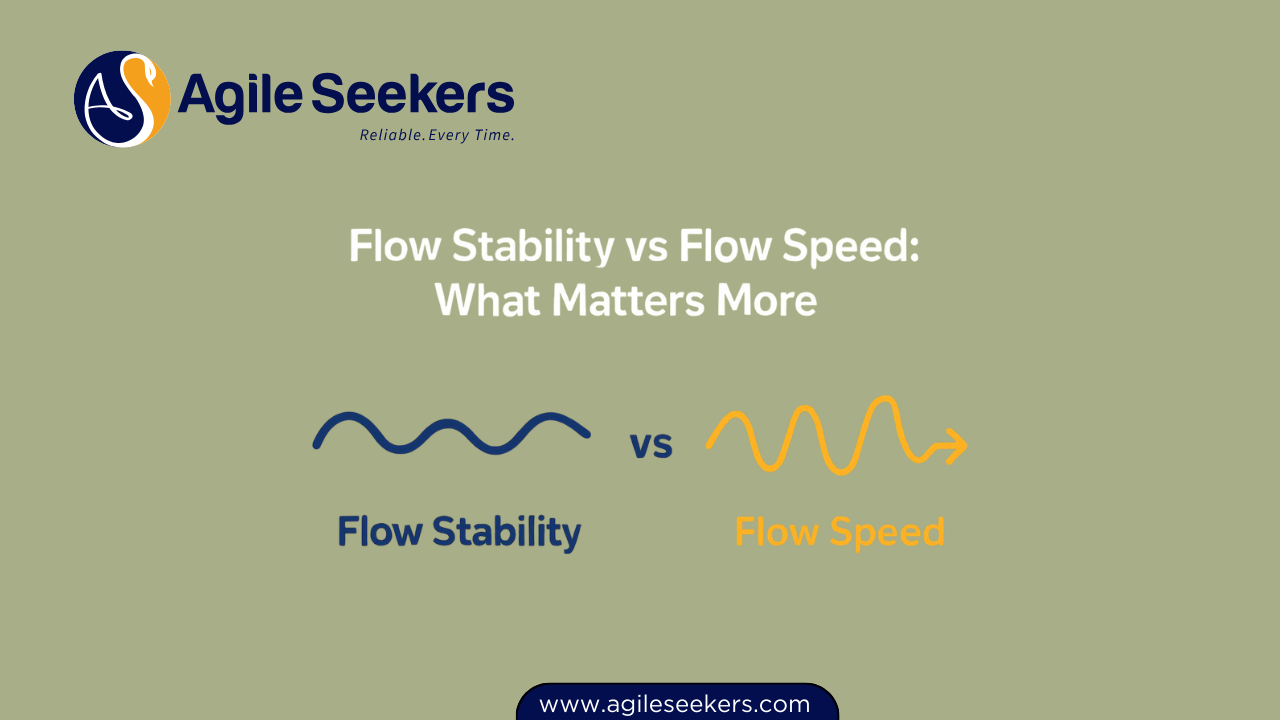
Flow stability means work moves through the system in a consistent, predictable manner. Teams avoid sudden spikes in workload, frequent bottlenecks, or unpredictable delays. When flow becomes stable, organizations can forecast delivery more accurately and maintain a sustainable pace.
This leads to an important question: Should organizations prioritize flow speed or flow stability?
The answer is not always obvious. Both matter. However, stable flow often creates the foundation that allows speed to emerge naturally.
Understanding Flow in Agile Systems
Flow describes how work items move from idea to delivery. In Agile and Lean systems, teams aim to move work smoothly through stages such as backlog refinement, development, testing, and release.
Flow metrics help teams understand how work behaves inside the system. Common flow indicators include:
- Lead Time
- Cycle Time
- Throughput
- Work in Progress (WIP)
- Flow Efficiency
Organizations that scale Agile practices often analyze these metrics across multiple teams and value streams. Frameworks such as SAFe emphasize flow as a critical indicator of delivery performance.
Leaders who complete a Leading SAFe training often learn how flow metrics reveal system-wide delivery challenges that traditional productivity metrics miss.
What Is Flow Speed?
Flow speed refers to how quickly work moves through the system.
Teams often try to improve speed by:
- Reducing cycle time
- Increasing throughput
- Accelerating feature delivery
- Automating development and testing
Speed can produce visible short-term results. Features ship faster. Stakeholders see more activity. Delivery metrics improve.
However, speed without control can create new problems.
When teams push for speed alone, they may:
- Start too many items simultaneously
- Overload testing environments
- Create technical debt
- Cause unpredictable release schedules
Work begins moving quickly but then stalls in queues or bottlenecks. This creates uneven delivery patterns that confuse stakeholders and reduce trust.
What Is Flow Stability?
Flow stability refers to consistency in the movement of work through the system.
Instead of focusing only on how fast work moves, stability focuses on how predictably work flows.
Stable flow systems usually show these characteristics:
- Work enters the system at a manageable rate
- Teams limit work in progress
- Bottlenecks are identified early
- Work items complete at a consistent pace
Stable systems produce smoother delivery patterns. Stakeholders can forecast outcomes more accurately because work behaves in a predictable way.
Product leaders trained through a SAFe Product Owner Product Manager certification often focus on maintaining balanced flow across features, capabilities, and enablers to protect stability.
Why Teams Often Chase Speed First
Speed is easier to observe than stability.
Executives often ask questions like:
- How quickly can we deliver this feature?
- How many stories did the team finish?
- How fast can we release the next version?
These questions naturally drive organizations toward speed optimization.
But speed improvements rarely last if the underlying flow remains unstable.
Imagine a highway system. If traffic flows smoothly, vehicles move efficiently. But if cars constantly accelerate and brake due to congestion, overall travel time increases even when some drivers briefly move faster.
The same pattern appears in software delivery systems.
The Hidden Cost of Unstable Flow
Unstable systems produce several hidden costs.
1. Bottlenecks Become Frequent
When work enters the system faster than teams can process it, queues form. Development might complete quickly, but testing becomes overloaded. Or features reach release readiness while deployment teams struggle to keep up.
This creates unpredictable delivery patterns.
2. Context Switching Increases
When too many items enter the system, teams shift attention constantly between tasks. Context switching reduces focus and slows actual progress.
Studies discussed by Scrum.org frequently highlight how multitasking reduces productivity in Agile teams.
3. Forecasting Becomes Difficult
Unstable systems produce irregular throughput. One sprint delivers many features while the next produces very few.
Stakeholders struggle to plan because delivery outcomes fluctuate unpredictably.
4. Technical Debt Accumulates
Teams rushing to maintain speed may compromise quality. Over time, technical debt slows future development and introduces additional instability.
Why Stability Creates Sustainable Speed
Here is the interesting part: when teams stabilize flow, speed usually improves naturally.
Stable systems reduce friction inside the delivery pipeline.
Work moves forward without interruptions. Bottlenecks appear earlier and can be addressed before they cause delays.
Several practices help achieve this balance.
Limit Work in Progress
WIP limits prevent teams from starting too many items simultaneously. By finishing existing work before starting new work, teams maintain steady progress.
Visualize the Flow of Work
Kanban boards and value stream maps allow teams to see where work accumulates. Visualization helps teams detect system constraints quickly.
Balance Demand and Capacity
Stable systems avoid sudden spikes in incoming work. Instead, teams manage backlog intake carefully to align with available capacity.
Scrum Masters trained through a SAFe Scrum Master certification often guide teams in maintaining this balance.
The Role of Flow Metrics
Flow metrics help teams measure both stability and speed.
Important indicators include:
- Flow Time – how long work takes from start to finish
- Flow Velocity – how many items complete within a period
- Flow Load – how much work is currently in progress
- Flow Distribution – the mix of work types delivered
Tracking these indicators allows organizations to detect early warning signs of instability.
For example, increasing WIP combined with longer cycle times often signals that teams are pushing for speed while the system cannot sustain the demand.
Scaling Flow Across Agile Release Trains
When organizations operate multiple Agile teams, maintaining stable flow becomes more complex.
Dependencies between teams can introduce delays. Shared services may become bottlenecks. Architecture constraints may slow delivery.
Release Train Engineers play an important role in identifying and removing these systemic obstacles. Professionals who complete a SAFe Release Train Engineer certification training learn how to monitor ART-level flow and coordinate improvements across teams.
Stable flow across an Agile Release Train ensures that features move predictably from backlog to production.
Advanced Flow Leadership
Improving flow stability requires leadership beyond individual teams.
Organizations must address structural factors such as:
- Dependency management
- Architecture constraints
- Resource allocation
- Portfolio prioritization
Advanced Scrum Masters often move beyond ceremony facilitation and begin focusing on system-level flow optimization. Those pursuing a SAFe Advanced Scrum Master certification training learn techniques for improving flow stability across multiple teams.
When Speed Still Matters
Stability should not eliminate the pursuit of speed.
Organizations must still reduce delays and improve delivery efficiency.
Speed improvements become effective when they address real system constraints.
Examples include:
- Automating testing pipelines
- Reducing handoffs between teams
- Improving backlog clarity
- Reducing dependency complexity
These improvements increase speed without destabilizing the system.
Balancing Stability and Speed
Healthy Agile systems balance both elements.
Think of stability as the foundation and speed as the outcome.
When work enters the system at the right pace, teams maintain focus, bottlenecks remain manageable, and delivery becomes predictable. Once stability emerges, speed improvements become easier and more sustainable.
Organizations that ignore stability often experience cycles of rapid acceleration followed by sudden slowdowns.
Organizations that stabilize flow first tend to maintain consistent delivery over long periods.
Practical Steps to Improve Flow Stability
Teams can take several practical actions to strengthen stability.
Start Measuring Flow
Many teams track velocity but ignore system-level flow indicators. Measuring cycle time, WIP, and throughput reveals hidden constraints.
Reduce Batch Sizes
Smaller work items move more smoothly through the system and reduce risk.
Address Bottlenecks Early
When a stage consistently delays work, investigate root causes. Bottlenecks often indicate capacity or process constraints.
Encourage Cross-Functional Collaboration
Cross-functional teams reduce handoffs and improve flow continuity.
Align Portfolio and Team Capacity
Leadership must avoid introducing more work than teams can realistically deliver.
Final Thoughts
The debate between flow speed and flow stability often leads organizations in the wrong direction.
Speed alone can create fragile delivery systems. Teams may appear productive for short periods but struggle with unpredictable outcomes.
Flow stability provides the conditions that allow sustainable speed to emerge.
When work moves through the system consistently, teams maintain focus, stakeholders gain confidence in delivery forecasts, and organizations improve their ability to respond to change.
For Agile leaders, the real goal is not simply faster delivery. The goal is reliable, predictable, and continuous value delivery.
That outcome becomes possible when flow stability and speed work together within a well-designed Agile system.
Also read - Why Improving Throughput Alone Doesn’t Improve Value
Also see - Using Cumulative Flow Diagrams for Enterprise Decisions