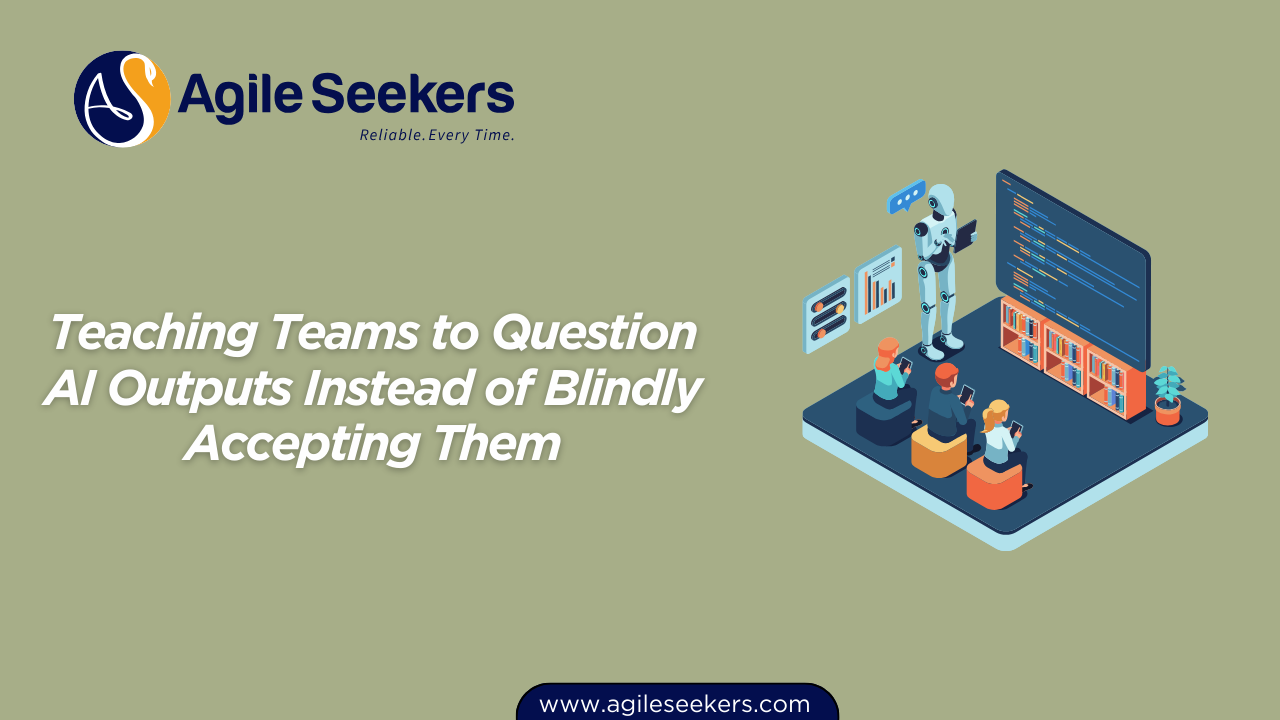
AI tools now sit inside daily workflows. Teams use them to draft user stories, summarize PI objectives, generate test cases, estimate effort, and even suggest architectural decisions. The speed feels impressive. The confidence they project feels convincing. That’s exactly where the risk begins.
If teams treat AI outputs as final answers instead of starting points, they weaken critical thinking, reduce accountability, and introduce hidden errors into delivery. Teaching teams to question AI outputs is not about slowing innovation. It is about protecting quality, flow, and business outcomes.
This article breaks down why blind acceptance is dangerous, how AI errors actually show up in Agile environments, and what leaders can do to build disciplined, thoughtful AI usage across teams.
Why Blind Trust in AI Is Dangerous for Agile Teams
AI tools generate responses based on patterns, not understanding. They do not grasp context the way experienced practitioners do. They do not feel ownership of business impact. They do not carry accountability for release failures.
When a team accepts AI output without challenge, three problems surface:
- False confidence: Clean language hides flawed logic.
- Context blindness: AI may miss domain-specific constraints.
- Reduced team thinking: Discussion drops because “the tool already answered it.”
In a SAFe environment, this becomes more serious. AI-generated feature descriptions, WSJF calculations, or risk assessments can influence multiple Agile Release Trains. A small mistake scales quickly.
Scaled Agile Framework (SAFe) emphasizes alignment, transparency, and built-in quality. None of these principles support unquestioned automation.
Common Places Where Teams Overtrust AI
1. Backlog Creation
AI drafts user stories in seconds. But does it understand regulatory constraints? Performance expectations? Integration details? Usually not.
2. Estimation
AI can suggest story points based on description length or complexity signals. That does not replace team-based relative estimation and shared understanding.
3. Risk Identification
AI produces risk lists that look complete. Yet it may miss organization-specific political risks or architectural dependencies.
4. Architecture Suggestions
Large language models can recommend patterns. They cannot evaluate your existing legacy constraints without deep, structured context.
Blind acceptance in these areas leads to delivery drift. The plan looks strong. Execution tells another story.
The Real Issue: Cognitive Offloading
Here’s the thing. The risk is not bad AI output. The risk is reduced human thinking.
When teams stop debating backlog clarity because AI “already refined it,” collaboration weakens. When Product Owners stop validating assumptions because AI “analyzed the market,” discovery quality drops.
AI should reduce mechanical work, not replace reasoning.
This is especially important for professionals pursuing Leading SAFe training, where systems thinking and economic decision-making sit of enterprise agility.
How AI Hallucinations Actually Appear in Agile Delivery
AI hallucinations are not always dramatic. They often look subtle:
- Incorrect acceptance criteria hidden in fluent language
- Misapplied domain terminology
- Invented statistics
- Outdated framework practices presented as current guidance
According to research published by Nature, large language models can produce confident but factually incorrect outputs when context gaps exist. That pattern shows up in Agile teams when prompts lack business depth.
In enterprise settings, even a small hallucination can affect release planning, stakeholder alignment, or compliance documentation.
Building a Culture of Constructive Skepticism
Teaching teams to question AI does not mean rejecting it. It means introducing structured skepticism.
1. Make AI Output a Draft, Not a Decision
Establish a rule: AI-generated content must be reviewed collaboratively before acceptance. Whether it’s backlog refinement or architectural documentation, treat it as a first draft.
2. Add a “Challenge Round” in Refinement
During backlog refinement, assign one team member to challenge assumptions in AI-generated stories. Ask:
- What might this miss?
- What constraints are not visible here?
- Does this align with our architectural runway?
This strengthens thinking instead of suppressing it.
3. Separate AI Speed From Business Judgment
AI accelerates drafting. Humans own prioritization and trade-offs. That distinction must stay clear.
Professionals pursuing SAFe POPM certification already understand that prioritization demands economic reasoning, not automated ranking alone.
Practical Training Exercises to Build Critical AI Use
Exercise 1: AI Output Review Workshop
Give teams a backlog generated by AI. Ask them to:
- Identify unclear assumptions
- Spot missing non-functional requirements
- Rewrite acceptance criteria
Compare original output with improved version. The gap becomes visible.
Exercise 2: Prompt Engineering Transparency
Show how weak prompts create weak output. Then refine prompts with business context and constraints. Teams learn that input quality shapes output reliability.
Exercise 3: AI Risk Mapping
Ask teams to list where AI mistakes would hurt most: compliance, performance, integration, customer trust. This increases ownership.
Scrum Masters trained through SAFe Scrum Master certification can facilitate these workshops effectively, ensuring learning without blame.
Leadership’s Role in Preventing Blind Acceptance
If leadership celebrates AI speed without measuring outcome quality, teams will prioritize speed over thinking.
Leaders must:
- Reward thoughtful review, not just output volume
- Encourage questioning during PI planning
- Model critical evaluation in executive reviews
Release Train Engineers who complete SAFe Release Train Engineer certification play a key role here. They influence ART-level conversations and ensure alignment discussions do not skip necessary scrutiny.
Embedding AI Questioning Into PI Planning
During PI Planning, AI tools may help generate dependency maps or draft objectives. That’s fine. But teams must validate:
- Are dependencies technically accurate?
- Are objectives realistic given capacity?
- Do business outcomes align with strategic themes?
Blindly trusting AI-created dependency boards could create cascading risks across trains.
Advanced facilitators, including those trained via SAFe Advanced Scrum Master certification, should deliberately introduce review checkpoints.
Quality Gates for AI Usage
Organizations can define lightweight quality controls:
- AI-generated backlog items require peer validation.
- Architectural suggestions require architect review.
- Market data generated by AI must include verifiable sources.
- Regulatory documentation requires human compliance check.
These controls protect delivery without slowing innovation.
Balancing Trust and Verification
There is a difference between healthy trust and blind acceptance.
Healthy trust says: “AI is helpful, but we verify.”
Blind acceptance says: “AI sounds confident, so we move forward.”
The second approach leads to silent failure signals that appear later as missed sprint goals, rework, or stakeholder dissatisfaction.
Measuring Whether Teams Are Thinking or Copying
How do you know if teams are over-relying on AI?
- Backlog refinement sessions become shorter and quieter.
- Fewer clarifying questions appear during sprint planning.
- Retrospectives stop discussing requirement quality.
- Story defects increase after development.
These are subtle but measurable signals.
AI as a Thought Partner, Not a Decision Engine
Let’s break it down. AI works best when treated as a thought partner.
- Use it to generate options.
- Use it to summarize data.
- Use it to identify patterns.
Do not use it as the final authority on architecture, compliance, prioritization, or enterprise risk.
Harvard Business Review has repeatedly emphasized that AI adoption succeeds when paired with strong human judgment and governance frameworks. You can explore leadership perspectives at Harvard Business Review.
Shaping an AI-Literate Agile Culture
An AI-literate team does four things consistently:
- Understands how AI generates output.
- Knows its limitations.
- Validates important decisions.
- Maintains accountability for outcomes.
This mindset strengthens enterprise agility rather than weakening it.
Professionals growing through structured learning paths such as Leading SAFe agilist certification develop systems thinking skills that help them evaluate AI decisions within broader portfolio and value stream contexts.
Final Thoughts: Speed Is Not the Goal. Quality Is.
AI will continue to evolve. Tools will become more capable. Outputs will look increasingly polished.
That does not remove the need for questioning.
Strong Agile teams debate assumptions. They challenge unclear requirements. They validate economic impact. AI should enhance that discipline, not replace it.
Teaching teams to question AI outputs is not about resistance. It is about maturity.
Organizations that combine AI acceleration with human judgment will outperform those that trade thinking for convenience.
The goal is simple: faster delivery with stronger reasoning.
And that requires teams who know when to ask, “Is this actually correct?”
Also read - How to Build an AI-Augmented Backlog Refinement Workflow
Also see - How to Use AI to Identify Scope Creep Early in a PI