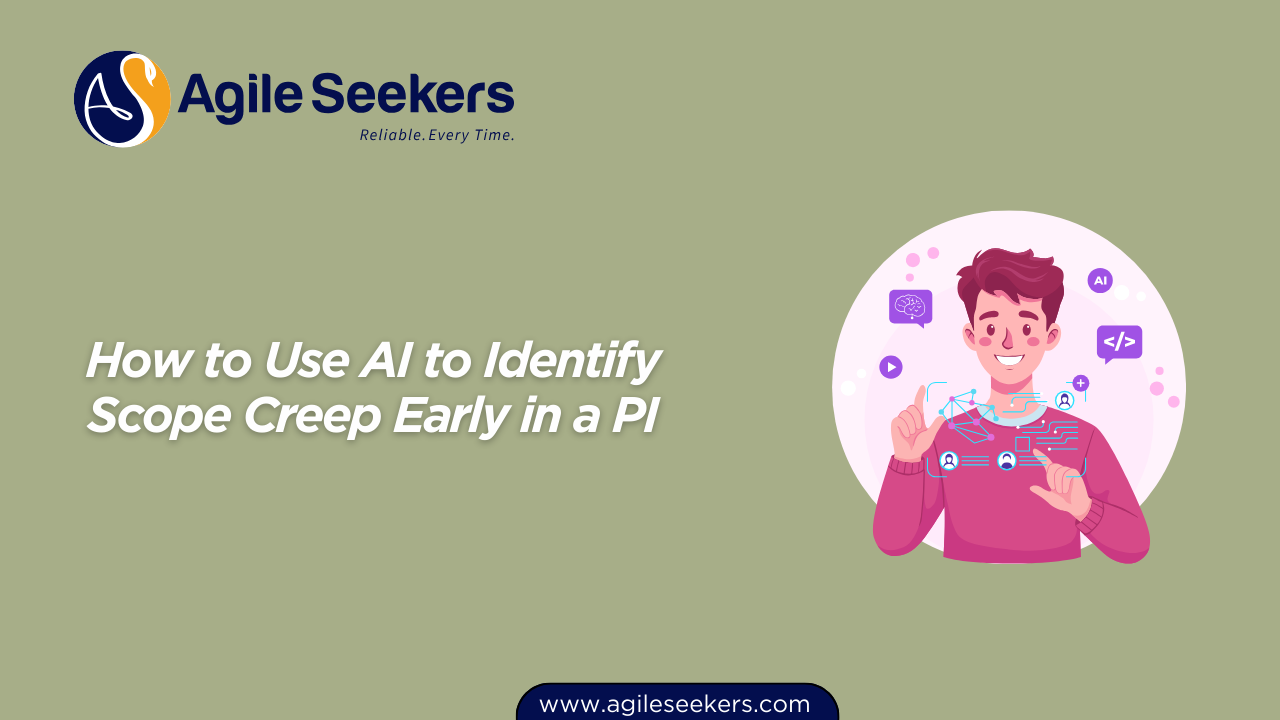
Scope creep rarely announces itself loudly. It starts small. A new feature added “just in case.” A dependency that quietly expands. A stakeholder request that slips into the backlog without a clear trade-off. By the time teams notice, the PI feels overloaded, predictability drops, and objectives blur.
If you work in SAFe, you already know that a Program Increment is built on commitment and alignment. Once that balance shifts, flow suffers. The good news? AI can help you spot scope creep early, before it damages delivery.
Let’s break down how to use AI practically inside a PI to detect early signals, protect focus, and support smarter decisions.
What Scope Creep Really Looks Like in a PI
In SAFe, scope creep is not just about “extra work.” It shows up in patterns:
- Unplanned stories added mid-iteration
- Features expanding beyond original acceptance criteria
- Hidden enablers turning into mini-epics
- Dependencies multiplying after PI Planning
- PI Objectives slowly changing in meaning
According to Scaled Agile’s definition of a Program Increment, a PI should provide alignment, cadence, and synchronization. Scope creep quietly attacks all three.
AI becomes valuable when it monitors change patterns across tools and conversations, not just task counts.
Why Humans Miss Scope Creep Early
Here’s the uncomfortable truth. Most teams see scope creep only after velocity drops or risks escalate.
Why?
- Backlog changes feel incremental
- Stakeholder conversations happen across multiple channels
- Teams normalize “just one more thing” behavior
- Metrics focus on output, not change volatility
Humans are good at reacting. AI is better at spotting patterns across time.
1. Use AI to Track Backlog Volatility
One of the earliest signals of scope creep is backlog churn.
AI can monitor:
- Story additions after PI Planning
- Story resizing trends
- Acceptance criteria changes
- Priority reshuffles
If the system detects that story points increase consistently after Iteration 2, that’s a red flag.
Modern tools like Jira allow AI integrations that analyze historical sprint data. When AI flags a deviation from original PI capacity, you can intervene early.
POPMs trained through SAFe Product Owner Product Manager certification programs already understand backlog discipline. AI simply gives them real-time intelligence.
2. Detect Scope Drift in Feature Descriptions
Scope creep often hides in evolving language.
AI-powered text analysis can compare original feature descriptions from PI Planning with updated versions in the backlog.
For example:
- Original: “Implement payment gateway integration.”
- Updated: “Implement payment gateway integration with fraud analytics, dynamic routing, and reporting dashboard.”
That’s not refinement. That’s expansion.
Natural Language Processing models can track semantic shifts and highlight when feature intent expands beyond agreed boundaries.
This approach aligns well with Lean thinking principles described in Lean-Agile Leadership.
3. Monitor Dependency Growth Using AI Graph Analysis
Dependencies multiply silently.
AI can analyze dependency maps across teams and identify:
- New cross-team links formed after PI Planning
- Increasing wait times between teams
- Rising coordination overhead
When dependency density increases mid-PI, scope usually expands or shifts.
Release Train Engineers trained through SAFe Release Train Engineer certification training can use AI dashboards to detect structural complexity early.
The earlier you see dependency creep, the faster you can re-align ART priorities.
4. Compare Planned vs Actual Capacity in Real Time
Scope creep always affects capacity.
AI can continuously compare:
- Committed story points vs completed points
- Planned PI Objectives vs realized objectives
- Unplanned work percentage per iteration
If unplanned work crosses 15–20% consistently, that’s not noise. That’s scope instability.
Scrum Masters trained via SAFe Scrum Master certification programs can use this AI insight to facilitate fact-based discussions instead of relying on gut feel.
5. Analyze Stakeholder Requests Across Communication Channels
Scope creep often begins outside the backlog.
AI tools can scan:
- Email threads
- Slack or Teams conversations
- Meeting transcripts
- Executive review notes
When new requirements appear repeatedly in stakeholder conversations but aren’t part of original PI scope, AI can flag “emerging scope themes.”
This prevents silent commitments made during informal discussions.
6. Identify Scope Risk Through Flow Metrics
Flow metrics tell the truth when interpreted correctly.
According to SAFe Flow Metrics, you should monitor Flow Load, Flow Time, Flow Efficiency, and Flow Distribution.
AI can detect patterns such as:
- Rising Flow Load without increased capacity
- Increasing Flow Time variability
- More work entering the system than leaving
These patterns signal creeping scope.
Leaders who complete SAFe agile training understand system-level thinking. AI gives them early warnings at scale.
7. Predict PI Objective Risk Before It Becomes Visible
AI models trained on historical PI data can predict which objectives are at risk based on:
- Story spillover trends
- Dependency changes
- Team velocity variability
- Defect injection rates
If the model detects similarity to past failed PIs, it can flag risk in Iteration 2 instead of Iteration 5.
This predictive approach changes the conversation from reactive firefighting to proactive correction.
8. Use AI During Inspect & Adapt to Spot Hidden Scope Drivers
During Inspect & Adapt, most teams analyze symptoms.
AI can help uncover drivers:
- Which teams receive most unplanned requests?
- Which roles introduce the most mid-PI changes?
- Which feature types expand most often?
Advanced practitioners trained through SAFe Advanced Scrum Master certification training can use this intelligence to coach systemic improvement instead of surface fixes.
9. Combine WSJF Analysis with AI Scenario Modeling
Weighted Shortest Job First (WSJF) helps prioritize work. But when scope changes mid-PI, WSJF assumptions often shift.
AI can simulate:
- What happens if we accept this new feature?
- How does it affect Cost of Delay distribution?
- What objectives lose focus?
This creates evidence-based conversations instead of emotional decisions.
10. Create a “Scope Stability Index” Dashboard
One powerful approach is to build an AI-driven Scope Stability Index combining:
- Backlog churn rate
- Dependency growth rate
- Unplanned work percentage
- Feature description volatility
- Flow variability
When the index crosses a threshold, leadership intervenes early.
This index becomes as important as predictability metrics.
Practical Implementation Roadmap
Step 1: Integrate Data Sources
Connect Jira, Azure DevOps, communication tools, and PI Planning artifacts.
Step 2: Define Baselines
Use previous PIs to establish normal churn and variability ranges.
Step 3: Train AI Models
Use historical success and failure data.
Step 4: Build Real-Time Alerts
Focus on deviation, not raw numbers.
Step 5: Embed in Cadence
Review scope stability during ART Sync and Iteration Reviews.
Common Mistakes When Using AI for Scope Control
- Using AI only for reporting, not decision-making
- Overreacting to small fluctuations
- Ignoring human context
- Tracking too many metrics
AI supports judgment. It does not replace it.
Why This Matters for SAFe Practitioners
Scope creep weakens predictability. Predictability affects trust. Trust shapes enterprise agility.
When you combine disciplined SAFe roles with AI-driven visibility, you create a stronger feedback loop.
Scrum Masters detect iteration instability faster.
POPMs protect feature intent.
RTEs manage systemic complexity.
Leaders preserve strategic alignment.
Final Thoughts
Scope creep is rarely dramatic. It’s gradual. Quiet. Almost polite.
AI changes that dynamic. It shines light on patterns humans normalize.
If you treat AI as a continuous monitoring partner inside your PI cadence, you reduce surprises, improve predictability, and protect focus.
The goal isn’t rigid control. It’s informed flexibility.
That’s how you keep your PI aligned without losing adaptability.
Also read - Teaching Teams to Question AI Outputs Instead of Blindly Accepting Them
Also see - AI Prompts Every SAFe POPM Should Master