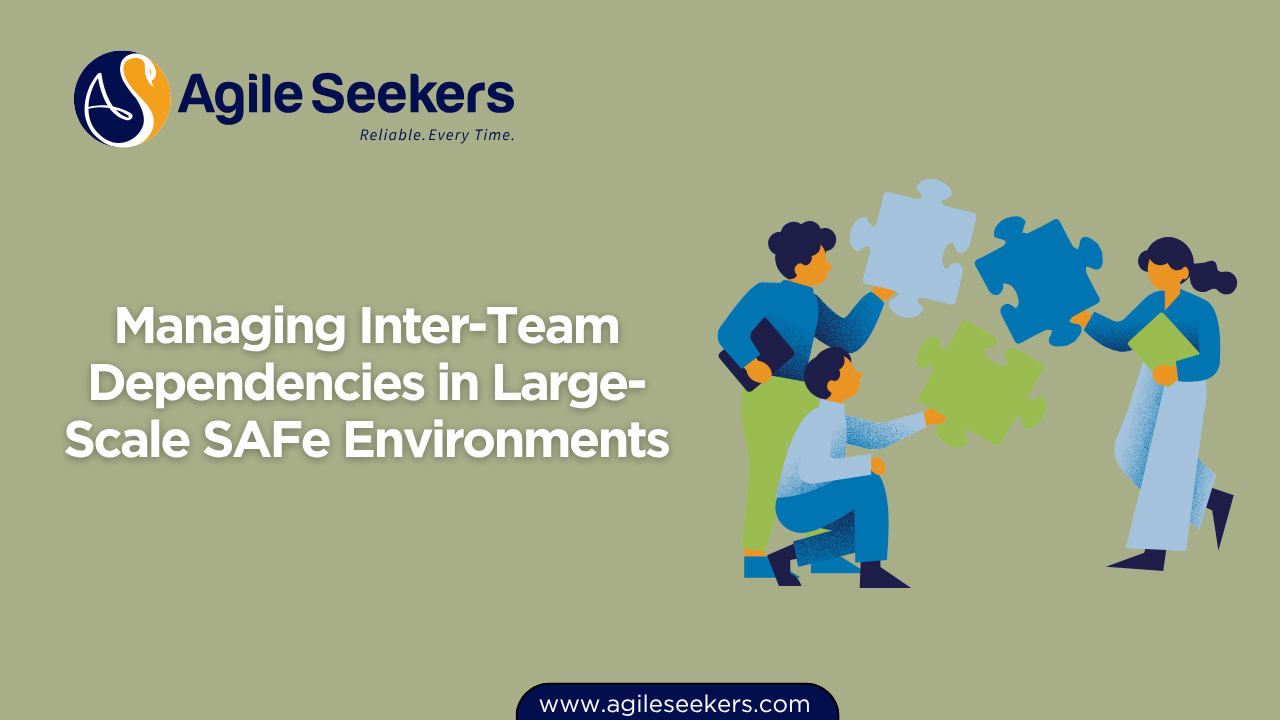
In large-scale SAFe (Scaled Agile Framework) environments, managing inter-team dependencies is one of the key challenges for organizations aiming to achieve business agility. With multiple Agile teams working on different aspects of a product or system, dependency management becomes crucial for smooth collaboration, efficient execution, and successful delivery. Without effective management, these dependencies can cause delays, bottlenecks, and misalignments between teams, ultimately hindering the flow of value.
This blog post will examine the proven methods, strategies, and tools for managing inter-team dependencies in large-scale SAFe environments. We will explore the role of various SAFe roles, ceremonies, and artifacts in addressing these dependencies and ensuring smooth coordination among teams.
The Importance of Managing Inter-Team Dependencies in SAFe
Inter-team dependencies arise when one team relies on the work of another team to complete its own tasks. These dependencies can occur at different levels, from technical components and systems integration to shared business objectives and milestones. In a SAFe environment, where Agile Release Trains (ARTs) span multiple teams, these dependencies are more prevalent and complex.
Key challenges include:
-
Delayed delivery: If one team is delayed, it impacts the entire ART.
-
Misalignment: Without effective coordination, teams may diverge from shared goals and objectives.
-
Reduced flow of value: Dependencies that aren't well-managed disrupt the flow of work, slowing down the overall delivery of value.
Efficient management of these dependencies is crucial for enabling a synchronized, predictable, and continuous flow of value across the organization. Examine how SAFe structures and principles help address these challenges.
Key Roles in Managing Dependencies
-
Release Train Engineer (RTE):
The RTE is the servant leader and coach for the ART. One of their primary responsibilities is to ensure that dependencies between teams are identified and managed effectively. They facilitate communication and coordination across teams and help track progress on dependencies during ART ceremonies like Program Increment (PI) Planning. -
Product Owner/Product Manager (PO/PM):
In a SAFe environment, the PO/PM is responsible for aligning teams with customer needs and business goals. They play an important role in managing dependencies at a product level. For example, they ensure that features requiring collaboration between multiple teams are prioritized and that inter-team dependencies are mapped out during PI Planning. -
Scrum Masters:
Scrum Masters work within individual teams to manage dependencies related to sprint-level work. They also help identify external dependencies on other teams and escalate them to the RTE or PO/PM for resolution.
Managing Dependencies in SAFe Ceremonies
-
Program Increment (PI) Planning:
PI Planning is the most critical event in SAFe for managing inter-team dependencies. During this two-day event, teams come together to plan the work for the upcoming increment, identify dependencies, and negotiate commitments.-
Identifying Dependencies: Teams should document all dependencies with other teams, both internal and external, as part of their planning process.
-
Cross-Team Collaboration: If dependencies between teams are identified, the teams involved must collaborate to define clear integration points, timelines, and deliverables. This helps to align the teams' work towards shared objectives and reduces the risk of misalignment.
-
Dependency Boards: Many organizations use visual tools such as dependency boards during PI Planning to make dependencies visible across teams. This ensures that all teams can see and address their interdependencies before work begins.
-
-
Scrum of Scrums:
Scrum of Scrums (SoS) is a key ceremony in SAFe for managing cross-team dependencies. This daily or weekly meeting allows representatives from each team to provide updates on their progress and highlight any dependencies that need attention. This forum also is a space for teams to escalate issues and ask for help in addressing dependencies that could impede progress. -
ART Sync:
The ART Sync, also known as the "System Demo," is held regularly to ensure that all teams are aligned on their progress and objectives. It offers a chance to check whether dependencies are being met, validate integration points, and adjust plans as needed. If any dependency-related issues are identified during this sync, they can be immediately escalated for resolution.
Techniques for Managing Dependencies
-
Cross-Functional Teams:
A proven methods in SAFe is to build cross-functional teams capable of delivering end-to-end features. Cross-functional teams reduce the need for external dependencies, as they can perform all the necessary work within the team. By creating teams with the right mix of skills, organizations can minimize the friction caused by inter-team dependencies and increase the flow of work. -
Feature Teams vs. Component Teams:
A common challenge in large-scale environments is the conflict between feature teams (focused on delivering customer-facing functionality) and component teams (focused on technical aspects or specific components of the system). Ensuring that feature teams have the right skills and resources to independently deliver end-to-end features reduces the need to rely on component teams, thus minimizing inter-team dependencies. -
Dependency Mapping and Tracking:
Using tools and techniques to map and track dependencies is a must in managing inter-team work. Visualizing dependencies using tools like Jira, Confluence, or even a simple dependency board provides clarity and allows teams to manage expectations. Dependency mapping can include:-
Dependency Backlogs: A specific backlog that focuses solely on resolving dependencies.
-
Cross-Team Dependency Mapping: A visual map that displays how teams are interdependent and when deliverables from one team affect others.
-
-
Continuous Integration and Test Automation:
Building a reliable Continuous Integration/Continuous Delivery (CI/CD) pipeline helps reduce dependency-related risks by ensuring that teams can frequently integrate their work into a shared codebase. Automated testing also allows for faster detection of issues related to dependencies, enabling teams to resolve problems earlier in the development cycle. -
Risk Management:
SAFe emphasizes the identification and management of risks throughout the development process. Dependency-related risks, such as late delivery or integration issues, should be identified early during PI Planning and managed as risks. These risks can be tracked, mitigated, and adjusted throughout the iteration cycle to ensure they don't escalate into blockers.
Tools and Practices for Dependency Management
-
Visualizing Dependencies with Dependency Boards:
These boards act as a visual representation of how different teams are interdependent. The boards can be used during PI Planning to track and manage dependencies and are particularly useful for large ARTs where communication can otherwise become fragmented. -
Collaboration Tools (Jira, Confluence, Trello):
Jira, Confluence, and Trello are widely used tools for tracking dependencies in SAFe environments. These tools allow teams to document their dependencies, track them across sprints and releases, and ensure that they are visible to all relevant stakeholders. -
Risk and Issue Logs:
Maintaining a centralized risk and issue log helps teams identify dependencies that may become risks. This log tracks potential delays, misalignments, or other dependency-related issues that may affect the ART's ability to deliver on time.
External Resources and Practices to Consider
-
Agile Release Train (ART) Structure:
To streamline dependency management, many organizations implement a well-defined ART structure, ensuring that ARTs are organized around end-to-end delivery rather than purely functional silos. This reduces the inter-team dependencies that often arise when ARTs operate in isolated ways. -
The SAFe 5.0 Version Update:
The latest updates to SAFe introduce a more focused approach to dependency management, such as the integration of the Solution Train. This addition can help organizations more effectively manage inter-team dependencies, especially in large-scale implementations.
For more on how SAFe helps manage large-scale dependencies, consider exploring the SAFe POPM Certification or Project Management Professional (PMP) training. These certifications offer further insights into how to manage dependencies across complex projects.
Conclusion
Managing inter-team dependencies in large-scale SAFe environments is essential to maintaining flow, avoiding delays, and ensuring alignment across multiple teams. Through effective use of SAFe roles, ceremonies, techniques, and tools, organizations can minimize the impact of these dependencies and improve their overall business agility.
By addressing dependencies early in the process and fostering communication between teams, organizations can deliver value more predictably and consistently. With these proven methods in place, large-scale Agile environments will be better equipped to tackle complexity and stay on track for successful outcomes.
For those looking to advance their understanding of Agile practices, certifications such as PMP Certification or SAFe POPM Certification can provide a structured learning path for mastering these skills.
-
Explore PMP Certification to enhance your project management capabilities.
-
Learn more about SAFe POPM Certification for expertise in managing dependencies across large-scale Agile programs.
Also read - Driving Adoption of CI/CD Practices in the Product Lifecycle
Also see - Coordinating Capabilities Across ARTs Using Solution Trains