A roadmap is an argument, not a calendar
Every roadmap makes claims about customers, technology, economics, capacity, regulation, and timing. A feature placed in the next Planning Interval quietly assumes the need is important, the solution can change the outcome, enabling work is feasible, and the opportunity will still matter when released. Treating those claims as facts creates false certainty. Treating the roadmap as an argument makes the evidence and gaps discussable.
In SAFe, a roadmap communicates anticipated deliverables and milestones over time. It should connect vision and strategy to an evolving sequence without turning a forecast into a promise. The practical move is to attach assumptions to roadmap decisions before confidence hardens around dates.
Build an assumption register beside the roadmap
| Assumption type | Example claim | Useful evidence |
|---|---|---|
| Desirability | Claims reviewers will adopt assisted triage | Interviews, workflow observation, prototype behavior |
| Viability | Faster triage will lower handling cost | Volume, cost model, benefit range |
| Feasibility | The model can meet latency and accuracy limits | Spike, architecture runway, test results |
| Delivery | Two ARTs can integrate before the market event | Dependency evidence, capacity, integration demo |
| External | The regulation will take effect in Q3 | Authoritative update and scenario trigger |
Write each entry as a falsifiable claim. Add an owner, current evidence, confidence level, next test, review date, and the decision that would change. The register is not a second backlog; it is a compact explanation of why the sequence remains credible.
Match uncertainty to the roadmap horizon
Near-term items need stronger feasibility, dependency, and capacity evidence because teams will soon plan them. Mid-horizon items need credible customer and economic evidence but can retain solution options. Long-horizon themes should express outcomes and scenarios, not detailed feature promises. Precision should fall as distance and uncertainty rise.
- Now: identify unresolved conditions that could invalidate a PI commitment.
- Next: fund discovery and enablers that reduce the most expensive uncertainty.
- Later: preserve options and name events that would bring work forward or move it out.
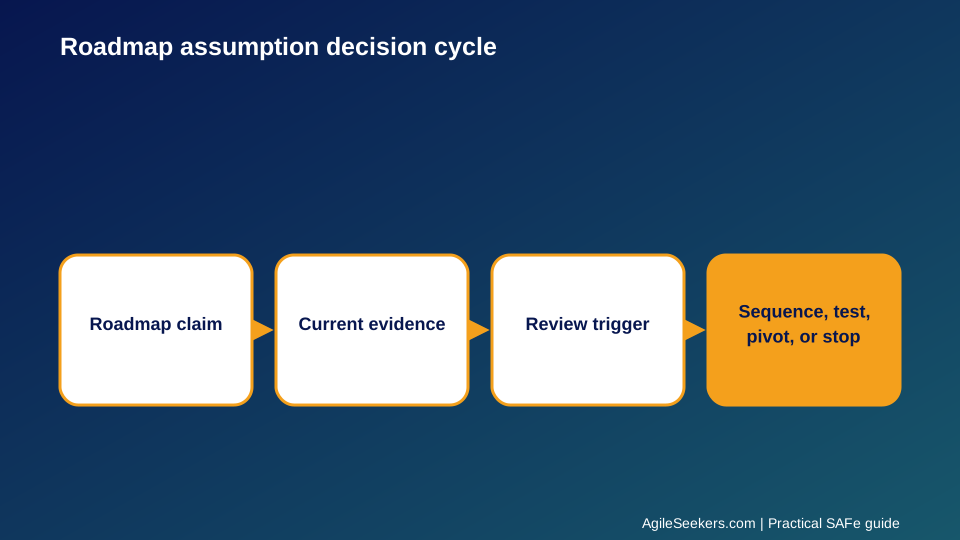
Use triggers instead of ceremonial monthly reviews
A review trigger is an observable condition: conversion remains below a threshold, an interface misses an integration date, a competitor changes the market, or an experiment contradicts the need. Trigger-based reviews make adaptation timely. Calendar reviews still help, but they should ask which evidence changed rather than invite another presentation of the same plan.
When an assumption fails
Do not automatically cancel the initiative or defend sunk cost. Revisit the outcome, separate evidence against the problem from evidence against one solution, and compare options. The appropriate decision may be to pivot, narrow the segment, sequence an enabler, change the milestone, or stop. Record the reasoning so a later roadmap conversation does not revive the same claim without new evidence.
A working session for product leaders
- Choose one multi-PI roadmap item with high value and high uncertainty.
- Ask what must be true across customer, business, technology, delivery, and external conditions.
- Rank assumptions by impact if wrong and weakness of current evidence.
- Design the smallest ethical test for the top assumption.
- Set the evidence threshold, owner, date, and roadmap decision before running the test.
The SAFe POPM certification course helps product roles connect roadmaps, features, and ART backlogs. Leading SAFe training adds the strategy and portfolio perspective needed when assumptions cross funding or governance boundaries.
Roadmap integrity questions
- Which roadmap item depends on the weakest evidence?
- Where does a precise date hide a range?
- Which assumption needs an architectural or compliance voice?
- What new evidence would change sequence, scope, or investment?
- Are teams learning early enough to preserve an alternative?
A trustworthy roadmap is not one that never changes. It is one whose changes can be traced to evidence, economic choices, and explicit learning rather than politics or surprise.