Most transformation problems don’t come from bad strategy. They come from translation.
Leaders define bold strategic themes. Slides look impressive. Roadmaps feel confident. Then work hits the team level and something breaks. Stories feel disconnected. Sprints feel busy but not meaningful. Teams ship features yet stakeholders still ask, “Why aren’t we moving the needle?”
Here’s the thing. Strategy doesn’t fail at the boardroom. It fails between the portfolio slide and the team backlog.
If teams cannot clearly explain how today’s sprint supports a strategic theme, alignment is already lost.
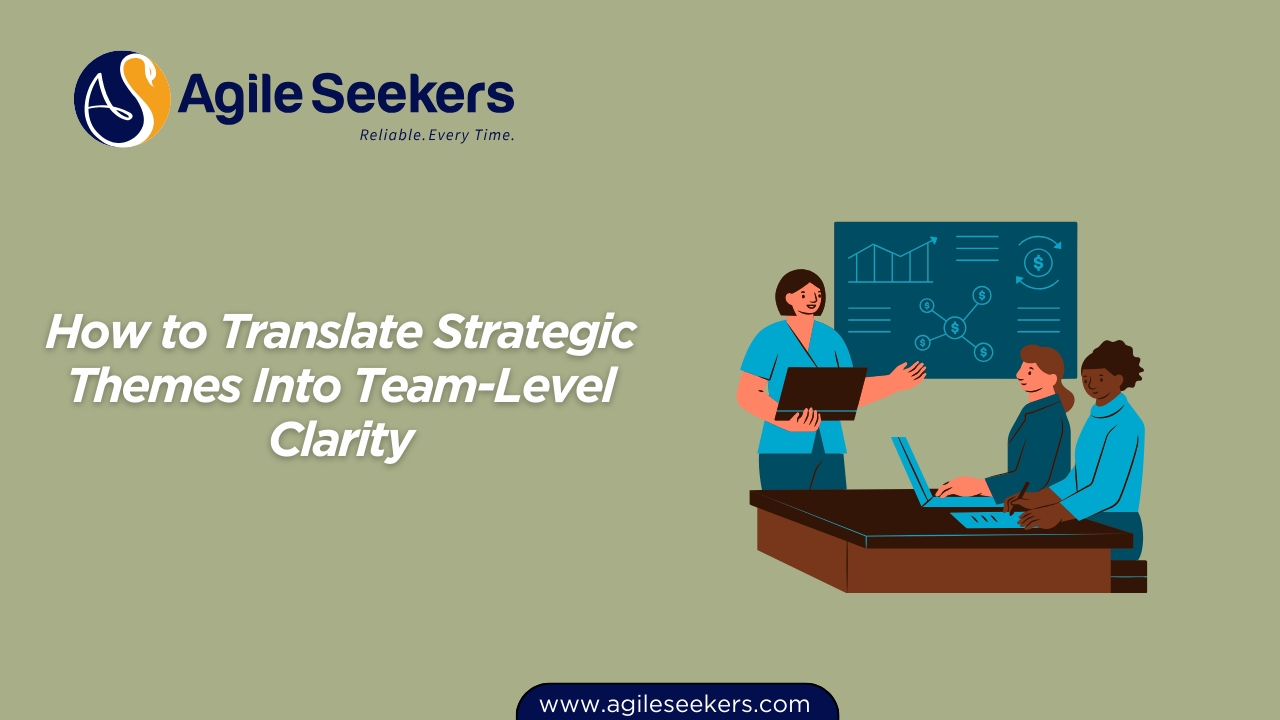
This guide breaks down how to translate strategic themes into language teams can act on. You’ll learn how to move from abstract direction to day-to-day clarity without creating more bureaucracy.
What Strategic Themes Really Mean (and Why Teams Struggle With Them)
Strategic themes describe what the business must achieve. They usually sound like:
- Improve customer retention
- Reduce operational cost
- Accelerate digital onboarding
- Increase platform reliability
All valid. All important. All completely unusable for a Scrum team on Monday morning.
A developer can’t pick up “improve retention” and start coding. A tester can’t verify “increase platform trust.” A team needs something concrete.
So the gap appears:
- Leadership talks outcomes
- Teams work on tasks
- Nobody connects the two consistently
The result is local optimization. Teams deliver tickets. The organization misses outcomes.
Frameworks like the Scaled Agile Framework guidance on strategic themes emphasize that themes must directly influence investment decisions and backlogs. But that influence only happens when you deliberately translate them.
Where Translation Breaks Down
Before fixing the problem, let’s call out the common failure points.
1. Themes stay at leadership level
They live in PowerPoints and never enter planning events.
2. Too many abstraction layers
Theme → Initiative → Program → Feature → Story. By the time it reaches teams, the original intent disappears.
3. No measurable outcomes
If you can’t measure it, teams can’t aim for it.
4. Teams don’t see customer impact
Work feels mechanical instead of meaningful.
Clarity disappears quietly. Nobody notices until delivery feels slow or misaligned.
The Translation Model That Actually Works
Let’s break this down into a simple flow that teams can follow every quarter.
Strategic Theme → Business Outcome → Portfolio Epic → Feature → Story → Sprint Goal
Every level must answer one question: “How does this directly support the theme?”
If the answer isn’t obvious, you’re working on the wrong thing.
Step 1: Convert Themes Into Measurable Outcomes
Start by forcing specificity.
Bad example:
Improve customer experience
Better:
Reduce onboarding time from 5 days to 1 day
Now teams have direction.
Use outcome language:
- Reduce
- Increase
- Improve
- Shorten
- Automate
Attach numbers. Always.
When leaders learn this thinking deeply, programs like SAFe agile certification help them connect strategy, portfolio funding, and execution without guesswork.
Step 2: Break Outcomes Into Clear Epics
Outcomes define the destination. Epics define the big bets.
Example:
- Outcome: Reduce onboarding time to 1 day
- Epic: Self-serve digital onboarding platform
Notice the difference. The epic describes a solution. The outcome describes value.
Teams build solutions. Business measures outcomes.
Keep both visible.
Step 3: Define Features Teams Can Actually Own
Features must be:
- Customer visible
- Small enough for a PI
- Owned by a specific team
If five teams own a feature, nobody owns it.
This is where Product Owners and Product Managers play a critical role. They connect the strategic dots and slice work properly. Skill-building programs like the SAFe POPM certification focus exactly on this translation layer.
Step 4: Write Stories That Express Value, Not Tasks
Teams often slip here.
Weak story:
Update API schema
Better:
As a new user, I can verify identity in 2 minutes so I complete onboarding faster
The second one links directly to the onboarding outcome.
Developers understand purpose. Motivation improves. Decisions get easier.
Step 5: Tie Every Sprint Goal to Strategy
Sprint goals are the final translation layer.
If your sprint goal says:
Complete 32 stories
You’ve lost.
If it says:
Enable same-day onboarding for 30% of new customers
Now the team sees impact.
This shift transforms execution. Sprint goals become mini-strategies, not task lists.
Scrum Masters drive this clarity daily. Many refine these skills through the SAFe Scrum Master certification.
Make Strategy Visible to Teams
Clarity fades when strategy hides in slide decks.
Keep it visible:
- Theme posters on team walls
- Outcome dashboards
- PI objective boards
- Sprint goals mapped to themes
When teams see the “why” every day, decision-making speeds up naturally.
Use PI Planning as the Translation Engine
PI Planning isn’t just scheduling. It’s alignment work.
During planning:
- Start with strategic themes
- Show outcomes first, not features
- Let teams ask “why” repeatedly
- Connect every objective back to a theme
Release Train Engineers often facilitate this system-level clarity. Structured training like the SAFe Release Train Engineer certification training helps them manage these conversations effectively.
A Simple Template Teams Can Use
Give teams this structure for every feature:
- Strategic theme supported
- Business outcome targeted
- Customer problem solved
- Metric impacted
- Expected benefit
Five lines. Massive clarity.
Common Anti-Patterns to Avoid
Feature factories
Shipping without measuring outcomes.
Vanity metrics
Tracking velocity but ignoring value delivered.
Over-planning
Too many approval layers slow learning.
Strategy theater
Big words. No behavior change.
If you spot these, stop and realign immediately.
How Advanced Scrum Masters Support Translation
Experienced Scrum Masters don’t just run ceremonies. They protect alignment.
They:
- Challenge unclear stories
- Push for outcome-based goals
- Facilitate stakeholder conversations
- Expose dependency risks early
Deeper facilitation skills come with practice and advanced learning paths like the SAFe Advanced Scrum Master certification training.
Use Metrics That Reinforce Strategy
Choose metrics that tie to outcomes:
- Lead time
- Cycle time
- Customer adoption
- Defect escape rate
- Revenue impact
Resources like Lean Enterprise Institute’s guide on lead time explain why flow metrics connect directly to business value.
Avoid measuring activity alone. Activity doesn’t equal progress.
What This Really Means in Practice
When translation works:
- Teams understand purpose
- Prioritization gets easier
- Waste drops naturally
- Stakeholder trust increases
- Delivery feels calmer, not chaotic
You don’t need more process. You need clearer intent.
Strategy becomes useful only when the team writing code today can explain exactly why their work matters.
Final Thoughts
Strategic themes should guide daily decisions, not decorate slides.
If teams can’t trace their stories back to outcomes, translation failed.
Start simple:
- Make outcomes measurable
- Slice features small
- Write value-focused stories
- Align sprint goals with strategy
- Keep everything visible
Do this consistently and clarity stops being a struggle. It becomes normal.
And when strategy feels obvious at the team level, execution speeds up without pressure. That’s when Agile really works.
Also read - Managing Assumptions Explicitly in Product Roadmaps
Also see - Why Teams Confuse Features With Outcomes