Every Agile Release Train looks fine on the surface… until it isn’t.
Standups happen. Stories move across boards. Sprint goals get checked off. Yet releases slip, teams feel rushed, and stakeholders keep asking the same question:
“Why does everything feel slower than it should?”
Here’s the thing. Most delays inside a SAFe environment don’t come from obvious failures. They come from quiet constraints. Work piles up in places nobody is watching. Decisions stall. Dependencies wait. Reviews drag.
These are silent bottlenecks.
They don’t shout. They don’t break dashboards. But they quietly tax your entire system.
If you run or support an ART under the Scaled Agile Framework, learning to spot these hidden slowdowns early can easily double your flow efficiency without adding people or tools.
Let’s break it down step by step.
What Is a Silent Bottleneck Inside an ART?
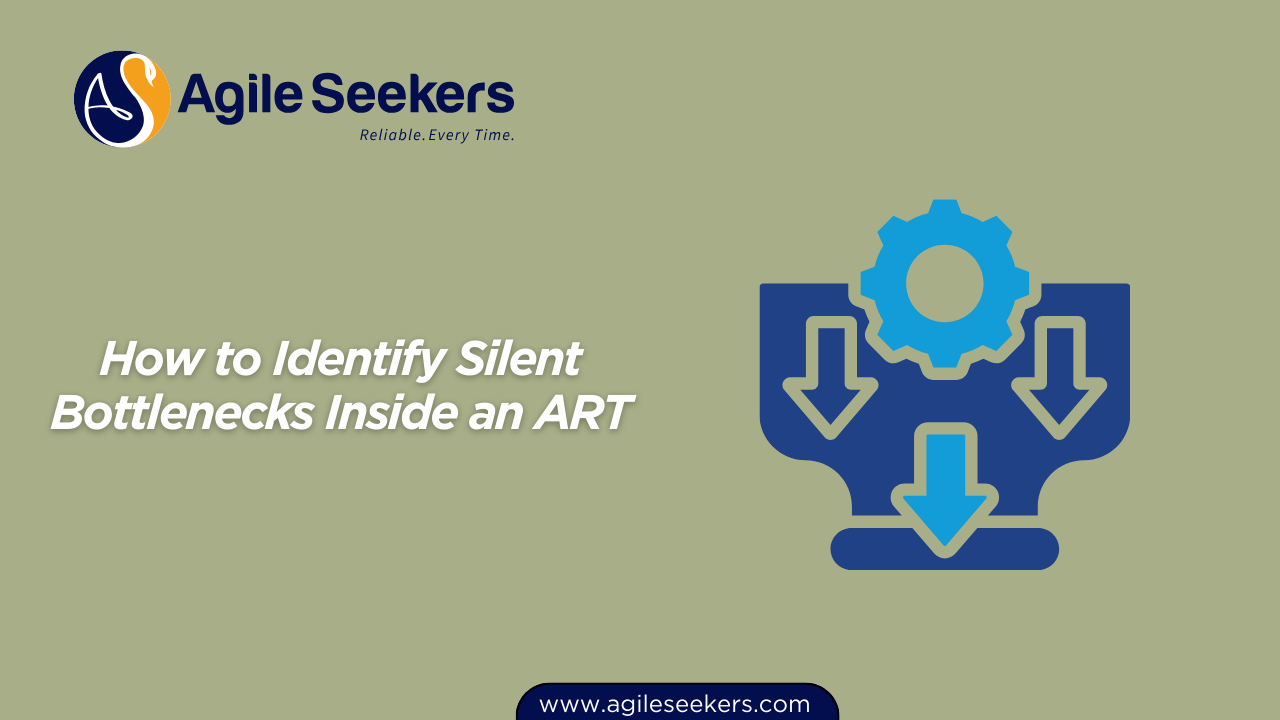
A silent bottleneck is any constraint that slows delivery without triggering alarms.
It doesn’t show up as a red status. It doesn’t fail a sprint. But it quietly increases:
- Lead time
- Wait time
- Context switching
- Rework
- Frustration
Think of it like traffic merging into a single lane. Cars still move, just painfully slowly.
Inside an ART, this could be:
- One architect reviewing everything
- One Product Manager approving all features
- Testing queues
- Compliance sign-offs
- Dependency handoffs between teams
Nothing looks broken. But throughput quietly collapses.
Why ARTs Are Especially Vulnerable
Single Scrum teams usually spot problems fast. Work is visible. Conversations are tight.
ARTs are different.
You have 8 to 12 teams, dozens of stakeholders, and layers of coordination. Small delays compound across the system.
One team waiting two days might not matter. Ten teams waiting two days each? That’s an entire sprint lost.
This is why roles trained through structured programs like Leading SAFe certification focus heavily on flow at the system level, not just team efficiency.
Common Silent Bottlenecks Most ARTs Miss
1. Decision Bottlenecks
If every feature needs approval from one person, you’ve already created a queue.
Watch for:
- Backlog items stuck in “waiting for business”
- Features aging without progress
- PM calendars fully booked
What this really means is simple. Your system depends on one brain.
That’s not agility. That’s a gate.
2. Dependency Chains
Team A can’t start until Team B finishes. Team B waits on Team C. Suddenly nothing moves.
During PI Planning, dependencies look manageable. Mid-PI, they explode.
If teams frequently say “we’re blocked,” you’re looking at a structural bottleneck.
3. Testing and Release Queues
Centralized testing sounds efficient. It rarely is.
When five teams push work to one testing group, queues form instantly.
Flow dies quietly here.
4. Hidden WIP Overload
Teams often “start more to stay busy.”
Result? Everything half done.
High WIP hides constraints because progress appears everywhere but finishes nowhere.
5. Overloaded Scrum Masters or RTEs
When facilitation, reporting, risk management, and coaching all sit on one person, flow slows without anyone noticing.
Modern ARTs increasingly solve this using automation and AI assistance, which you’ll learn deeply in programs like the SAFe Scrum Master certification.
How to Actually Detect Silent Bottlenecks
Theory is nice. Detection is better.
Here are practical ways to surface what’s hidden.
1. Track Flow Metrics, Not Just Velocity
Velocity tells you output. It hides waiting.
Start measuring:
- Lead time
- Cycle time
- Flow efficiency
- Queue time
- Blocked time
Tools that support Kanban flow metrics make this simple.
If lead time is 12 days but actual work takes 3, you’ve found a waiting problem.
2. Visualize the Entire Value Stream
Don’t stop at team boards.
Map:
- Idea → Analysis → Development → Test → Release
The longest waiting column usually reveals the bottleneck instantly.
3. Look for Aging Work
Stories that sit untouched for days tell a story.
Add aging indicators. Anything older than expected becomes a conversation starter.
4. Run “Where Do We Wait?” Retrospectives
Ask one question:
Where did work wait this sprint?
You’ll hear things dashboards never show.
5. Follow the Hand-offs
Every hand-off adds delay.
Count how many steps a feature touches. More steps usually mean more queues.
Role-Based Responsibility for Fixing Bottlenecks
Flow is not just the RTE’s job. Every role influences constraints.
Product Owners and Product Managers
They shape demand. Poor slicing creates large batches and long queues.
Sharper feature breakdown and prioritization skills come with structured learning like the SAFe POPM certification.
Scrum Masters
They protect flow daily. Removing impediments quickly keeps queues short.
Advanced facilitation and system thinking are covered in the SAFe Advanced Scrum Master training.
Release Train Engineers
They see the system end to end.
Capacity balancing, dependency management, and flow orchestration define their impact, which is why the SAFe Release Train Engineer certification emphasizes value stream thinking.
Practical Fixes That Work Fast
Reduce Batch Size
Smaller features move faster and expose problems earlier.
Limit WIP Aggressively
Finishing beats starting. Always.
Decentralize Decisions
Empower teams. Don’t create approval queues.
Cross-Skill Teams
Fewer specialists means fewer waiting lines.
Automate Repetitive Reviews
Use tooling and AI for reporting, documentation, and analysis so humans focus on thinking.
Signals That You’ve Removed the Right Bottleneck
You’ll know improvements are real when:
- Lead time drops quickly
- Teams feel calmer
- Dependencies shrink
- Predictability improves
- PI Objectives complete earlier
Notice something important. None of these require hiring more people.
They come from better flow.
Final Thoughts
Most ARTs don’t struggle because teams lack talent.
They struggle because work waits in places nobody measures.
If you focus only on velocity, you’ll miss it. If you watch flow, you’ll see everything.
Start small. Visualize queues. Ask where work waits. Remove one constraint at a time.
Do that consistently and your ART won’t just move faster. It will feel lighter.
And that’s when Agile finally feels effortless.
Also read - What Happens When Teams Optimize Locally Instead of Systemically
Also see - When ART Predictability Drops Despite Stable Velocity
A practical sequence to apply this guidance
- What Is a Silent Bottleneck Inside an ART?: Clarify the decision, people affected and evidence needed before acting.
- Why ARTs Are Especially Vulnerable: Apply the guidance to one current example and record important constraints.
- Common Silent Bottlenecks Most ARTs Miss: Choose one small action with an owner, boundary and review date.
- 1. Decision Bottlenecks: Compare the result with the intended outcome and update the approach.
Use the sequence as a decision aid, not a rigid template. Preserve the article's context and adapt the steps when evidence, risk or authority differs.