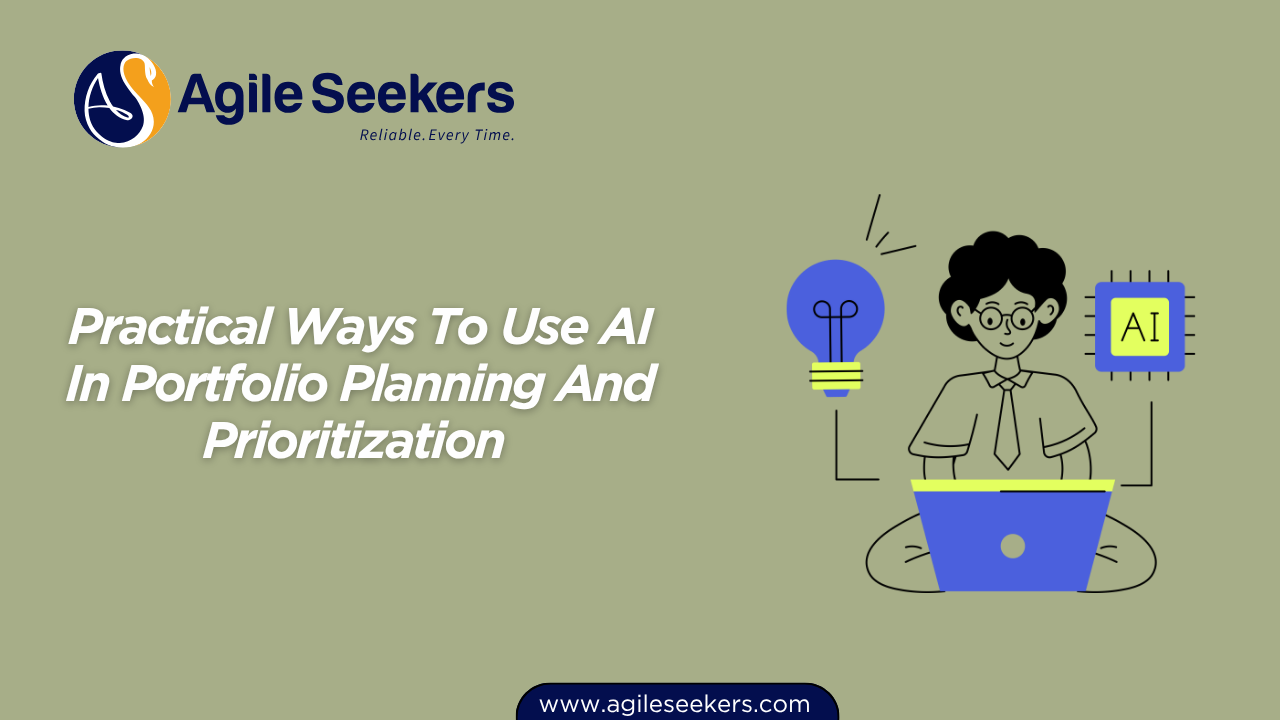
Agile planning has always lived in tension. Teams want flexibility, leaders want predictability, and customers want value delivered sooner than expected. Planning and prioritization sit right in the middle of that tension. They depend on human judgment, context, and constant trade-offs. Now AI is stepping into that space, not to replace Agile thinking, but to sharpen it.
What this really means is simple. AI changes how teams see their work, how they decide what matters next, and how fast they can adjust when reality shifts. Agile planning stops being a periodic exercise and becomes a continuous, data-informed conversation.
Let’s break this down and look at where AI is already influencing Agile planning, where it will push harder next, and what roles like Product Owners, Scrum Masters, and Release Train Engineers need to do to stay ahead.
Why Agile Planning Struggles at Scale
At team level, planning often works reasonably well. Backlogs are visible, priorities are discussed, and trade-offs happen in the open. Problems start when scale enters the picture.
Multiple teams share dependencies. Priorities compete across products. Leadership wants alignment to strategy, while teams feel the pressure of delivery commitments. Most planning systems rely on static snapshots. Spreadsheets, quarterly roadmaps, and fixed commitments try to predict a future that rarely behaves.
The result is familiar. Plans become outdated quickly. Teams re-plan too often or stick to plans that no longer make sense. Prioritization turns political instead of evidence-based.
AI does not remove uncertainty. What it does is reduce blind spots.
From Opinion-Driven to Evidence-Informed Prioritization
Traditional prioritization frameworks like WSJF or MoSCoW work well when inputs are reliable. The challenge is that many inputs come from assumptions.
AI changes that dynamic by pulling signals from real work data. Flow metrics, cycle time trends, customer behavior, defect patterns, and dependency delays can all feed prioritization decisions.
Instead of debating which feature feels more urgent, teams can see how similar work performed in the past, how long it took, and what risks slowed it down.
This shift aligns closely with how SAFe leaders learn to think about economic decision-making in SAFe agile training, where prioritization connects directly to value, cost of delay, and system constraints.
AI as a Continuous Planning Partner
Agile planning often happens in events. Sprint Planning, PI Planning, backlog refinement. Between those events, reality moves faster than the plan.
AI introduces continuous planning support. It can flag emerging risks before planning sessions. It can highlight backlog items that keep getting postponed. It can surface dependencies that are likely to cause delays based on past patterns.
Here’s the key difference. AI does not tell teams what to plan. It helps teams see what they are missing.
For Product Owners working across complex backlogs, this becomes especially powerful. In SAFe Product Owner Product Manager training, prioritization already extends beyond features to include enablers, risks, and learning work. AI strengthens those decisions with real data instead of gut feel.
Smarter Backlogs, Not Bigger Ones
One common fear is that AI will flood teams with more data and more backlog items. In practice, the opposite tends to happen when used well.
AI can cluster similar work, identify duplicates, and suggest backlog consolidation. It can analyze refinement history and show which items repeatedly fail acceptance or spill over sprints.
Over time, teams learn which types of work create the most churn and which flow smoothly. Planning conversations move away from volume and toward quality.
Backlogs become shorter, clearer, and more intentional.
Forecasting Without False Precision
Agile teams often resist forecasting because it feels like a return to predictive planning. AI introduces a different approach.
Instead of promising fixed dates, AI models generate probabilistic forecasts. They show ranges, confidence levels, and likely outcomes based on historical flow.
This supports more honest conversations with stakeholders. Rather than saying a feature will be done in four weeks, teams can say there is a 70 percent chance it will complete within the next five to seven weeks.
Release Train Engineers benefit significantly here. In SAFe Release Train Engineer certification, predictability and transparency matter more than optimism. AI-backed forecasting strengthens that credibility without locking teams into unrealistic commitments.
Planning With Constraints in Mind
Every system has constraints. The problem is that many of them remain invisible during planning.
AI helps surface constraints by analyzing where work consistently queues. It can identify teams that become bottlenecks, approval steps that slow flow, or skill gaps that cause repeated delays.
Instead of planning as if capacity were infinite, teams plan with real constraints in view. This aligns strongly with Lean thinking and flow-based planning.
Scrum Masters trained through SAFe Scrum Master certification can use these insights to shift conversations from individual productivity to system improvement.
AI and Sprint Planning
Sprint Planning often suffers from two extremes. Either teams overcommit based on optimism, or they undercommit to stay safe.
AI adds a third option. It analyzes historical sprint data, team capacity trends, unplanned work patterns, and spillover rates. It then suggests a realistic range for sprint commitments.
The team still decides. AI simply makes trade-offs clearer.
This leads to calmer planning sessions, fewer surprises mid-sprint, and better trust with stakeholders.
Prioritization Beyond Features
Many teams still prioritize only customer-facing features. Technical debt, architectural work, and learning activities often sit at the bottom of the backlog.
AI changes this by showing the long-term cost of neglecting that work. It can correlate rising defect rates with postponed refactoring. It can link slower cycle times to ignored enablers.
Advanced Scrum Masters, especially those who go deeper through SAFe Advanced Scrum Master training, can use these insights to coach leadership toward more balanced prioritization.
What AI Will Not Do
It is important about limits.
AI will not replace human judgment. It cannot understand strategy, ethics, or organizational culture on its own. It does not know why a customer promise matters politically or why a regulatory deadline cannot move.
AI supports decisions. People still own them.
Building Trust in AI-Assisted Planning
Trust does not come from dashboards alone. Teams trust AI when its insights match reality and when they can question its outputs.
Start small. Use AI to support one planning decision at a time. Compare outcomes. Learn where models help and where they mislead.
Transparency matters. Teams should understand what data feeds AI recommendations and what assumptions sit behind them.
External Perspectives on AI and Agile
Industry thinking continues to evolve. Scaled Agile regularly updates guidance on flow, metrics, and decision-making, which can be explored further on the official Scaled Agile Framework site at scaledagileframework.com.
For team-level practices, the Scrum Guide remains a useful reference point, especially as teams experiment with AI without losing core Scrum values.
The Real Shift: From Planning as Prediction to Planning as Learning
The biggest change AI brings is not speed or automation. It changes the purpose of planning.
Planning becomes less about predicting the future and more about learning faster than the environment changes. Prioritization becomes a living process, not a quarterly negotiation.
Teams that embrace AI thoughtfully will plan with more confidence, fewer surprises, and clearer conversations about value.
Final Thoughts
AI will not magically fix Agile planning problems. Poor priorities, unclear strategy, and weak collaboration still show up, just faster.
What AI offers is visibility. It shines light on patterns humans miss, connects decisions to outcomes, and supports better trade-offs.
For Agile leaders, Product Owners, Scrum Masters, and RTEs, the opportunity is clear. Learn how to work with AI as a planning partner, not as a replacement for thinking.
The teams that do this well will not just plan better. They will adapt better, deliver more consistently, and earn trust through transparency rather than promises.
Also read - The Role of Trend Analysis in Improving Team Throughput
Also see - Using AI Tools for Backlog Refinement and Story Creation