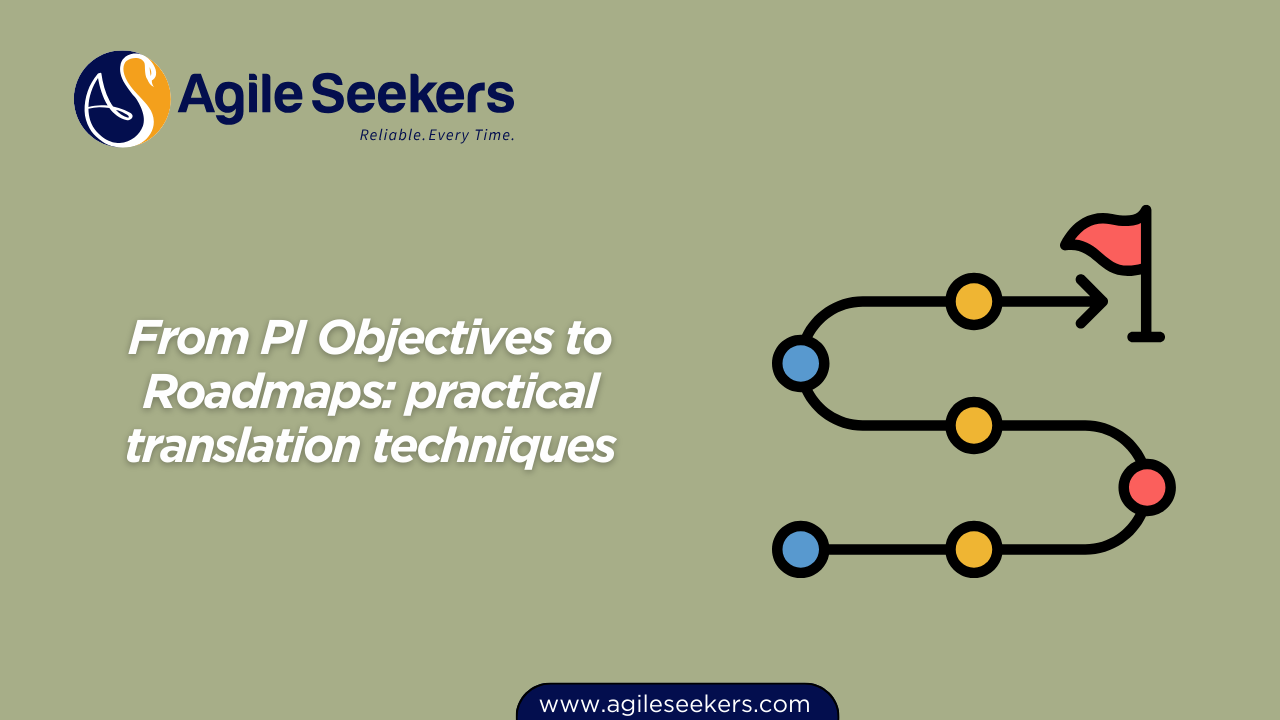
PI Objectives capture intent. Roadmaps communicate direction. The real challenge is what sits between them.
Many Agile Release Trains run solid PI Planning events, craft meaningful objectives, and still struggle when leaders ask a simple question a few weeks later: “So how does this translate into our roadmap?” What this really means is that teams planned well for the next 10–12 weeks, but the organization still can’t clearly see how those objectives shape medium-term outcomes.
This gap is common, and it’s not a tooling problem. It’s a translation problem.
This article breaks down practical, field-tested techniques to translate PI Objectives into roadmaps without diluting intent, overcommitting teams, or turning Agile planning into a fixed delivery contract.
Why PI Objectives and Roadmaps Often Drift Apart
PI Objectives serve a specific purpose. They align teams around value, provide a basis for confidence votes, and create shared accountability across the ART. Roadmaps serve a different purpose. They help business leaders, portfolio stakeholders, and customers understand where the product or solution is heading over time.
The drift happens when:
- PI Objectives stay at team-level language and never get aggregated
- Roadmaps are built independently by product management or leadership
- Objectives focus on outputs while roadmaps expect outcomes
- Dates creep in too early and lock assumptions
Bridging this gap requires discipline, not more documentation.
Start With the Right Type of PI Objectives
If PI Objectives are written as task lists, no translation technique will save you later.
Strong objectives share three characteristics:
- They describe value, not activity
- They are measurable or observable
- They reference the customer or business impact
For example, “Implement API caching” is a delivery task. “Reduce response time for high-volume APIs by 30%” gives product and portfolio leaders something they can map forward.
This is where training in Leading SAFe agilist certification often helps leaders recalibrate how objectives are framed across teams.
Cluster PI Objectives Into Value Themes
Once PI Planning concludes, resist the urge to immediately build a roadmap. Instead, run a short synthesis step.
Take all committed and uncommitted PI Objectives and cluster them into 4–7 value themes. These themes usually emerge around:
- Customer experience improvements
- Revenue or monetization enablers
- Operational resilience
- Regulatory or compliance needs
- Platform or architectural evolution
This clustering is not re-planning. It’s sense-making.
Each theme should answer a simple question: “If we succeed here, what will be different for the business or customer?”
Translate Team Objectives Into Feature-Level Intent
Roadmaps rarely operate at the team objective level. They work best at the feature or capability level.
The practical step here is reverse mapping:
- Start with a value theme
- Identify which PI Objectives contribute to it
- Extract the common delivery intent
- Express that intent as a feature-level statement
For example, three teams may have objectives around logging, alerting, and incident response. On the roadmap, this becomes “Improved production observability and faster recovery.”
This translation is a core skill for Product Owners and Product Managers, often reinforced through the SAFe Product Owner Product Manager (POPM) certification.
Anchor Roadmap Horizons to PIs, Not Dates
One of the fastest ways to kill trust in roadmaps is to lock them to calendar dates too early.
A more resilient approach is PI-based horizons:
- Current PI: Committed delivery focus
- Next PI: Planned intent with options
- Future PIs: Directional themes and bets
This structure allows you to show progress and intent without pretending you know exact delivery dates months in advance.
Many ARTs reinforce this practice through facilitation support from roles trained via the SAFe Scrum Master certification, especially when teams struggle with stakeholder expectations.
Use Confidence Levels Instead of Commitments
PI Objectives already include business value and confidence votes. Roadmaps should reflect that uncertainty instead of hiding it.
Practical techniques include:
- High / Medium / Exploratory confidence tags
- Option-based roadmap lanes
- Explicit assumptions listed under each theme
This keeps roadmaps honest and reduces the pressure to treat them as fixed contracts.
Advanced facilitation and coaching around these techniques often comes from practitioners trained in the SAFe Advanced Scrum Master certification, especially in complex or scaled environments.
Connect PI Objectives to Outcome Metrics
A roadmap without outcomes is just a timeline.
For each roadmap theme, identify one or two measurable signals:
- Customer adoption or usage
- Cycle time or flow efficiency
- Defect escape rates
- Revenue or cost impact
These metrics should trace back to PI Objectives. If you can’t draw a line from an objective to a metric on the roadmap, the objective may not be written at the right level.
External references like SAFe’s guidance on outcome-based roadmaps provide useful framing without prescribing templates. A good starting point is the Scaled Agile guidance on roadmaps and PI execution available on the Scaled Agile site.
Make the RTE the Integrator, Not the Owner
One common mistake is assigning roadmap ownership to a single role.
In practice, the Release Train Engineer acts as the integrator. Product Management owns content. Business Owners provide strategic context. Teams validate feasibility.
This orchestration role is central to the SAFe Release Train Engineer certification, where roadmap alignment is treated as a system-level responsibility rather than a document exercise.
Run a Post-PI Roadmap Sync
Within two weeks of PI Planning, schedule a short roadmap sync.
Agenda:
- Review PI Objectives and confidence votes
- Confirm value themes
- Validate roadmap language against objectives
- Surface major risks and assumptions
This meeting is not about re-committing work. It’s about ensuring the story told externally matches what teams actually planned.
Keep the Roadmap Alive Throughout the PI
The roadmap should evolve as learning happens.
Use System Demos, Inspect & Adapt workshops, and milestone reviews to:
- Update confidence levels
- Refine themes based on feedback
- Retire items that no longer make sense
This reinforces the idea that the roadmap reflects reality, not aspiration.
Common Anti-Patterns to Watch For
- Copy-pasting PI Objectives directly onto the roadmap
- Using roadmap dates to pressure teams mid-PI
- Ignoring uncommitted objectives that signal risk
- Overloading the roadmap with technical detail
If any of these show up regularly, the issue is usually structural, not individual performance.
Final Thoughts
Translating PI Objectives into roadmaps is not a formatting exercise. It’s a leadership capability.
When done well, roadmaps amplify what teams planned instead of rewriting it. They create clarity without false certainty and alignment without micromanagement.
Organizations that master this translation stop arguing about dates and start focusing on outcomes. That shift alone often unlocks more value than any new tool or framework tweak.
The work is subtle, but the payoff is real.
Also read - Flow, Queue, and WIP at scale: how to measure and improve
Also see - Managing architectural runway in long-term planning