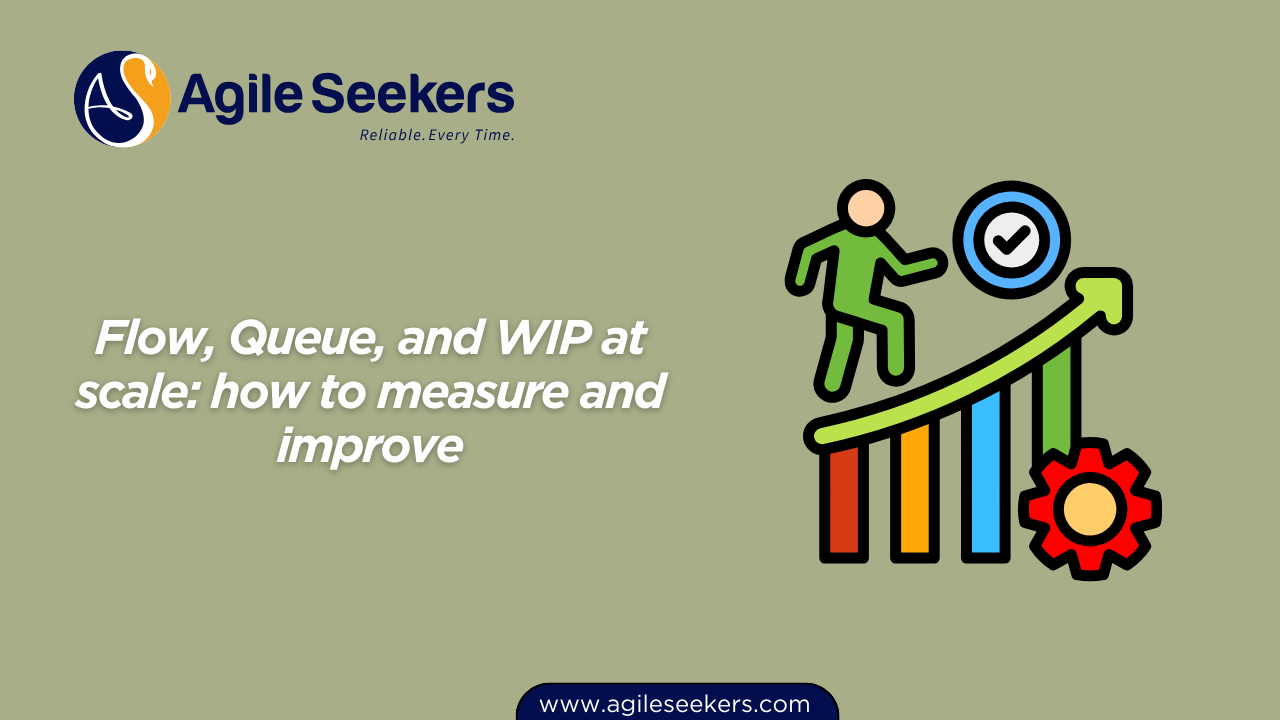
Most large Agile organizations believe they have a delivery problem. Deadlines slip, dependencies pile up, teams feel busy, and yet real outcomes move slowly. When you look closer, the issue is rarely effort or talent. It is almost always flow.
Flow tells you how work moves through your system. Queues show you where work waits. WIP reveals how much unfinished work you are carrying at any moment. At scale, these three forces decide whether your Agile Release Trains feel smooth or constantly jammed.
This article breaks down flow, queue, and WIP in a scaled environment. You will learn how to measure them in ways that actually help, where most organizations go wrong, and what practical changes improve flow without adding process overhead.
Why Flow Matters More at Scale Than at Team Level
A single Agile team can often survive with informal flow management. They talk daily, see blockers quickly, and adapt fast. Once you scale to multiple teams, shared backlogs, cross-team dependencies, and portfolio commitments, small delays multiply.
At scale, poor flow hides in plain sight. Teams look productive. ARTs appear fully used. Leaders see long roadmaps. Meanwhile, customers wait longer for value.
This is exactly why SAFe places flow metrics alongside business outcomes. Leading SAFe Agilist training emphasizes that speed without flow discipline only accelerates chaos. Leaders who understand flow manage systems, not heroics.
Understanding Flow in a Scaled Agile System
Flow is the movement of value from concept to cash. In SAFe, this movement cuts across portfolio, solution, ART, and team levels.
Flow breaks when work pauses between steps. These pauses are rarely visible on sprint boards. They happen between backlog refinement and implementation, between development and validation, between one team and another, or between an ART and a dependent system.
To understand flow at scale, you need to stop asking “Are teams busy?” and start asking “How long does work wait?”
Scaled Agile Framework guidance on flow metrics explains why measuring time and variability gives better insight than tracking utilization alone. You can explore that perspective further on the official SAFe site at Scaled Agile Business Agility.
Queues: The Silent Killer of Predictability
A queue is any place where work waits. At scale, queues are everywhere.
- Features waiting for architectural review
- Stories waiting for test environments
- Capabilities waiting for dependent ARTs
- Epics waiting for portfolio approval
Queues do not show up in sprint velocity. They show up in lead time. The longer your queues, the less predictable your system becomes.
Here’s the uncomfortable truth. Most organizations create queues deliberately. Approval layers, handoffs, shared services, and multitasking all generate waiting.
Queue length is a signal. Long queues tell you where demand exceeds capacity or where policies are unclear.
Kanban research consistently shows that waiting time dominates total lead time. The Kanban Guide highlights this clearly: reduce waiting, and flow improves even without working faster. You can review this principle directly at kanbanguides.org.
WIP at Scale: Why “Busy” Is the Wrong Goal
Work in Progress is the amount of started but unfinished work in your system. At scale, WIP exists at many levels.
- Portfolio epics in progress
- Capabilities in development
- Features committed in PI
- Stories started by teams
High WIP creates congestion. It increases context switching. It hides problems because nothing ever finishes.
Most large organizations believe limiting WIP slows them down. The opposite happens. When you limit WIP, flow accelerates because work finishes sooner.
This principle applies directly to Product Owners and Product Managers operating at scale. The SAFe Product Owner Product Manager certification focuses heavily on economic prioritization and WIP discipline because POPMs influence how much work enters the system.
How Flow, Queue, and WIP Interact
These three elements form a system.
When WIP increases, queues grow. When queues grow, flow time increases. When flow time increases, predictability collapses.
You cannot fix flow by optimizing one team. You must manage entry into the system and movement through it.
Little’s Law explains this relationship mathematically: Lead Time equals WIP divided by Throughput. You do not need complex analytics to apply it. You need discipline in limiting started work.
This is why SAFe Scrum Masters play a critical role beyond facilitation. They help teams visualize WIP, surface queues, and enforce working agreements that protect flow. The SAFe Scrum Master certification builds these system-level coaching skills.
Measuring Flow at Scale Without Drowning in Metrics
Many organizations fail here. They measure everything and learn nothing.
Effective flow measurement focuses on a small set of indicators that reveal system behavior.
Flow Time
Flow time measures how long work takes from start to finish. Track it at feature and capability level, not just stories.
Flow Efficiency
Flow efficiency compares active work time to waiting time. Low efficiency highlights queues immediately.
WIP Levels
Track WIP by state, not by team. Look at how many items sit in analysis, development, validation, and deployment.
Queue Length and Age
Count how many items wait and how long they wait. Aging work items expose risk early.
Scaled Agile dashboards often include these metrics, but tools alone do not fix behavior. Leaders must act on what they see.
Improving Flow at the ART Level
Agile Release Trains amplify both good and bad flow patterns.
To improve flow at ART level:
- Limit feature WIP per PI
- Use explicit policies for when work can start
- Visualize queues across teams
- Reduce dependency-based handoffs
Release Train Engineers play a central role here. They see the system end to end and can coach leaders on removing systemic blockers. This is why the SAFe Release Train Engineer certification emphasizes flow optimization over schedule enforcement.
Portfolio-Level Flow: Where Most Bottlenecks Begin
Many ARTs struggle because too much work enters from the top.
Portfolio Kanban exists to control this flow. Yet organizations often treat it as a reporting tool instead of a decision system.
Effective portfolio flow management means:
- Limiting active epics
- Shortening approval cycles
- Aligning funding to value streams
- Actively killing stalled initiatives
Lean Portfolio Management guidance on Scaled Agile’s site explains how WIP limits at portfolio level improve enterprise agility. You can explore that thinking further at Scaled Agile Lean Portfolio Management.
Advanced WIP Control Techniques That Actually Work
Basic WIP limits help, but advanced systems need more nuance.
Class of Service
Different work types need different flow policies. Expedite work should be rare and visible.
Capacity Allocation
Allocate fixed capacity for maintenance, innovation, and technical debt to avoid starvation.
Pull-Based Planning
Let teams pull work based on readiness and capacity, not commitment pressure.
Advanced Scrum Masters often lead these practices across multiple teams. The SAFe Advanced Scrum Master certification focuses on coaching flow at system level rather than team mechanics.
Common Anti-Patterns That Kill Flow
- Starting everything at once
- Using utilization as a success metric
- Hiding queues inside tools
- Ignoring aging work
- Overloading PIs with “just in case” features
If your ART constantly re-plans, misses objectives, or carries over work every PI, flow is the issue, not estimation.
What Sustainable Flow Improvement Looks Like
Organizations that improve flow at scale see clear changes.
- Shorter lead times
- Fewer surprises late in the PI
- Calmer planning events
- Higher confidence in commitments
Most importantly, people stop feeling busy and start feeling effective.
Flow is not a framework add-on. It is the operating system of scaled agility. When leaders, POPMs, Scrum Masters, and RTEs align around flow, queue, and WIP, delivery stops being a struggle.
This is exactly why flow-based thinking runs through SAFe training programs, from Leading SAFe Agilist to role-based certifications. Understanding flow changes how you see work. Improving flow changes how fast value reaches customers.
And once that happens, everything else becomes easier.
Also read - Forecasting delivery with AI vs traditional methods in SAFe
Also see - From PI Objectives to Roadmaps: practical translation techniques
A practical sequence to apply this guidance
- Why Flow Matters More at Scale Than at Team Level: Clarify the decision, people affected and evidence needed before acting.
- Understanding Flow in a Scaled Agile System: Apply the guidance to one current example and record important constraints.
- Queues: The Silent Killer of Predictability: Choose one small action with an owner, boundary and review date.
- WIP at Scale: Why Busy Is the Wrong Goal: Compare the result with the intended outcome and update the approach.
Use the sequence as a decision aid, not a rigid template. Preserve the article's context and adapt the steps when evidence, risk or authority differs.