Speed is often misunderstood in business. Many assume it means working faster, pushing teams harder, or delivering more features in less time. But speed alone doesn’t create an advantage. What truly separates high-performing organizations from the rest is how quickly they make decisions.
Think about it. Every product change, customer response, release, or pivot starts with a decision. If decisions move slowly, everything else slows down with them. If decisions move quickly, the entire system gains momentum.
This is why decision-making speed has become a real competitive edge. Not just for startups, but for large enterprises running complex Agile environments.
What Decision-Making Speed Really Means
Decision-making speed is not about rushing. It’s about reducing the time between identifying a need and taking action. That gap is where most organizations lose their edge.
Fast decision-making comes from clarity, trust, and structure. Teams know who decides what. Leaders provide direction without creating bottlenecks. Information flows without friction.
Slow decision-making, on the other hand, usually looks like this:
- Too many approvals required
- Unclear ownership
- Fear of making mistakes
- Data scattered across systems
- Endless discussions without closure
None of these are technical problems. They are system design issues.
Why Decision Speed Directly Impacts Business Outcomes
Let’s break this down.
Every delay in decision-making creates a chain reaction. A delayed product decision pushes backlog prioritization. That affects sprint planning. That impacts release timelines. That delays customer value.
Now flip that.
When decisions happen quickly, teams move with confidence. Work flows without interruption. Releases happen more predictably. Customers see value sooner.
This is where frameworks like SAFe emphasize decentralized decision-making. The idea is simple. Push decisions to the people closest to the work.
Organizations that master this don’t just move faster. They learn faster. And learning speed compounds over time.
The Hidden Cost of Slow Decisions
Most organizations underestimate how expensive slow decisions are.
Here’s what really happens behind the scenes:
- Teams wait instead of working
- Context switching increases
- Motivation drops
- Opportunities are missed
- Competitors move ahead
What this really means is simple. Slow decisions create invisible waste.
Lean thinking calls this delay waste. And it’s one of the most damaging forms because it affects everything else in the system.
You can explore this further through Lean Enterprise Institute’s explanation of delay waste, which shows how waiting time reduces overall flow efficiency.
Decision-Making in Agile and SAFe Environments
Agile frameworks were not created just to improve delivery. They were created to improve decision-making.
In Scrum, decisions happen daily through team collaboration. In SAFe, decision-making scales across teams, programs, and portfolios.
But here’s the challenge. As organizations scale, decision speed often drops. More layers get added. More stakeholders get involved. Alignment becomes harder.
This is where structured roles and responsibilities matter.
For example, Product Owners and Product Managers play a key role in making quick backlog decisions. If they hesitate, the entire Agile Release Train slows down. Professionals trained through SAFe POPM certification learn how to prioritize effectively and make informed decisions without waiting for approvals.
Similarly, Scrum Masters remove blockers that delay decisions at the team level. If decision bottlenecks exist, they surface them and help resolve them quickly. This is a core focus area in SAFe Scrum Master certification.
At the program level, Release Train Engineers ensure decisions don’t get stuck across teams. Their role is not just coordination but flow optimization. You can explore this further through SAFe Release Train Engineer certification training.
Centralized vs Decentralized Decision-Making
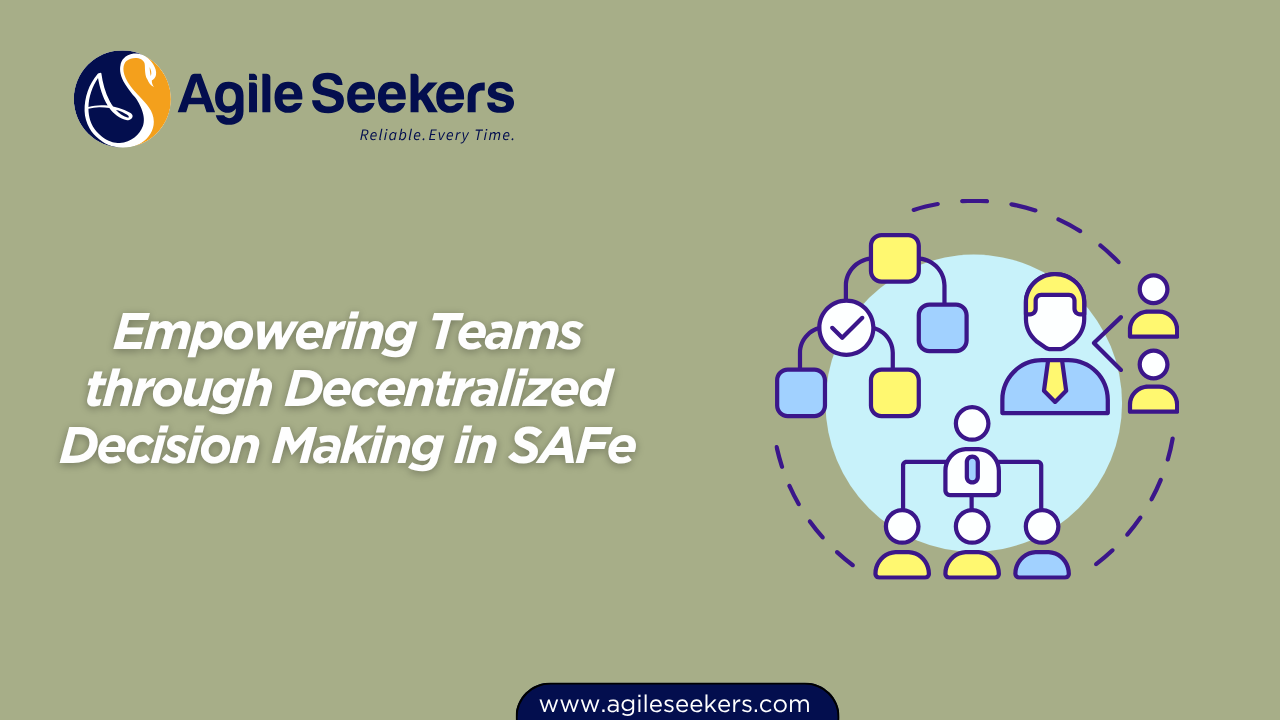
One of the biggest shifts organizations need to make is moving from centralized to decentralized decision-making.
Centralized decision-making feels safe. Leaders control outcomes. Risks appear managed. But it slows everything down.
Decentralized decision-making feels uncomfortable at first. Teams take ownership. Decisions happen at different levels. Leaders let go of control.
But this is where speed comes from.
SAFe encourages decentralized decision-making with guardrails. That means teams can act quickly within defined boundaries.
This balance is critical. Without guardrails, decisions become chaotic. With too many controls, decisions slow down.
Leaders trained through SAFe agile certification learn how to create this balance effectively.
How to Improve Decision-Making Speed
Improving decision speed is not about pushing teams harder. It’s about redesigning how decisions flow through the system.
1. Clarify Decision Ownership
Every decision should have a clear owner. Not a group. Not a committee.
When ownership is unclear, decisions stall. When ownership is clear, decisions move.
2. Reduce Approval Layers
Each approval layer adds delay. Ask a simple question. Does this approval add real value or just control?
Removing unnecessary approvals can dramatically improve speed.
3. Use Data, But Don’t Wait for Perfect Data
Data supports decisions. It should not delay them.
High-performing teams make decisions with available information and adjust as they learn.
4. Define Decision Guardrails
Guardrails help teams act quickly without constant escalation. These can include budget limits, architectural guidelines, or business priorities.
This concept is explained well in Lean Budget Guardrails.
5. Limit Work in Progress
Too much work creates too many decisions. That slows everything down.
Limiting WIP helps teams focus and make better decisions faster.
6. Build a Culture That Supports Fast Decisions
Culture plays a huge role.
If teams fear failure, they delay decisions. If leaders punish mistakes, decisions get escalated.
But if teams feel safe to act, decisions happen quickly.
This is where advanced roles like those covered in SAFe Advanced Scrum Master certification training focus on coaching teams and leaders to build the right environment.
The Role of AI in Decision-Making Speed
AI is starting to change how decisions are made in Agile environments.
Not by replacing people, but by supporting faster and better decisions.
Here’s how:
- Analyzing large datasets quickly
- Identifying risks early
- Suggesting backlog prioritization
- Predicting delivery timelines
- Highlighting bottlenecks in real time
For example, AI tools can analyze historical sprint data and suggest realistic commitments. That reduces debate during planning and speeds up decisions.
Similarly, AI-driven dashboards can highlight delays or risks instantly, allowing teams to act without waiting for reports.
This shift aligns with how modern Agile frameworks are evolving. Decision-making is becoming data-informed, not data-delayed.
Decision Latency: The Metric That Matters
Most organizations track velocity, throughput, and lead time. But very few track decision latency.
Decision latency is the time it takes to make a decision after a need is identified.
This is one of the most powerful metrics you can track.
Why?
Because reducing decision latency improves everything else.
- Faster decisions reduce cycle time
- Faster decisions improve flow
- Faster decisions increase predictability
You can think of decision latency as the hidden driver behind all delivery metrics.
Real-World Example
Consider two organizations working on similar products.
Organization A takes two weeks to make a key product decision. Organization B takes two days.
Over a year, Organization B makes dozens of additional decisions. That means more experiments, more learning, and more improvements.
This compounding effect is what creates a real competitive advantage.
The focus is moving smarter rather than working harder.
Common Pitfalls to Avoid
While improving decision speed, organizations often make mistakes.
Confusing Speed with Chaos
Fast decisions without structure lead to inconsistency. Guardrails are essential.
Overloading Leaders
If all decisions still go to leadership, speed will never improve.
Ignoring Feedback Loops
Fast decisions need fast feedback. Otherwise, mistakes repeat.
Measuring the Wrong Things
Focusing only on delivery metrics without tracking decision speed misses the root issue.
What This Means for Agile Leaders
If you’re leading an Agile transformation, decision-making speed should be a top priority.
Not as a slogan, but as a system design goal.
Ask yourself:
- Where do decisions get stuck?
- Who is waiting for approvals?
- Which decisions can be decentralized?
- How long does it take to move from idea to action?
The answers to these questions will reveal more than any dashboard.
Final Thoughts
Decision-making speed is not just an operational improvement. It’s a strategic advantage.
Organizations that decide faster don’t just deliver faster. They learn faster, adapt faster, and grow faster.
And in a competitive market, that difference matters.
If you want to improve delivery, don’t start with tools or processes. Start with decisions.
Because every improvement begins with one.
Also read - The Role of Informal Power Structures in SAFe Success
Also see - How Organizational Design Impacts Flow