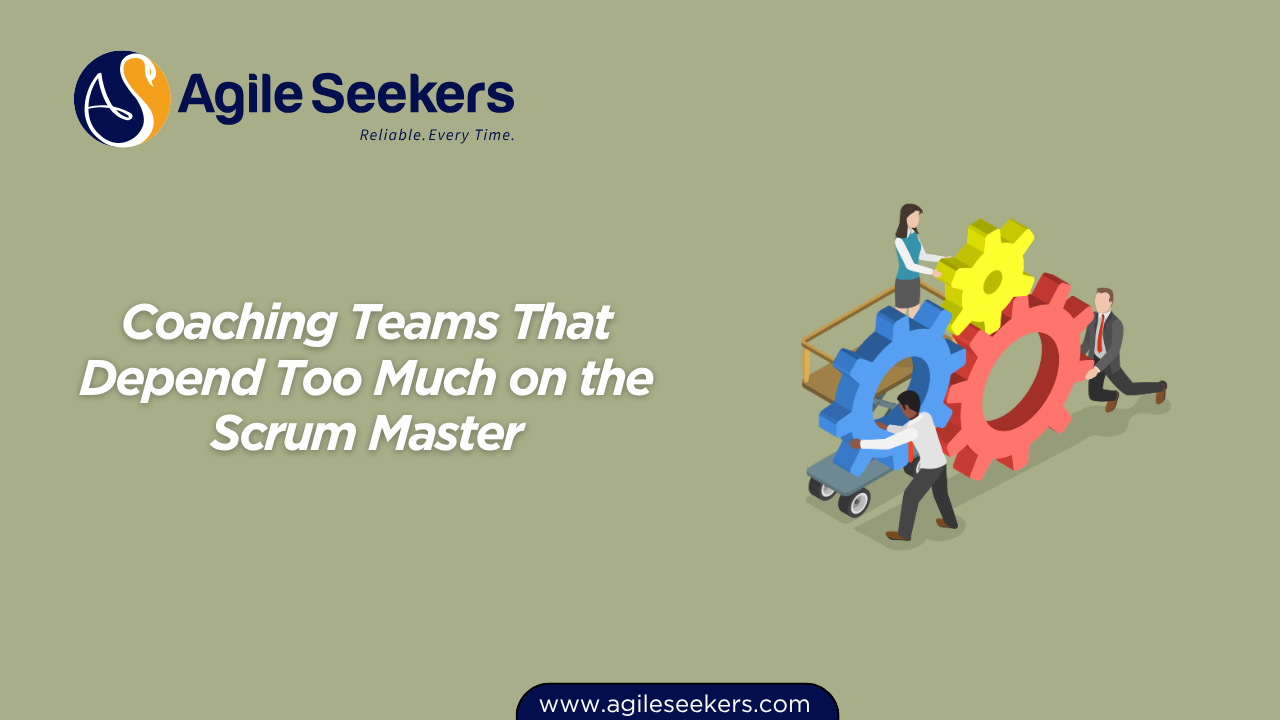
Here’s something most Scrum Masters notice but rarely say out loud: the team looks Agile on the surface, but underneath, everything still flows through one person.
Decisions get delayed until the Scrum Master weighs in. Blockers sit unresolved unless someone escalates them. Meetings don’t start unless the Scrum Master initiates them. The team waits instead of acts.
This isn’t a people problem. It’s a system problem.
When teams depend too much on the Scrum Master, they lose one of the core promises of Agile: self-management. And once that happens, delivery slows down, ownership weakens, and learning stalls.
This article breaks down why this dependency happens, how to recognize it early, and most importantly, how to coach teams toward true independence.
What Over-Dependency on the Scrum Master Looks Like
You don’t need a survey to spot it. You can see it in everyday behavior.
- Team members ask the Scrum Master for decisions instead of discussing among themselves
- Standups turn into status updates directed at the Scrum Master
- Blockers stay unresolved until the Scrum Master intervenes
- Retrospectives depend on the Scrum Master to drive every insight
- The team hesitates to interact directly with stakeholders
At first glance, it looks like strong facilitation. In reality, it creates a bottleneck.
The Scrum Master becomes the system. And that’s exactly what Agile tries to avoid.
Why Teams Become Dependent
If you want to fix this, don’t start with the team. Start with the environment around them.
1. Habit from Traditional Structures
Many teams come from command-and-control environments. They are used to someone leading, deciding, and guiding every step. The Scrum Master becomes the closest replacement.
2. Over-Helping Scrum Masters
Scrum Masters often step in with good intent. They remove blockers quickly, answer questions instantly, and keep everything moving.
Over time, the team learns a simple pattern: wait, and someone will fix it.
3. Fear of Making Wrong Decisions
Teams hesitate when the cost of failure feels high. Without psychological safety, they prefer to defer decisions.
You can explore more about creating safe environments through psychological safety in Scrum teams.
4. Lack of Clarity in Roles
When ownership is unclear, people default to the most visible leader. In many cases, that’s the Scrum Master.
5. Organizational Signals
If stakeholders approach the Scrum Master instead of the team, dependency increases. Teams mirror the system around them.
Why This Dependency Hurts Delivery
This goes beyond a maturity issue. It directly impacts outcomes.
Slower Decisions
Every decision waits for a single person. That creates delays and reduces flow.
Reduced Accountability
If the Scrum Master owns the process, the team stops owning it.
Limited Growth
Teams don’t learn how to solve problems if someone else always steps in.
Hidden Bottlenecks
The Scrum Master becomes a silent constraint in the system.
Research from Harvard Business Review on teamwork shows that autonomy and shared ownership drive higher performance. Dependency does the opposite.
The Real Role of a Scrum Master
The Scrum Master is not a coordinator, manager, or problem-solver for the team.
The role is to build a system where the team can operate without constant intervention.
That means stepping back more than stepping in.
Professionals who go deeper into this role through SAFe Scrum Master certification often realize that the real impact comes from enabling, not doing.
How to Coach Teams Toward Independence
Let’s move from theory to action. This is where most Scrum Masters struggle.
1. Stop Answering Immediately
When someone asks a question, resist the urge to respond right away.
Instead, ask:
- What do you think?
- Who else can help with this?
- Have you discussed this as a team?
This small shift changes behavior over time.
2. Make Ownership Visible
Use boards, agreements, and working norms to clarify who owns what.
When ownership is explicit, dependency reduces.
Frameworks taught in POPM certification also emphasize clear accountability across product roles.
3. Redesign the Standup
If the team talks to the Scrum Master during standup, change the format.
Ask team members to speak to each other:
- What did we complete?
- What are we picking next?
- What’s blocking us as a team?
Standups should feel like coordination, not reporting.
4. Let the Team Handle Blockers First
Don’t jump in immediately when a blocker appears.
Give the team time to resolve it. Step in only when they truly need support.
This builds problem-solving muscle.
5. Shift Stakeholder Conversations
If stakeholders approach you, redirect them to the team.
This simple move changes how the system behaves.
In scaled environments, this becomes even more critical. Practices covered in SAFe agile training focus on decentralizing decisions across teams.
6. Use Retrospectives to Build Ownership
Stop facilitating every idea and action.
Instead:
- Let the team identify issues
- Let them propose solutions
- Let them own follow-ups
Your role is to guide, not drive.
7. Encourage Direct Collaboration
If team members rely on you to communicate, step aside.
Encourage them to talk directly with Product Owners, stakeholders, and other teams.
Advanced practices from SAFe Advanced Scrum Master certification training go deeper into facilitating cross-team collaboration.
8. Introduce Decision Boundaries
Define what decisions the team can make without escalation.
Clear boundaries reduce hesitation and build confidence.
9. Measure Independence
Track simple signals:
- How often does the team resolve blockers without help?
- Are decisions made during discussions or escalated?
- Do retrospectives produce team-driven actions?
What gets measured improves.
10. Coach the System, Not Just the Team
If the organization keeps routing decisions through the Scrum Master, the team cannot become independent.
Work with leadership to change that flow.
At scale, roles like Release Train Engineers play a key role in shaping this system. You can explore this further through SAFe Release Train Engineer certification training.
Common Mistakes to Avoid
Doing Everything Faster
Speed feels good, but it creates long-term dependency.
Acting as the Team’s Spokesperson
This reduces direct communication and ownership.
Over-Facilitating Meetings
If every meeting depends on you, the team never learns to run them.
Avoiding Silence
Silence in discussions often means thinking. Don’t rush to fill it.
What Good Looks Like
You know the shift is working when:
- The team starts meetings without waiting
- Decisions happen within the group
- Blockers get resolved collaboratively
- Stakeholders engage directly with the team
- The Scrum Master becomes less visible in daily execution
This doesn’t reduce the value of the Scrum Master. It increases it.
The focus moves from managing work to improving the system.
Final Thoughts
Dependency on the Scrum Master doesn’t happen overnight. It builds through small patterns repeated over time.
The good news is that independence builds the same way.
One question instead of one answer.
One step back instead of one step in.
One decision made by the team instead of one decision made for them.
That’s how teams grow.
And when they do, delivery becomes faster, ownership becomes stronger, and the Scrum Master finally gets to focus on what really matters, building a system that works without them.
Also read - Why Teams Stay Quiet in Retrospectives and How to Fix It