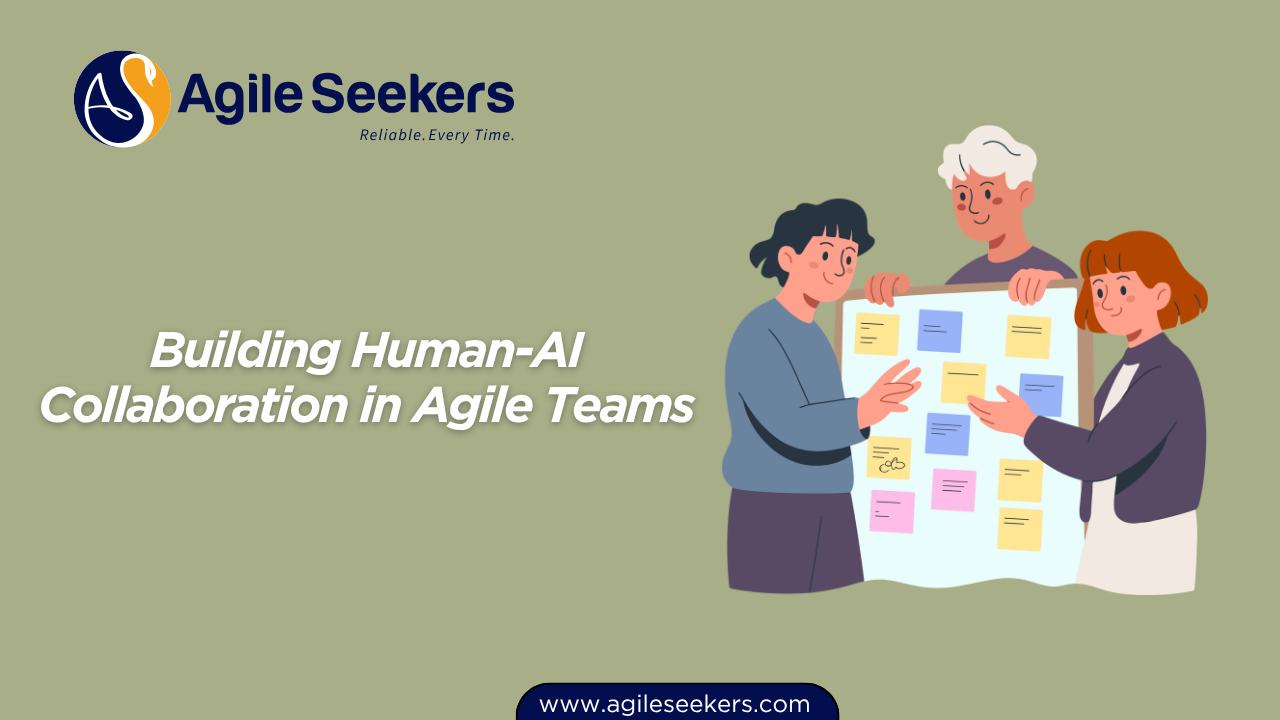
Agile teams have always relied on collaboration, quick feedback loops, and shared ownership. Now, AI is entering that space, not as a replacement for people, but as a new kind of teammate. The real shift isn’t about tools. It’s about how humans and AI work together inside Agile systems.
Here’s the thing: teams that treat AI as just another automation layer miss the bigger opportunity. The real advantage comes when AI supports thinking, decision-making, and flow, while humans stay in control of context, judgment, and value.
This post breaks down how to build that kind of collaboration inside Agile teams, what changes in roles, and how to make it work without disrupting your delivery.
What Human-AI Collaboration Actually Means in Agile
Human-AI collaboration isn’t about handing off work. It’s about pairing, just like developers pair program.
AI handles patterns, speed, and scale. Humans handle intent, context, and trade-offs.
In an Agile setup, this shows up in practical ways:
- AI suggests backlog improvements, but the Product Owner decides priorities
- AI analyzes sprint trends, but the Scrum Master interprets team dynamics
- AI generates options, but teams choose what delivers value
What this really means is simple: AI supports decisions. It doesn’t make them.
Why Agile Teams Are Perfect for AI Collaboration
Agile teams already operate with short cycles, feedback loops, and continuous learning. That makes them ideal for integrating AI.
Here’s why:
- Frequent iterations allow teams to test AI-driven insights quickly
- Cross-functional teams can validate AI outputs from multiple angles
- Transparency helps teams challenge and refine AI suggestions
- Retrospectives create space to improve how AI is used
AI fits naturally into this environment, but only if teams treat it as part of their workflow, not an external tool.
Where AI Adds the Most Value in Agile Teams
1. Backlog Refinement
AI can analyze past user stories, suggest improvements, and even identify missing acceptance criteria.
But the Product Owner still decides what matters most. That’s where domain knowledge and business context come in.
If you're working toward scaling these responsibilities, programs like SAFe Product Owner and Manager Certification help you understand how to balance data-driven insights with product strategy.
2. Sprint Planning
AI can predict capacity based on historical velocity, highlight risks, and suggest realistic sprint scopes.
Still, teams need to validate those suggestions. AI doesn’t know when a team is mentally drained or dealing with external pressure.
3. Daily Standups
AI tools can summarize blockers, track dependencies, and flag delays across teams.
This reduces noise, but the real value comes from conversations. Teams still need to align, clarify, and act.
4. Retrospectives
AI can surface patterns across multiple sprints, things teams often miss.
For example:
- Recurring blockers
- Overcommitment trends
- Hidden dependencies
But improvement actions still depend on human commitment. AI can highlight problems, not fix them.
5. Program-Level Coordination
In large-scale environments, AI helps track dependencies across teams and predict risks before they escalate.
Roles like Release Train Engineers benefit heavily here. If you want to deepen this capability, explore SAFe Release Train Engineer certification to understand how coordination works at scale.
How Roles Evolve with AI in Agile Teams
AI doesn’t remove roles. It changes how they operate.
Product Owners and Product Managers
They move from managing backlogs manually to validating AI-assisted insights.
Instead of writing everything from scratch, they focus on:
- Validating AI-generated stories
- Prioritizing based on business impact
- Aligning AI suggestions with customer needs
Scrum Masters
Scrum Masters shift from tracking team activity to improving system flow.
AI handles data collection. Scrum Masters focus on:
- Coaching teams based on insights
- Removing systemic blockers
- Strengthening team collaboration
If you're stepping into this space, the SAFe Scrum Master certification gives a strong foundation on facilitating teams in complex environments.
Advanced Scrum Leaders
As AI adoption grows, deeper coaching skills become critical.
That’s where advanced learning paths like SAFe Advanced Scrum Master certification help you guide teams through change, not just manage ceremonies.
Agile Leaders
Leaders need to create an environment where AI supports decision-making without replacing human accountability.
Programs like Leading SAFe training help leaders understand how to align people, processes, and technology at scale.
Common Mistakes Teams Make with AI
Most teams don’t fail because of AI. They fail because of how they use it.
1. Treating AI as an Authority
AI outputs can look confident. That doesn’t mean they’re correct.
Teams must question and validate everything.
2. Over-automation
Automating everything kills collaboration.
Agile works because of conversations. Remove those, and you lose alignment.
3. Ignoring Context
AI works on patterns. It doesn’t understand business nuances, customer emotions, or organizational politics.
Humans fill that gap.
4. Lack of Transparency
If teams don’t understand how AI generates outputs, trust drops.
Make AI usage visible and explainable.
Proven methods to Build Strong Human-AI Collaboration
Start Small and Expand
Don’t introduce AI across the entire workflow at once.
Start with one area, like backlog refinement, and build from there.
Keep Humans in the Loop
Every AI output should go through human validation.
No exceptions.
Train Teams to Work with AI
AI tools don’t create value on their own. Teams need to learn how to use them effectively.
That includes:
- Writing better prompts
- Validating outputs
- Understanding limitations
You can explore frameworks for responsible AI usage through resources like NIST AI Risk Management Framework, which explains how organizations can manage AI risks while maintaining trust.
Focus on Outcomes, Not Tools
It’s easy to get excited about AI tools.
But tools don’t matter. Outcomes do.
Ask:
- Is this improving delivery speed?
- Is this reducing waste?
- Is this helping teams make better decisions?
Create Feedback Loops for AI Usage
Just like product features, AI usage needs feedback.
Use retrospectives to ask:
- Did AI help or distract?
- Where did it add value?
- Where did it create confusion?
Building Trust Between Humans and AI
Trust doesn’t come from accuracy alone. It comes from understanding.
Teams trust AI when:
- They know how it works
- They can challenge its outputs
- They see consistent value over time
Without trust, AI becomes noise.
With trust, it becomes a powerful assistant.
The Future of Agile Teams with AI
Agile teams won’t become automated systems. They’ll become smarter systems.
Expect to see:
- AI-driven insights shaping sprint planning
- Real-time risk detection across teams
- Better forecasting without heavy reporting
- More focus on strategy and value
But the core of Agile won’t change.
People will still collaborate, solve problems, and make decisions.
AI will simply make those decisions sharper and faster.
Final Thoughts
Human-AI collaboration isn’t a future concept. It’s already happening inside Agile teams.
The difference lies in how teams approach it.
Use AI to support thinking, not replace it. Keep humans accountable for decisions. Build workflows where both can contribute effectively.
Teams that get this right won’t just move faster. They’ll make better decisions, reduce waste, and deliver more meaningful outcomes.
And that’s what Agile was always meant to do.
Also read - Ethical Governance of AI in Agile Organizations
Also see - Why AI Will Change the Definition of “Done”