Agile transformations rarely happen in a few months. Most organizations spend years reshaping how teams plan work, collaborate, deliver value, and measure success. During that time, excitement often fades. What begins as a bold transformation initiative can slowly turn into exhaustion.
Teams attend workshops, learn new frameworks, adjust processes, and respond to changing expectations. Leaders track progress across multiple Program Increments. Coaches push for continuous improvement. Yet after a while, many teams start to feel drained.
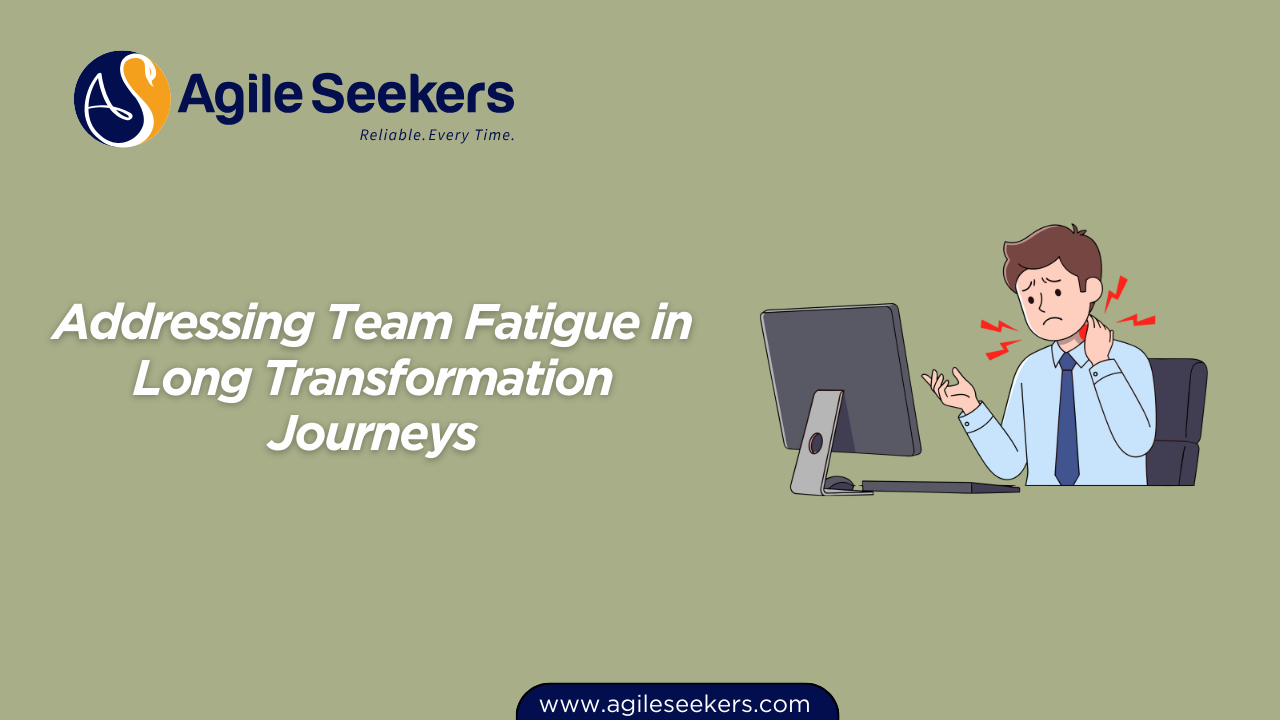
This condition is often called transformation fatigue. It appears when the pace of change stays high for too long without enough recovery, clarity, or visible impact. If organizations ignore it, productivity drops, engagement declines, and people begin to question the value of the transformation itself.
Leaders who want sustainable agility must learn how to address team fatigue. The goal is not to slow progress but to create a rhythm that teams can maintain over the long run.
Why Transformation Journeys Often Create Fatigue
Large-scale transformations introduce many changes at once. Teams must adjust to new roles, new ceremonies, new planning methods, and new expectations around delivery.
Frameworks such as SAFe bring structure to this complexity. They connect strategy to execution through Agile Release Trains, Program Increment planning, and synchronized delivery cycles. While these structures help organizations align, they also increase the number of moving parts.
When teams participate in repeated planning cycles, backlog refinements, demos, and improvement events without enough reflection time, fatigue can emerge.
Research shared by the Scaled Agile Framework highlights that large transformations require strong leadership support, continuous communication, and a sustainable pace to succeed.
Without those elements, people feel overwhelmed rather than empowered.
Signs That Teams Are Experiencing Transformation Fatigue
Fatigue rarely appears suddenly. It builds gradually and shows up through subtle behavioral changes across teams.
Common signs include:
- Reduced participation in ceremonies and discussions
- Growing skepticism toward transformation initiatives
- Teams completing rituals but losing the purpose behind them
- Lower engagement during planning sessions
- Increased resistance to process improvements
- Burnout among Scrum Masters, Product Owners, and technical leads
When leaders ignore these signals, teams begin to operate mechanically. The framework remains, but the mindset behind it fades.
The Hidden Cost of Ignoring Fatigue
Some organizations push harder when progress slows. Leaders increase reporting, add more metrics, and schedule additional transformation meetings.
This approach often makes the situation worse.
Fatigued teams do not need more pressure. They need clarity, stability, and time to absorb changes.
Studies from the McKinsey Organizational Performance group show that constant change without recovery periods significantly reduces transformation success rates.
People can adapt to change, but they cannot adapt to endless change without meaning.
Understanding the Human Side of Agile Transformation
Transformation discussions often focus on frameworks, tools, and processes. Yet the real challenge lies in human behavior.
People must unlearn habits built over years of traditional project management. They must shift from command-and-control decision making toward collaborative product development.
That transition takes emotional energy.
Scrum Masters guide teams through these changes. Product Owners adjust how they manage value delivery. Leaders learn to empower teams rather than direct them.
Training helps teams build the skills needed for this shift. Programs like the SAFe Scrum Master certification help practitioners learn how to support teams during complex transformation efforts.
However, learning new skills is only one part of the journey. Sustaining motivation is equally important.
Clarifying the Purpose of the Transformation
Fatigue often grows when teams lose sight of the transformation's purpose.
If the initiative feels like a compliance exercise, enthusiasm disappears quickly.
Leaders must continuously connect the transformation to real outcomes:
- Faster delivery of customer value
- Improved product quality
- Better collaboration across teams
- Shorter feedback cycles
- Stronger alignment between strategy and execution
When teams understand how their work improves customer outcomes, the transformation regains meaning.
Leadership training programs such as the SAFe agilist certification often emphasize this connection between organizational strategy and team execution.
Reducing Cognitive Overload During Transformation
One of the fastest ways to exhaust teams is to introduce too many changes at the same time.
Organizations sometimes launch multiple initiatives simultaneously:
- Agile adoption
- DevOps integration
- Tool migrations
- New governance models
- Structural reorganization
Each change requires learning, adaptation, and coordination.
Leaders should prioritize improvements instead of launching everything together. Focus on a few high-impact changes, stabilize them, and then move forward.
This incremental approach mirrors Agile itself.
Strengthening the Role of Product Leadership
Strong product leadership helps reduce fatigue because it provides clear priorities.
When product strategy shifts frequently, teams feel like they are chasing moving targets. They invest effort in initiatives that later lose importance.
Product Owners and Product Managers play a critical role here. They translate strategy into meaningful backlog priorities.
Many organizations strengthen this capability through structured learning paths such as the SAFe Product Owner Product Manager certification, which focuses on value management, backlog prioritization, and collaboration across Agile Release Trains.
Clear priorities reduce stress because teams know where to focus their effort.
Supporting Scrum Masters and Change Agents
Scrum Masters often carry the emotional weight of transformation efforts. They facilitate ceremonies, resolve conflicts, coach teams, and help leaders understand Agile principles.
When organizations run multiple Agile Release Trains, this role becomes even more demanding.
Advanced training programs such as the SAFe Advanced Scrum Master certification training help experienced Scrum Masters develop deeper coaching skills and conflict management techniques.
Organizations should also create peer networks where Scrum Masters can share experiences and support each other.
This simple step often reduces burnout.
Creating Real Improvement Cycles
Retrospectives and Inspect and Adapt workshops exist for a reason. They allow teams to pause, reflect, and improve.
Unfortunately, some organizations treat these events as routine ceremonies rather than learning opportunities.
To address fatigue, leaders should use improvement events to remove real obstacles.
Teams should see visible action after each reflection cycle:
- Process changes
- Tool improvements
- Reduced administrative overhead
- Clearer decision structures
When teams notice that feedback leads to change, energy returns.
The Importance of Release Train Leadership
Large transformations rely heavily on coordination across teams. The Release Train Engineer often plays a key role in maintaining alignment.
This role connects product management, system architects, and multiple delivery teams.
Training programs such as the SAFe Release Train Engineer certification training prepare leaders to manage these complex coordination challenges while supporting team health.
Strong Release Train Engineers maintain transparency and remove organizational friction that contributes to fatigue.
Maintaining a Sustainable Pace
One of the core ideas in Agile development is sustainable delivery.
Teams cannot maintain creativity or high-quality work when they operate under constant pressure.
The Agile Manifesto principles clearly state that Agile processes promote sustainable development where teams can maintain a constant pace indefinitely.
Leaders should take this principle seriously.
A sustainable pace may involve:
- Reducing unnecessary meetings
- Limiting parallel initiatives
- Improving backlog clarity
- Protecting focus time for development work
Small improvements in work rhythm often have a large impact on team energy.
Recognizing Progress and Celebrating Wins
Long transformations rarely provide instant results. Teams may work for months before seeing measurable improvements.
That delay can reduce motivation.
Leaders should highlight progress regularly:
- Improved delivery predictability
- Better customer feedback cycles
- Reduced production incidents
- Faster feature releases
Celebrating these achievements reminds teams that their efforts matter.
Encouraging Learning and Professional Growth
Transformation journeys provide excellent learning opportunities. When organizations invest in skill development, people feel more confident navigating change.
Training programs, workshops, and knowledge sharing sessions can help teams build new capabilities.
Continuous learning also shifts the mindset from surviving change to mastering it.
Building Psychological Safety
Teams experiencing fatigue often hesitate to speak openly about their struggles. They worry that raising concerns might appear negative.
Leaders must actively encourage honest conversations.
Psychological safety allows team members to discuss challenges, propose improvements, and admit mistakes without fear.
Research by Google’s Project Aristotle identified psychological safety as one of the strongest factors influencing team effectiveness.
When teams feel safe to speak openly, fatigue becomes visible earlier and easier to address.
Creating Space for Recovery
Transformation journeys require effort, but they also require recovery.
Organizations should plan occasional pauses between major transformation initiatives. These pauses allow teams to stabilize their processes and build confidence.
Even small adjustments, such as lighter iterations after major releases, can restore energy.
The goal is not to slow progress but to protect the long-term health of the organization.
Leadership Sets the Tone
Ultimately, leadership behavior determines whether transformation fatigue spreads or fades.
Leaders who demonstrate patience, curiosity, and support create an environment where teams feel motivated to continue improving.
Leaders who focus only on speed and compliance unintentionally increase pressure.
Successful transformation leaders balance ambition with empathy.
Conclusion
Long transformation journeys test both organizational systems and human resilience. Teams must adapt to new roles, new structures, and new ways of delivering value.
Without careful leadership, this journey can lead to exhaustion.
Organizations that address fatigue early create a healthier transformation environment. They prioritize clarity, maintain a sustainable pace, support continuous learning, and remove unnecessary friction.
Agile transformations succeed when people remain engaged, motivated, and confident in the direction of the change.
When leaders focus on team health as much as delivery speed, transformations move forward with renewed energy and lasting impact.
Also read - Facilitating Hard Conversations During PI Planning