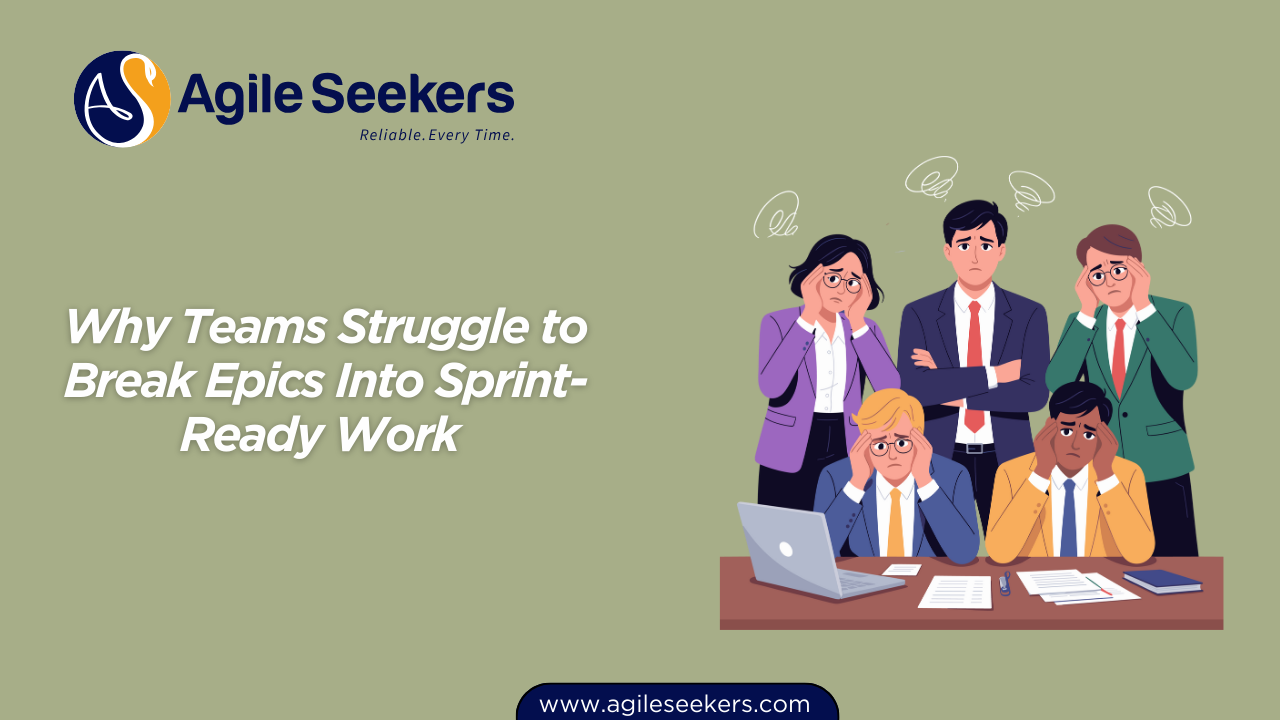
Most Agile teams say they struggle with delivery, but when you look closer, the real problem often starts much earlier. It starts with epics that refuse to become sprint-ready stories. The backlog looks full, planning feels rushed, and teams carry vague commitments into sprints. When work finally begins, surprises pile up.
This is not a tooling problem. It is not a Jira problem. And it is rarely a team capability issue. What this really comes down to is how teams think about epics, value, and flow.
Let’s break this down clearly and honestly.
What an Epic Is Supposed to Do (And What It Usually Becomes)
An epic exists to capture a meaningful business outcome. It describes a problem worth solving or an opportunity worth pursuing. At that level, it should stay intentionally broad.
The trouble begins when teams treat epics like oversized user stories. They carry too much solution detail too early or stay so abstract that no one knows where to start.
Instead of guiding discovery and conversation, epics often become parking lots for assumptions. Everyone agrees they are important. No one agrees on what “done” looks like.
When sprint planning arrives, teams try to force these half-formed ideas into sprint-sized chunks. That is where things start to crack.
Lack of Clear Business Outcomes
Teams struggle to split epics because they do not understand the outcome the epic is meant to deliver.
If an epic reads like “Improve customer onboarding” or “Modernize reporting,” it sounds useful but gives no direction. Without a clear outcome, teams cannot decide what matters first or what can wait.
Good epics answer at least three questions:
- Who benefits from this?
- What changes if we succeed?
- How will we know this created value?
When these answers are missing, story slicing turns into guesswork. Teams slice by component, role, or technical layer instead of value.
Solution-Led Thinking Creeps in Too Early
Another common trap is jumping straight to solutions.
Epics often arrive already packed with technical decisions, UI assumptions, and architecture constraints. Developers inherit an epic that quietly says, “Build it this way,” even though no one validated whether that approach solves the real problem.
When teams try to break such epics down, they end up with tasks instead of stories. Each slice depends on another slice. Nothing stands on its own.
Sprint-ready work should deliver something usable, testable, or learnable. Solution-heavy epics make that almost impossible.
Weak Product Ownership at the Epic Level
Many organizations assign epics without assigning true ownership.
Product Owners are expected to manage stories, not epics. Managers or architects define epics, then disappear. The team is left to translate strategic intent into delivery without context.
This is where strong product ownership makes a real difference. In SAFe environments, the role of a Product Owner and Product Manager becomes critical. Training like SAFe Product Owner Product Manager (POPM) certification helps leaders learn how to connect epics to features, stories, and real outcomes instead of pushing work downstream.
Without that ownership, epics drift. Backlogs fill with stories that technically belong to an epic but do not clearly move it forward.
Teams Slice by Effort Instead of Value
When pressure builds, teams default to what feels safe.
They split epics into backend stories, frontend stories, integration stories, and testing stories. Everything looks organized, but value only appears at the very end.
This creates several problems:
- Stories are not independently valuable
- Progress looks good but nothing is usable
- Feedback arrives too late
Value-based slicing is harder. It requires understanding user behavior, workflows, and decision points. It also requires collaboration across roles.
Scrum Masters play a key role here. Those who invest in deeper facilitation skills through programs like the SAFe Scrum Master certification learn how to guide teams away from task-based thinking and toward outcome-focused slicing.
Refinement Happens Too Late (Or Not at All)
Many teams treat backlog refinement as optional.
They push epic breakdown discussions into sprint planning, where time is already tight. Decisions get rushed. Assumptions go unchallenged.
Breaking epics into sprint-ready work requires space for exploration. Teams need time to ask:
- What is the smallest meaningful slice we can deliver?
- What can we validate early?
- What dependencies block this story?
Without regular refinement, epics remain too large for too long. Sprint planning becomes stressful instead of strategic.
Dependencies Are Hidden Until the Last Moment
Epics often cut across teams, systems, or vendors. When dependencies stay invisible, story slicing becomes risky.
Teams hesitate to commit to sprint work because they do not control everything needed to finish it. Stories look ready on paper but stall once work begins.
This is especially common in large-scale setups. Roles like Release Train Engineers exist to surface and manage these risks early. The SAFe Release Train Engineer certification focuses heavily on enabling flow across teams and reducing these hidden blockers.
Without this system-level view, teams keep breaking epics incorrectly or avoid breaking them at all.
Definition of Ready Is Vague or Ignored
Some teams claim they do not believe in a Definition of Ready. In practice, they suffer without one.
Sprint-ready stories share a few common traits:
- Clear acceptance criteria
- Known dependencies
- Testable outcomes
- Shared understanding across the team
When teams skip these checks, epics bleed into sprints unfinished. Work spills over. Confidence drops.
A clear Definition of Ready is not bureaucracy. It is a safety net.
Leadership Pushes for Output, Not Clarity
Here is the uncomfortable truth.
Many teams struggle with epic breakdown because leadership rewards speed over understanding. The message becomes “just start” instead of “make sense of this first.”
That pressure flows downhill. Teams slice epics hastily to meet planning deadlines. Nobody wants to slow things down by asking deeper questions.
Organizations that invest in Lean-Agile leadership development see a shift here. Programs like the SAFe certification help leaders understand why clarity upfront actually increases delivery speed over time.
Advanced Facilitation Skills Are Missing
Breaking epics is not just a technical exercise. It is a facilitation challenge.
Teams need help working through ambiguity, aligning perspectives, and making trade-offs. Without strong facilitation, discussions drift or stall.
This is where experienced Scrum Masters and Agile coaches stand out. Advanced training like the SAFe Advanced Scrum Master certification focuses on coaching teams through complexity, not just running ceremonies.
When facilitation improves, epic breakdown becomes a shared problem-solving activity instead of a frustrating chore.
How Strong Teams Break Epics Successfully
Teams that consistently turn epics into sprint-ready work do a few things differently.
- They start with outcomes, not solutions
- They involve the whole team early
- They slice for learning and feedback
- They refine continuously, not last-minute
They also borrow proven techniques such as story mapping, example mapping, and impact mapping. External resources like Jeff Patton’s work on user story mapping offer practical guidance on visualizing value and flow.
Final Thoughts
Teams do not struggle to break epics because they lack skill or motivation. They struggle because the system around them makes it hard to do the right thing.
Unclear outcomes, rushed refinement, hidden dependencies, and solution-first thinking all stack the odds against sprint-ready work.
The good news is this is fixable.
When organizations invest in better product thinking, stronger facilitation, and leadership that values clarity, epics stop being intimidating. They become what they were meant to be: a starting point for meaningful, incremental delivery.
And when that happens, sprint planning gets calmer, delivery gets smoother, and teams finally feel in control of their work.
Also read - How to Connect Sprint Planning to Long-Term Product Goals
Also see - How to Manage Team Dependencies Without Breaking Sprint Planning