Roadmaps look calm on the surface. They line up milestones, forecast priorities, and give teams something solid to rally around. But anyone who has worked in product long enough knows the calm is an illusion. Markets shift without warning. Technology forces a rethink. A competitor releases something that reshapes expectations overnight. A learning from a customer interview flips your assumptions upside down.
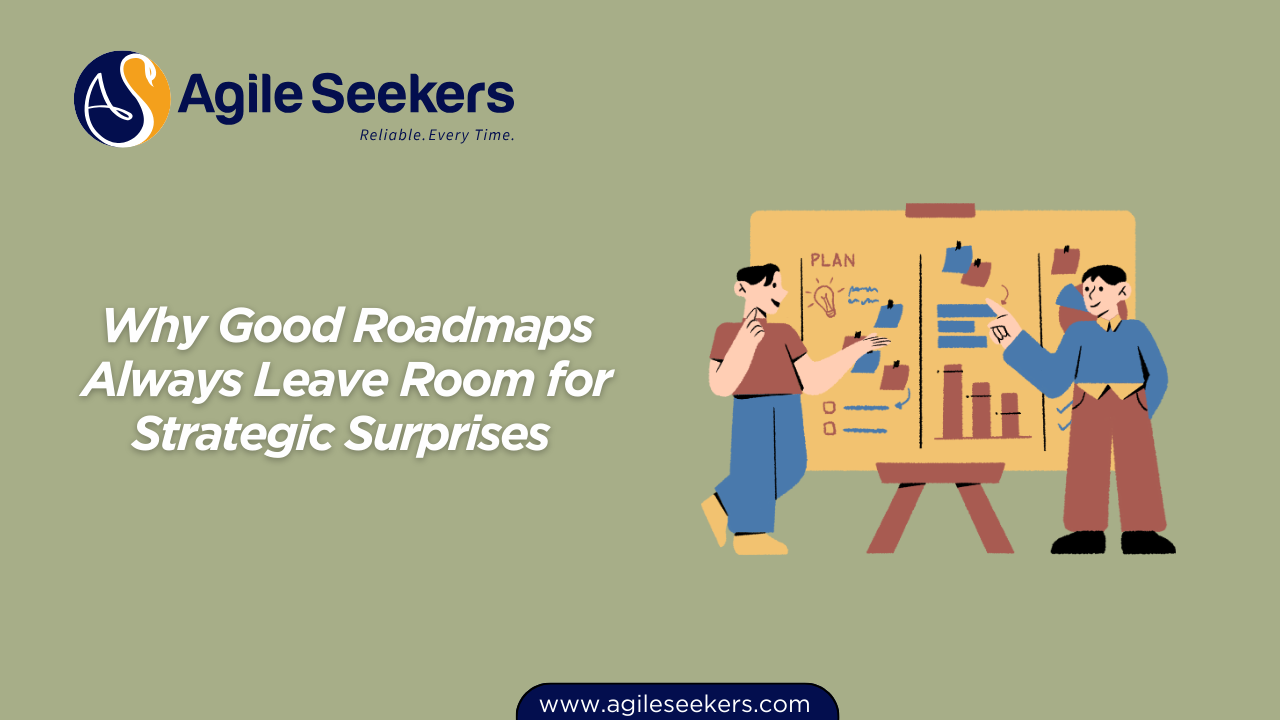
This is exactly why strong roadmaps never lock everything down. They leave intentional gaps, space for moves you didn’t expect when the plan was first drafted. These strategic surprises aren’t a sign of bad planning. They’re a sign of good leadership and awareness of how real product work unfolds.
Let’s break down what this really means and how teams can build roadmaps that stay structured without becoming brittle.
The Roadmap Is a Bet, Not a Contract
Here’s the thing: every roadmap begins with assumptions. Even when you run Discovery with care, test ideas early, and anchor decisions with data, you’re still making bets.
A roadmap that pretends every quarter is already defined usually ends up hiding this truth. Teams polish timelines instead of challenging them. The plan becomes theater instead of strategy.
Good product leaders approach roadmaps with a different mindset. They frame them as hypotheses that evolve as the team gathers new information. This mindset is heavily emphasized in SAFe agile training. It invites curiosity, experimentation, and healthy skepticism.
A roadmap can set direction while still allowing room for smart pivots. That balance is where strategic surprises flourish, in a controlled, intentional way.
Why Strategic Surprises Matter
Strategic surprises aren't random ideas tossed into a backlog. They emerge when the team discovers something meaningful and unexpected:
- A customer problem that turns out to be more widespread than assumed
- A technical shortcut that opens doors you didn’t know existed
- A market opportunity that aligns perfectly with your vision
- A competitive move that demands a timely response
- A compliance shift or new regulation
- A user pattern that disrupts your existing prioritization logic
You can’t predict these moments, but you can prepare your roadmap to respond.
This is where professionals trained through SAFe POPM certification tend to excel. They understand that a roadmap should breathe and evolve.
The Cost of Roadmaps That Are Too Tight
Teams often get stuck because their roadmap appears full for the next several quarters. It might feel productive to map everything out, but a packed roadmap creates pressure to deliver what’s written instead of what’s right.
You ignore new information
When something unexpected comes up, leaders hesitate because the plan is already committed. Valuable opportunities pass unnoticed.
You optimize for predictability instead of value
Delivery becomes a checklist routine, while customer outcomes fade into the background.
You lose the ability to negotiate trade-offs
A rigid plan puts teams into a corner, making every change feel like failure instead of evolution.
Trust erodes
Stakeholders eventually realize the roadmap isn’t grounded in reality, even if no one says it outright.
Teams who learn adaptive execution methods, like those in SAFe Scrum Master certification, understand how to keep feedback loops active so surprises never catch them flat-footed.
How Strategic Surprises Strengthen a Product Strategy
A roadmap built with intentional gaps becomes a catalyst for learning. Instead of resisting surprises, the team begins to expect them. This mindset strengthens nearly every aspect of product planning.
1. Better responsiveness to customer insights
Your roadmap becomes a living, evolving system shaped by real signals.
2. Faster adoption of new technologies
New techniques and platforms emerge constantly. Flexibility lets you take advantage of them sooner.
3. Stronger competitive positioning
Competitors won’t follow your schedule. Flexibility lets you respond quickly and confidently.
4. Higher team morale
Teams feel empowered when they aren’t trapped inside rigid plans.
5. Smarter product decisions
Surprises help the team uncover opportunities that weren’t obvious at planning time.
This adaptability is a core theme in SAFe Advanced Scrum Master certification, where leaders learn to balance structure with agility.
The Ingredients of a Roadmap Designed for Strategic Surprises
1. Clear outcomes, not fixed outputs
Outcome-driven roadmaps leave room for creative solutions. Overly detailed feature lists lock you into decisions made before learning begins.
2. Capacity buffers
Plan only around 70–80 percent of your capacity. The rest becomes your strategic reserve for unexpected discoveries.
3. Quarterly reset points
Each quarter becomes a checkpoint. You review new insights, refine priorities, and adjust direction without breaking momentum.
4. Lightweight governance
Governance should support adaptation, not slow it down. Leaders trained through SAFe Release Train Engineer certification often excel at keeping alignment strong without stifling innovation.
5. Strong discovery habits
Strategic surprises only appear when teams engage deeply in discovery, customer interviews, experiments, prototypes, data exploration, feasibility spikes, and continuous learning.
How to Communicate Strategic Slack Without Sounding Unprepared
Some leaders worry that leaving open space on the roadmap will look like a lack of planning. But with the right framing, it signals discipline and strategic maturity.
Emphasize learning
The space isn’t uncertainty, it’s flexibility that lets you invest where it matters most.
Be transparent about assumptions
Stakeholders appreciate clarity about what could change and why.
Use examples
Show how past course corrections led to stronger outcomes.
Use ranges instead of fixed dates
Target “early Q2” instead of “exact delivery in Q2”. This creates space for insights discovered during execution.
Teams that adopt this communication style, common in SAFe Scrum Master training, build deeper trust with business partners.
The Hidden Skill: Knowing Which Surprises to Ignore
Not every surprise deserves attention. Some are distractions dressed as opportunities.
Smart product leaders evaluate surprises by asking:
- Does this help us reach our vision faster?
- Does this align with our key customer outcomes?
- Is this insight driven or fear driven?
- Does the value outweigh the disruption?
A roadmap shouldn’t react to everything. It should react to the right things.
Real-World Examples of Strategic Surprises Done Well
A technical shortcut reveals a new edge
A seemingly complex capability turns out simpler than expected. This frees capacity and improves performance.
Customer interviews flip priorities
You assumed Feature A mattered most. Turns out Feature C solves a daily pain. The roadmap shifts accordingly.
New regulations reshape direction
Compliance changes often create opportunities for leadership and trust-building if addressed early.
A competitor forces a rethink
Instead of panic, the team uses the surprise as fuel to differentiate.
Building a Culture That Welcomes Good Surprises
If your culture treats change as disorder, surprises feel threatening. If your culture treats change as insight, surprises become a competitive advantage.
To create this culture:
- Reward thoughtful course corrections
- Encourage open questioning
- Run assumption reviews regularly
- Celebrate validated learning
- Never punish teams for uncovering new truths
This mindset aligns closely with the thinking behind SAFe certification.
A Helpful External Resource
If you want a clean explanation of how strategy adapts in uncertainty, Richard Rumelt’s work on kernel strategy and diagnosis-before-action offers valuable insights. You can learn more through his public talks and analyses available on major strategy platforms.
Roadmaps That Welcome Surprises Stay Relevant Longer
A roadmap that tries to predict everything eventually loses relevance. A roadmap that leaves room for discovery stays honest, adaptive, and resilient.
Surprises will happen. The question is whether your roadmap turns them into a burden or a strategic advantage.
Teams that master this balance deliver value with intention, not rigidity. They move confidently even when the field shifts.
Also read - How to Build a Roadmap When You Have Zero Historical Data
Also see - What Product Leaders Get Wrong About Long-Term Roadmap Predictability