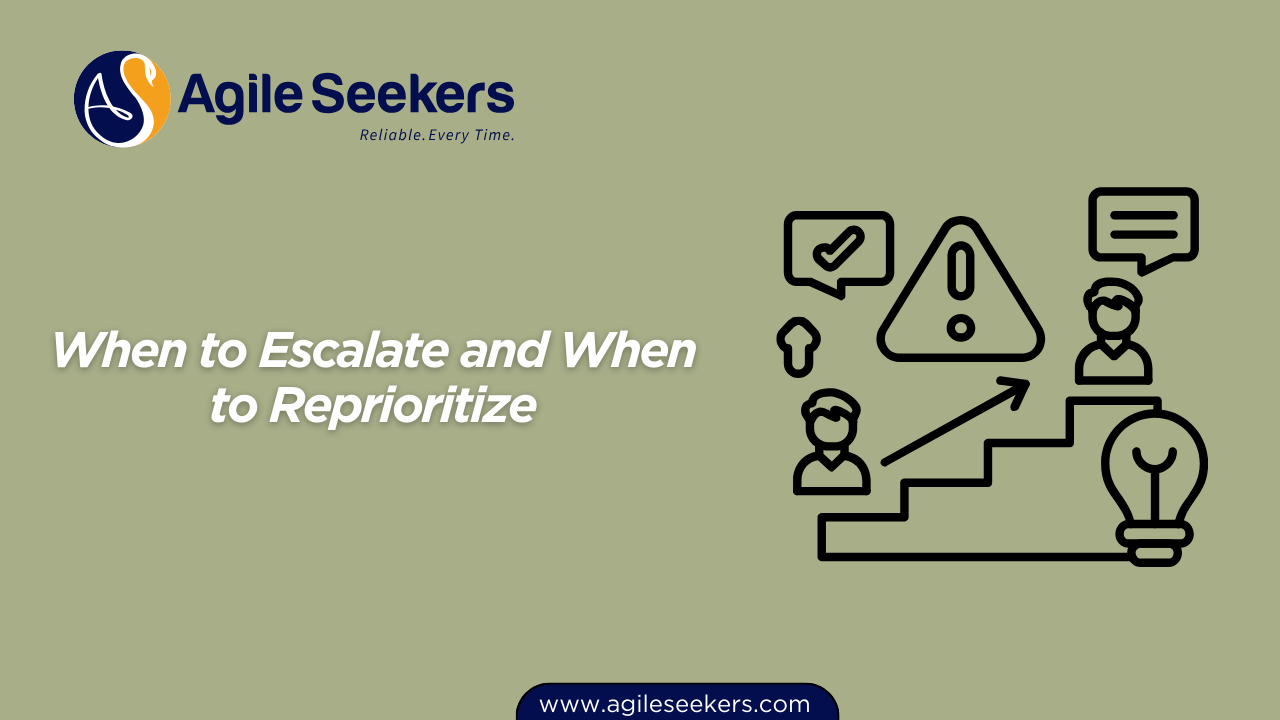
Every Agile Release Train faces the same tension at some point. A dependency slips. A feature expands. A stakeholder pushes for a late addition. A compliance requirement surfaces mid-PI. Now the question lands on your table: do we escalate this issue, or do we reprioritize the backlog?
Escalate too quickly and you create noise, tension, and decision fatigue at higher levels. Reprioritize too casually and you risk misalignment, broken commitments, or silent failure. Knowing when to escalate and when to reprioritize is not a soft skill. It is a leadership decision that protects flow, strategy, and trust.
This article breaks down how to make that call with clarity inside a SAFe environment.
The Core Difference: Escalation vs Reprioritization
Let’s define both clearly.
- Escalation means raising a problem beyond the team or ART to a higher decision-making level. That might be the RTE, LPM, business owners, or executive leadership.
- Reprioritization means adjusting the backlog sequence within existing authority and guardrails to adapt to new information.
Reprioritization preserves autonomy. Escalation shifts accountability upward.
Inside SAFe, the system is designed to enable local decisions whenever possible. The Lean-Agile Leadership model emphasizes decentralizing decision-making to the lowest responsible level. That principle alone gives you a strong starting point: escalate only when the decision exceeds your authority or impacts strategic intent.
When Reprioritization Is the Right Move
1. The Issue Fits Within Existing Guardrails
If the ART can solve the issue within approved capacity allocation, budget guardrails, and PI objectives, reprioritize. Do not escalate simply because something changed.
For example:
- A feature estimate increases but still fits within the PI capacity.
- A low-value feature can be swapped with a higher-value urgent item.
- A team dependency can be renegotiated within the ART sync.
This is standard backlog stewardship. A well-trained Product Owner or Product Manager understands how to balance these trade-offs. If your teams need stronger decision frameworks around value, the SAFe POPM certification builds deep capability in prioritization using WSJF and economic decision-making.
2. The Change Improves Value Delivery
Sometimes new information increases clarity. Customer feedback, usage data, or competitive movement might show that another feature delivers stronger business impact.
In that case, reprioritize.
SAFe encourages economic thinking. The Weighted Shortest Job First (WSJF) model exists precisely to guide these shifts. If the economics change, the sequence should change.
Escalation would slow down the very responsiveness Agile is meant to protect.
3. The Impact Is Contained to One Team or ART
If the issue does not affect portfolio strategy, cross-ART alignment, or committed external deliverables, keep it local.
Strong Scrum Masters and RTEs help contain disruption by coaching teams through adaptive planning. Teams trained through a solid SAFe Scrum Master certification program understand how to manage flow without escalating routine turbulence.
4. There Is Slack or Adjustable Scope
Good PI planning includes uncommitted capacity and stretch objectives. If you can adjust within those buffers, reprioritize instead of escalating.
Escalation should not compensate for poor planning discipline.
When Escalation Is Necessary
1. The Decision Crosses Portfolio Boundaries
If resolving the issue requires changing strategic themes, budget allocation, or portfolio guardrails, escalation is appropriate.
For example:
- A regulatory change requires immediate redirection of funding.
- A critical architectural shift impacts multiple ARTs.
- A major customer commitment conflicts with current roadmap priorities.
These decisions sit beyond ART-level authority. Lean Portfolio Management must weigh trade-offs across value streams.
Leaders who complete the SAFe agile training develop a strong grasp of how portfolio strategy connects to execution. Without that understanding, teams either escalate too much or fail to escalate when required.
2. The Risk Exceeds Accepted Tolerance
If an issue threatens delivery of committed PI objectives or creates material financial, legal, or reputational risk, escalate early.
Delaying escalation in these cases often leads to silent failure. By the time leadership discovers the issue, recovery becomes expensive.
A Release Train Engineer trained through the SAFe Release Train Engineer certification training program understands how to identify systemic risks and raise them at the right forum, whether during ART sync or Inspect & Adapt.
3. The Issue Exposes Structural Dysfunction
Some problems are not tactical. They reveal deeper coordination failure, architectural bottlenecks, or funding misalignment.
For instance:
- Recurring cross-team dependency failures.
- Chronic overcommitment across PIs.
- Persistent mismatch between business expectations and ART capacity.
Reprioritizing repeatedly in these cases masks the root cause. Escalation forces systemic correction.
4. Guardrails Would Be Violated
If reprioritizing would break WIP limits, budget constraints, compliance boundaries, or committed external agreements, escalation is mandatory.
SAFe is not a free-form system. It operates within explicit economic guardrails. Breaking them quietly damages governance integrity.
A Practical Decision Framework
When faced with tension, ask these five questions:
- Does this decision fall within my defined authority?
- Does it affect only this team or ART?
- Can we resolve it within PI capacity or scope buffers?
- Does it change portfolio strategy or funding?
- Does it increase risk beyond our tolerance level?
If the answer to the first three is yes and the last two is no, reprioritize.
If the last two become yes, escalate.
This clarity reduces emotional decision-making.
The Hidden Cost of Escalating Too Often
Frequent escalation creates three major problems:
- Decision bottlenecks at leadership levels.
- Erosion of team autonomy.
- Reduced learning at the execution layer.
Teams stop thinking economically. They wait for instructions. Over time, flow slows down.
The advanced coordination techniques taught in SAFe Advanced Scrum Master certification training focus on enabling teams to solve complex issues locally without unnecessary escalation.
The Hidden Cost of Avoiding Escalation
On the other side, avoiding escalation creates a different failure pattern.
Teams silently absorb pressure. They cut quality. They overload capacity. They compromise architecture. Eventually, systemic breakdown surfaces.
Escalation, when used correctly, protects long-term sustainability.
The key is not minimizing escalation. The key is using it deliberately.
Escalation and Reprioritization During PI Planning
PI Planning is where most escalation confusion begins.
During breakout sessions, teams discover new dependencies and constraints. Some of these are solvable through scope negotiation. Others require business owner involvement.
A simple rule helps: if adjusting scope between teams solves the dependency, reprioritize. If it requires changing committed business value or funding, escalate during management review.
Strong ART facilitation makes this visible early. That capability is central to the SAFe Scrum Master certification, which builds confidence in managing alignment under pressure.
How Economic Thinking Clarifies the Decision
Economic prioritization removes ego from the equation.
When leaders frame the conversation around cost of delay, risk exposure, and opportunity cost, the path becomes clearer. If the economic impact of waiting for leadership review outweighs the risk of local adjustment, reprioritize.
If the economic consequences exceed local authority, escalate.
This approach keeps decisions rational rather than political.
Building a Culture That Knows the Difference
The real solution is cultural, not procedural.
Organizations that invest in Lean-Agile leadership training create clarity around decision rights. People understand where authority lives. They know when to act and when to elevate.
Escalation becomes structured, not emotional. Reprioritization becomes disciplined, not reactive.
Over time, this balance strengthens trust between teams and leadership.
Final Thoughts
When to escalate and when to reprioritize is not a binary rule. It is a leadership judgment grounded in authority, economics, and risk.
Reprioritize when the solution fits within your guardrails and improves value delivery.
Escalate when the decision affects portfolio strategy, funding, systemic stability, or risk tolerance.
Organizations that master this balance protect both flow and strategy. They avoid unnecessary noise at the top while preventing silent failure at the bottom.
If your teams struggle with these trade-offs, structured training across roles makes a measurable difference. Product leaders refine economic decision-making. Scrum Masters strengthen flow discipline. RTEs sharpen systemic awareness. Executives align strategy with execution.
That alignment is where SAFe delivers real value.
Also read - Using Cost of Delay Without Manipulating the Numbers
Also see - Managing Product Risk Explicitly in SAFe