Lean-Agile leadership has never been about titles. It has always been about behavior, decisions, and the way leaders shape systems around people. What changes in 2026 is not the core intent of Lean and Agile thinking, but the complexity leaders must navigate every single day.
Organizations now operate with distributed teams, AI-assisted workflows, shorter planning horizons, and constant market pressure. Traditional command-and-control leadership cracks under this weight. Even early Agile leadership models struggle if they stop evolving.
So what actually makes a great Lean-Agile Leader in 2026?
Let’s break it down in practical terms. Not theory. Not buzzwords. Real leadership traits that show up in decisions, conversations, and outcomes.
They Lead the System, Not the People
Great Lean-Agile leaders understand a simple truth: most performance problems are system problems.
In 2026, blaming individuals for missed outcomes feels outdated and ineffective. Leaders who still focus on individual productivity metrics miss the bigger picture. Flow, dependencies, policies, and decision latency matter far more.
Strong Lean-Agile leaders invest their energy in:
- Reducing handoffs and approval delays
- Clarifying decision ownership
- Making work visible across teams
- Designing systems that encourage fast learning
They ask better questions instead of issuing faster instructions. When something breaks, they look upstream. When results slow down, they examine policies, not people.
This mindset sits at the heart of modern Lean-Agile leadership and is deeply reinforced in programs like SAFe certification, where leaders learn how systems thinking shapes business agility.
They Treat Strategy as a Living Conversation
In 2026, strategy no longer lives in annual decks or leadership offsites. Markets shift too quickly for static plans to survive.
Great Lean-Agile leaders treat strategy as a continuous dialogue between business intent and execution reality.
They regularly connect:
- Customer signals
- Portfolio priorities
- Team-level feedback
- Economic trade-off decisions
Instead of asking teams to “execute the plan,” they ask whether the plan still makes sense.
This approach creates alignment without rigidity. Teams understand why work matters, not just what needs to be delivered.
Product leaders who operate at this intersection often grow through hands-on experience combined with structured learning such as the SAFe Product Owner Product Manager (POPM) certification, which emphasizes value-driven decision-making over feature delivery.
They Make Flow a Leadership Responsibility
Flow used to be seen as a team-level concern. In 2026, leaders know better.
Flow is shaped by funding models, governance policies, organizational design, and leadership behavior. When work piles up, queues grow, or priorities constantly shift, teams cannot fix that alone.
Great Lean-Agile leaders actively monitor:
- Work-in-progress across value streams
- Time to decision, not just time to delivery
- Dependency patterns between teams
- Unplanned work entering the system
They simplify portfolios, limit parallel initiatives, and create space for finishing work instead of starting more.
This systems-level focus separates surface-level Agile adoption from real business agility.
They Coach More Than They Control
Authority still exists in 2026, but the way it’s exercised has changed.
Lean-Agile leaders understand that control slows learning. Coaching accelerates it.
This doesn’t mean leaders avoid hard decisions. It means they involve teams in problem-solving before prescribing solutions.
You’ll see these leaders:
- Ask teams how they would solve a constraint
- Encourage experiments instead of demanding certainty
- Create psychological safety for honest feedback
- Step in only when alignment or ethics are at risk
Scrum Masters often experience this shift firsthand. Those who evolve beyond facilitation into true system coaching frequently deepen their leadership impact through programs like the SAFe Scrum Master certification.
They Use Metrics to Learn, Not to Police
Data is everywhere in 2026. Dashboards update in real time. AI tools generate insights instantly.
What separates great Lean-Agile leaders is how they use metrics.
They don’t weaponize numbers. They use them to ask better questions.
Instead of focusing only on output metrics, they look at:
- Flow efficiency
- Predictability trends
- Quality signals over time
- Customer impact, not internal milestones
When metrics dip, they explore causes collaboratively. When metrics improve, they study what enabled the change.
This learning-oriented approach builds trust and encourages teams to surface real issues early.
They Balance Alignment and Autonomy
One of the hardest leadership challenges in 2026 is knowing when to align tightly and when to step back.
Great Lean-Agile leaders are clear about:
- Strategic boundaries
- Non-negotiable constraints
- Economic priorities
Within those boundaries, they give teams room to decide how work gets done.
This balance allows organizations to scale without turning agility into chaos or bureaucracy.
Advanced Scrum Masters often play a critical role here, helping leaders understand when structure helps and when it hurts. That depth of thinking is a core theme in the SAFe Advanced Scrum Master certification.
They Understand the Economics of Agility
Lean-Agile leadership in 2026 demands economic literacy.
Great leaders don’t just ask if something is valuable. They ask:
- What is the cost of delay?
- What trade-offs are we making?
- Where are we over-investing?
- What outcomes justify continued funding?
They move away from project-based thinking and toward value stream funding and incremental investment decisions.
This economic mindset helps organizations stop wasting energy on low-impact initiatives and redirect focus toward real outcomes.
They Enable Cross-Team Alignment at Scale
As organizations grow, coordination becomes harder. Dependencies multiply. Communication noise increases.
Lean-Agile leaders in 2026 don’t rely on heroics or endless meetings to manage this complexity.
They invest in clear roles, shared cadences, and transparent planning mechanisms that allow teams to align without constant escalation.
Roles like the Release Train Engineer often support this system-level alignment. Leaders who work closely with these roles understand the importance of facilitation at scale, a focus area within the SAFe Release Train Engineer certification.
They Model the Behavior They Expect
Culture follows behavior, not slogans.
In 2026, great Lean-Agile leaders know their actions carry more weight than any transformation roadmap.
If they want transparency, they share context. If they want collaboration, they break silos themselves. If they want learning, they admit mistakes openly.
Teams quickly notice whether leaders:
- Respect WIP limits
- Honor team commitments
- Listen without defensiveness
- Act on feedback
This consistency builds credibility, which no framework can replace.
They Embrace AI Without Losing Human Judgment
AI plays a growing role in planning, analysis, and forecasting in 2026. Lean-Agile leaders don’t fear it, and they don’t blindly trust it either.
They use AI to:
- Spot patterns faster
- Reduce administrative load
- Support data-informed decisions
At the same time, they retain human judgment for ethical decisions, customer empathy, and long-term direction.
This balance prevents over-automation while still capturing AI’s advantages.
They Invest in Continuous Learning
The best Lean-Agile leaders in 2026 never consider themselves “done.”
They invest in:
- Personal leadership growth
- Systems thinking skills
- Coaching capabilities
- Business and technology awareness
They encourage the same mindset across the organization, creating learning loops instead of static maturity models.
Formal learning paths, peer communities, and real-world experimentation all play a role in keeping leadership relevant.
Final Thoughts
What makes a great Lean-Agile Leader in 2026 is not mastery of a framework. It’s the ability to think in systems, act with clarity, and lead with intent.
These leaders remove friction instead of adding pressure. They create focus instead of noise. They trust teams while holding the system accountable.
As complexity grows, this kind of leadership becomes less optional and more essential.
Organizations that invest in developing Lean-Agile leaders at every level don’t just adapt to change. They shape it.
Also read - Breaking organizational silos with shared KPIs and dashboards
Also see - Skills gap in scaled agile roles and how to close it
Culture reads the calendar, budget, and response to bad news
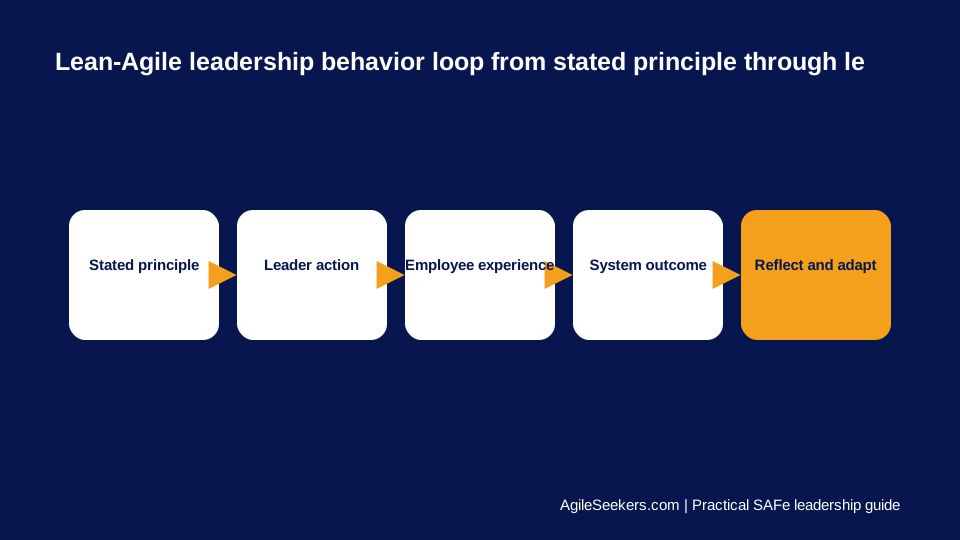
Lean-Agile leaders drive and sustain change by leading through example, modeling the mindset and principles, and creating conditions where people and teams can perform. Employees infer real priorities from which meetings leaders attend, how decisions are delegated, what work receives funding, and whether early risk reporting is rewarded or punished.
Turn principles into visible behavior
| Claim | Observable leader behavior |
|---|---|
| Respect for people | Involve affected people and challenge the system before blaming an individual |
| Decentralize decisions | Publish guardrails and leave local choices local |
| Make value flow | Limit demand, remove queues, and finish before starting more |
| Build quality in | Fund technical health and respond to evidence early |
| Relentless improvement | Run experiments and change leadership policy when results fail |
Inspect the shadow your incentives cast
A leader may ask teams to collaborate while rewarding individual utilization, request transparency while punishing forecast variance, or promote customer outcomes while funding output targets. Review performance systems, approval thresholds, budgeting, recognition, and escalation behavior. Culture will follow those mechanisms more reliably than a values presentation.
Leadership reflection after a difficult decision
- Which principle did the decision demonstrate?
- Whose knowledge influenced the choice?
- What authority remained with teams?
- What evidence would change the decision?
- Did our response make future risk reporting safer?
- Which system condition should we change next?
Leading SAFe training develops the leadership and SAFe foundation. SAFe RTE certification training helps leaders see how policies and decisions affect ART flow.