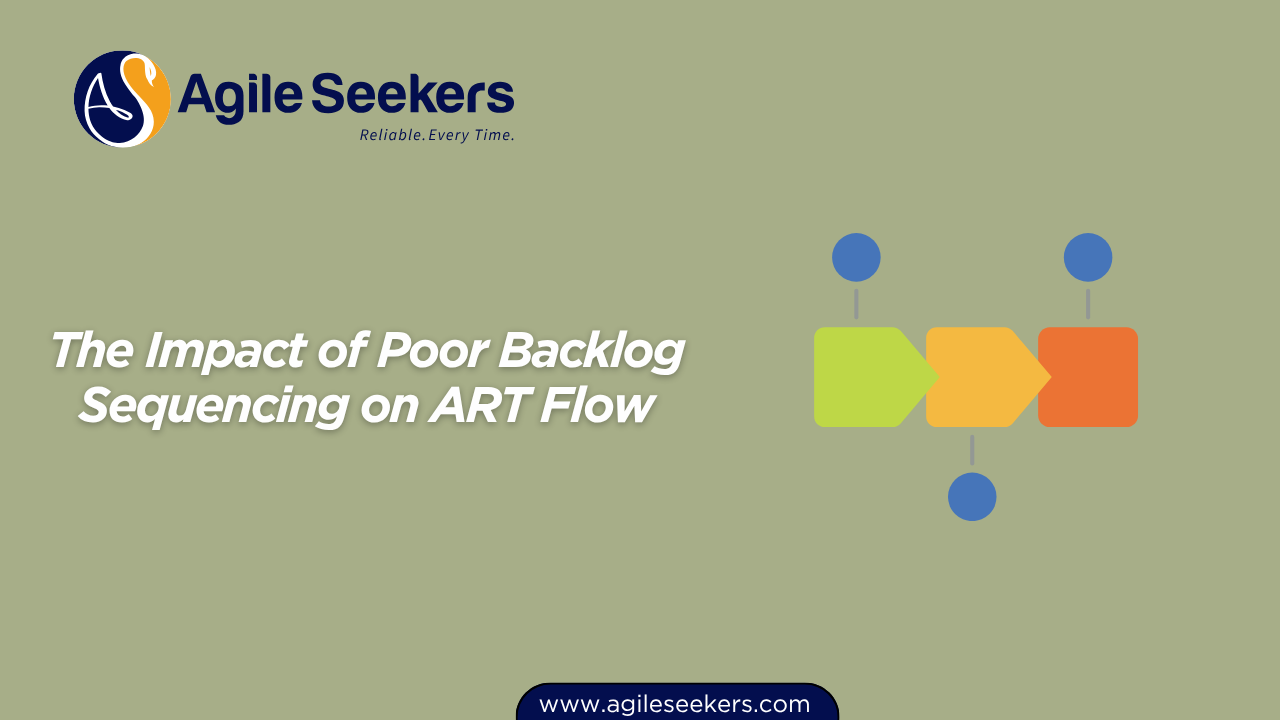
Backlog sequencing doesn’t get the attention it deserves. Teams often focus on writing better user stories, improving estimates, or speeding up delivery. But here’s the thing, if the order of work is wrong, even the best teams struggle to maintain flow.
In a SAFe Agile Release Train (ART), sequencing is not just about prioritization. It directly affects how value moves across teams, how dependencies are handled, and how predictable delivery becomes. When sequencing breaks down, the entire system slows down, even if individual teams are performing well.
Let’s break down how poor backlog sequencing impacts ART flow and what teams can do to fix it.
What Backlog Sequencing Really Means in SAFe
Backlog sequencing is often confused with prioritization. Prioritization decides what matters most. Sequencing decides the order in which work should happen to enable flow.
In SAFe, this becomes more critical because multiple teams work together on shared objectives. Features, enablers, and dependencies span across teams within the ART.
Frameworks like Weighted Shortest Job First (WSJF) help prioritize work based on economic impact. But sequencing goes a step further. It answers questions like:
- What needs to be done first to unblock other teams?
- Which features should move together to deliver value?
- What dependencies must be resolved early?
When these questions are ignored, flow starts to break.
How Poor Sequencing Disrupts ART Flow
1. Dependency Chaos Across Teams
One of the biggest issues caused by poor sequencing is unmanaged dependencies. Teams pick up work that looks important but depends on something not yet built.
This creates:
- Blocked stories
- Idle time
- Frequent context switching
Instead of a smooth flow, work starts and stops repeatedly. The ART begins to feel slow and unpredictable.
Strong sequencing ensures dependency-heavy items are handled early, reducing waiting time across teams.
2. Increased Work in Progress (WIP)
When sequencing is weak, teams start multiple items hoping something will move forward. This increases WIP across the ART.
High WIP leads to:
- Slower cycle times
- Reduced focus
- Lower quality output
According to Kanban principles, limiting WIP is key to improving flow. Poor sequencing does the opposite, it encourages teams to keep starting instead of finishing.
3. Broken Feature Flow
ARTs deliver value through features. But when backlog items are sequenced poorly, features get split across sprints in a fragmented way.
This leads to:
- Partially completed features
- Delayed business value
- Confusing system demos
Instead of seeing meaningful progress, stakeholders see incomplete work.
Proper sequencing aligns stories so that features move forward cohesively, not in scattered fragments.
4. Unpredictable PI Outcomes
Teams may commit confidently during PI Planning, but poor sequencing undermines those commitments during execution.
Why?
- Dependencies surface late
- Critical work gets delayed
- Teams re-plan mid-PI
This results in missed PI objectives and reduced trust in planning.
Predictability doesn’t fail because teams are incapable. It fails because the sequence of work doesn’t support flow.
5. Bottlenecks That Keep Moving
Without proper sequencing, bottlenecks don’t disappear, they shift.
One sprint, it’s a backend dependency. Next sprint, it’s testing. Then integration.
These moving bottlenecks are hard to detect and even harder to fix.
Flow-based metrics like Flow Metrics help identify these patterns, but sequencing is what prevents them in the first place.
Why Teams Struggle with Backlog Sequencing
1. Over-Focus on Priority, Not Flow
Teams often ask, “What is most important?” instead of “What should come first to enable flow?”
These are not the same.
A high-priority feature that depends on unfinished work shouldn’t be sequenced first.
2. Lack of Cross-Team Visibility
Sequencing requires understanding dependencies across teams. Without visibility, teams optimize locally.
This creates misalignment at the ART level.
3. Weak Backlog Refinement
Backlog refinement often focuses on story clarity, not sequencing logic.
Teams refine stories individually but don’t align them in a flow-friendly order.
4. Ignoring Enablers
Enablers are often pushed down the backlog because they don’t deliver immediate business value.
But skipping enablers breaks sequencing. Teams later struggle with technical blockers that could have been resolved earlier.
The Hidden Cost of Poor Sequencing
Poor sequencing doesn’t just slow teams down. It creates deeper organizational issues:
- Reduced trust: Stakeholders lose confidence in delivery timelines
- Team frustration: Constant blockers and rework drain motivation
- Lower throughput: Less value delivered despite high effort
- More firefighting: Teams react instead of plan
Over time, this becomes a cultural issue, not just a process problem.
How to Improve Backlog Sequencing in SAFe
1. Sequence for Flow, Not Just Priority
Start thinking in terms of flow:
- What enables other work?
- What reduces risk early?
- What unblocks multiple teams?
This shift changes how backlogs are structured.
2. Visualize Dependencies Clearly
Use tools like dependency boards or program boards during PI Planning.
Make dependencies visible, then sequence work to resolve them early.
3. Align Backlog Refinement Across Teams
Backlog refinement shouldn’t happen in isolation. ART-level alignment is essential.
Product Owners and Product Managers should collaborate regularly to sequence work across teams.
If you want to strengthen this capability, exploring a SAFe Product Owner and Manager Certification can help build the right mindset and skills.
4. Prioritize Enablers Strategically
Don’t treat enablers as optional. Treat them as flow enablers.
Sequence them early to avoid technical bottlenecks later.
5. Use Flow Metrics to Guide Sequencing
Track metrics like:
- Flow time
- Flow efficiency
- Flow load
These metrics highlight where sequencing is breaking down.
6. Strengthen the Role of Scrum Masters
Scrum Masters play a key role in identifying flow issues.
They should:
- Highlight blocked work
- Reduce WIP
- Facilitate better sequencing conversations
Building these capabilities is part of a strong SAFe Scrum Master Certification journey.
7. Improve ART-Level Coordination
Roles like Release Train Engineers (RTEs) ensure alignment across teams.
They help:
- Identify cross-team dependencies
- Facilitate sequencing decisions
- Maintain flow across the ART
Professionals aiming to lead at this level can benefit from a SAFe Release Train Engineer Certification.
Sequencing in Action: A Simple Example
Consider a feature that requires:
- Backend API changes
- UI updates
- Integration testing
Poor sequencing:
- UI team starts first
- Backend work is delayed
- Integration fails later
Result: rework, delays, frustration.
Better sequencing:
- Backend work starts first
- UI follows once APIs are ready
- Integration happens smoothly
Same work. Different outcome.
The Leadership Angle: Why Sequencing Needs Attention
Backlog sequencing is not just a team-level concern. Leadership plays a big role.
Leaders need to:
- Encourage system thinking over local optimization
- Support cross-team collaboration
- Focus on flow efficiency, not just output
Programs like the Leading SAFe certification help leaders understand how to manage flow at scale.
Common Signs Your Backlog Sequencing Is Broken
- Frequent blockers across teams
- Stories started but not finished
- Features dragging across multiple sprints
- Constant re-planning during the PI
- Low predictability despite high effort
If you see these patterns, sequencing is likely the root cause.
Final Thoughts
Teams often try to fix flow problems by working harder, adding more people, or improving tools. But many of these issues come down to something simpler, the order in which work is done.
Backlog sequencing shapes how smoothly value moves through an ART. Get it right, and flow improves naturally. Get it wrong, and even high-performing teams struggle.
Focus less on doing more, and more on doing things in the right order. That’s where real improvement begins.
For teams and leaders who want to deepen their understanding of flow, coordination, and scaled delivery, certifications like SAFe Advanced Scrum Master Certification offer practical insights into improving ART performance.
Also read - Why Feature Acceptance Gets Delayed Even After Development Is Done
Also see - How Context Switching Kills Productivity in SAFe Teams