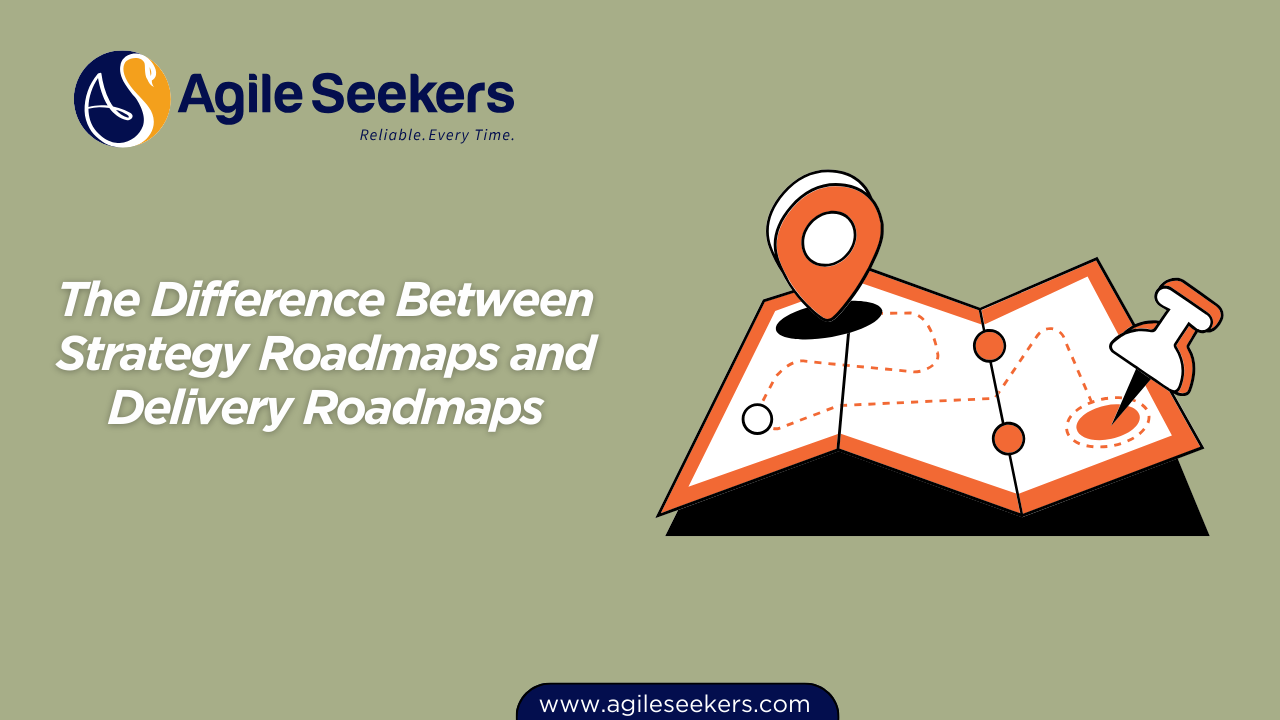
Roadmaps often get treated as a single artifact, but strategy roadmaps and delivery roadmaps play very different roles. When teams blur them together, it leads to shifting priorities, confused communication, and unrealistic expectations. When used separately and intentionally, they create alignment across product, engineering, and business layers.
This guide breaks down what each roadmap does, why both matter, and how to use them together without losing clarity.
Why Two Roadmaps Exist
A strategy roadmap explains why and where the organisation is heading. A delivery roadmap explains what will be built and when teams expect to deliver it. Both are essential. Strategy without execution stalls. Delivery without strategy drifts.
Many leaders sharpen this understanding through learning programs like the Leading SAFe training, which reinforces how strategy translates into execution in a Lean-Agile organisation.
What a Strategy Roadmap Really Does
A strategy roadmap frames long-term direction. It answers questions such as:
- Which customer segments matter most?
- Which capabilities will drive the next stage of growth?
- Where should we invest, and what outcomes should those investments deliver?
It focuses on themes, value streams, capabilities, and long-range outcomes rather than features or release dates.
Key characteristics of a strategy roadmap
- Longer horizon: usually 12–36 months.
- Outcome-led: success is defined through measurable results.
- Flexible: strategy gets refined as new insights appear.
- Theme and capability-driven: avoids examining solution details too early.
- Used by executives and portfolio leaders: helps guide funding and investment choices.
The strategy roadmap also feeds directly into portfolio-level collaboration supported by roles taught in the SAFe Release Train Engineer certification training.
What a Delivery Roadmap Really Does
Once strategic direction is clear, teams need a grounded view of what they will deliver over the next few increments. The delivery roadmap handles this.
It answers questions such as:
- Which features will the teams deliver next?
- How do dependencies affect sequencing?
- What risks or unknowns need early spikes?
- What does the plan look like across upcoming PIs?
Key characteristics of a delivery roadmap
- Shorter horizon: usually one to four PIs (6–12 months).
- Feature-focused: more tangible than strategy-level themes.
- Continuously updated: reflects discovery and feedback.
- Reflects complexity: includes enablers, risks, and capacity constraints.
- Used by ART leadership, POPMs, POs, Scrum Masters, and teams: becomes part of day-to-day planning.
The translation of strategy into executable work is a core skill developed in the SAFe Product Owner/Product Manager POPM certification, where product leaders learn how to convert themes into features and increments.
Why Organisations Confuse the Two
The confusion usually comes from trying to please everyone with one roadmap. Stakeholders want long-term visibility. Teams want realistic expectations. A single roadmap cannot satisfy both.
Common sources of confusion include:
- Requests for precise delivery dates far too early.
- Mixing strategy themes and PI-level features into one chart.
- Not translating outcomes into executable work.
- Unclear portfolio priorities or shifting investment patterns.
The separation becomes clearer when leaders understand how portfolio vision flows down to team execution, something reinforced in structured learning like the SAFe Scrum Master certification.
How Strategy and Delivery Roadmaps Connect
These two roadmaps aren’t competing, they complete each other. One provides direction. The other describes how teams will make progress step by step.
- Strategic themes define what matters.
- Capabilities show the systems or competencies needed to deliver the strategy.
- Epics break capabilities into manageable initiatives.
- Features emerge from epics once ARTs engage in discovery.
- Delivery roadmaps sequence features across PIs.
- Inspect and Adapt loops refine both roadmaps continuously.
This flow becomes smoother when leaders build mastery through advanced learning, such as the SAFe Advanced Scrum Master certification training.
Why Strategy Roadmaps Fail
Strategy roadmaps struggle when they remain too abstract or too broad. Common issues include:
- Vague or non-measurable outcomes.
- No prioritization among strategic themes.
- Frequent shifts caused by opinion rather than evidence.
- Lack of clarity around investment choices.
A good strategy roadmap creates focus. A poor one creates noise.
Why Delivery Roadmaps Fail
Delivery roadmaps falter when teams commit too early or overcommit based on pressure rather than capacity. Other challenges include:
- Dependency complexity that wasn’t mapped early.
- Not enough discovery work to understand feasibility.
- Ignoring enablers and technical constraints.
- Failing to update the roadmap as new information emerges.
Strong execution discipline, often taught in roles trained through SAFe Scrum Master certification, keeps delivery roadmaps grounded and credible.
Strategy vs Delivery Roadmap: A Simple Comparison
| Aspect | Strategy Roadmap | Delivery Roadmap |
|---|---|---|
| Purpose | Set long-term direction | Guide near-term execution |
| Horizon | 12–36 months | 6–12 months |
| Focus | Outcomes, themes, capabilities | Features, increments, risks |
| Detail | High-level | Granular |
| Owners | Executives, portfolio leaders | POPMs, Scrum Masters, RTEs, teams |
| Flexibility | Evolves quarterly | Refined every PI |
How to Use Both Roadmaps Without Confusion
- Start from outcomes. Features come later.
- Use separate views for different audiences. Executives need direction; teams need near-term clarity.
- Run quarterly alignment checkpoints. This keeps strategy stable without being rigid.
- Communicate uncertainty. Delivery is never absolute, show ranges or confidence levels.
- Ground delivery in discovery. Avoid planning features you haven’t explored technically.
- Let both roadmaps influence each other. Strategy and execution should shape each other continuously.
A Practical Example
Imagine a company planning to expand into a mid-market customer segment.
The strategy roadmap would outline:
- Goal: expand into mid-market accounts
- Theme: strengthen onboarding and automation
- Capabilities: provisioning automation, analytics, role management
- Horizon: 18–24 months
The delivery roadmap would outline:
- PI 1: spike automated provisioning
- PI 2: introduce basic role management
- PI 3: release beta onboarding flow
- PI 4: refine analytics and expand automation
Both roadmaps align, but each speaks a different language.
Helpful External References
You may find additional value in resources like the SAFe Portfolio Roadmap guidelines, Roman Pichler’s product strategy material, or Aha!’s roadmapping models. These expand on techniques for structuring long-range strategy without drowning in detail.
Final Thoughts
Strategy roadmaps and delivery roadmaps aren’t versions of the same thing. They are separate tools that work best when used together. One sets direction. The other shows how teams plan to move toward that direction through increments of value.
Get both right, and the organisation gains clarity, alignment, and predictable progress across teams, ARTs, and portfolios.
Also read - How to Build a Roadmap That Aligns Product, Engineering, and Business Priorities
Also see - Building a Technical Roadmap That Doesn’t Clash With the Product Roadmap
Product and AI path
Turn this product-management topic into applied AI practice
For product managers and product owners, the highest value is using AI safely for discovery, prioritization, PRDs, roadmap trade-offs, and stakeholder decisions.