Most teams understand psychological safety at a local level. A Scrum team feels safe to speak up, share ideas, and admit mistakes. That’s a good start. But here’s the real challenge, what happens when you try to extend that safety across multiple teams, Agile Release Trains, or even the entire organization?
This is where many Agile transformations struggle. One team feels safe, another stays silent. One Product Owner challenges assumptions, another avoids conflict. Over time, this inconsistency creates friction, slows decisions, and weakens flow.
Scaling psychological safety is not about running more workshops or adding values to posters. It requires structural alignment, leadership behavior shifts, and deliberate system design.
Let’s break it down.
What Psychological Safety Really Means at Scale
Psychological safety is often misunderstood as “being nice” or avoiding conflict. That’s not it. It means people feel safe to take risks, ask questions, challenge ideas, and admit uncertainty without fear of blame or punishment.
At the team level, this shows up in retrospectives, daily stand-ups, and planning discussions. But at scale, it becomes more complex.
Now you’re dealing with:
- Cross-team dependencies
- Leadership influence
- Portfolio-level decisions
- Organizational politics
Safety must exist not just within teams, but between teams, across hierarchies, and inside decision-making forums.
According to Google’s Project Aristotle research, psychological safety is the most critical factor in team effectiveness. What this really means is simple: when people feel safe, they contribute more. When they don’t, they withdraw.
At scale, that withdrawal becomes expensive.
Why Psychological Safety Breaks Down Beyond One Team
Many organizations assume that if individual teams are safe, the system will naturally scale. It doesn’t work that way.
Here’s where things usually fall apart:
1. Misaligned Leadership Behaviors
One leader encourages open discussion. Another shuts it down in reviews. Teams quickly learn where it’s safe to speak and where it’s not.
That inconsistency creates confusion and silence.
2. Fear in Decision-Making Forums
Events like PI Planning, System Demos, or Inspect & Adapt sessions should encourage transparency. But if leaders react defensively or punish bad news, teams start hiding risks.
What you get instead is filtered information.
3. Dependency Pressure Between Teams
When teams depend on each other, blame can creep in. One team delays another. Frustration builds. Conversations shift from problem-solving to finger-pointing.
Safety disappears quickly in these situations.
4. Metrics Used as Weapons
Metrics should drive learning. But when used to compare teams or evaluate individuals, they create fear.
Instead of honest reporting, teams optimize for perception.
The result? You lose visibility into real problems.
The Cost of Low Psychological Safety at Scale
When safety doesn’t scale, the impact is visible across the system:
- Risks surface late
- Decisions slow down
- Innovation drops
- Dependencies increase friction
- Teams avoid accountability conversations
This directly affects flow and delivery predictability.
If you're building large-scale Agile systems, understanding these dynamics is a key part of Leading SAFe certification, where leadership alignment plays a central role in creating a safe environment.
Shifting from Team Safety to System Safety
Scaling psychological safety requires a shift in thinking.
Instead of asking, “Do teams feel safe?” start asking:
- Can teams challenge leadership decisions?
- Can Product Owners push back on priorities?
- Can teams openly discuss risks during PI Planning?
- Can failures be shared without blame?
System safety means people feel safe across boundaries, not just within their immediate team.
Practical Ways to Scale Psychological Safety
1. Standardize Leadership Behaviors
Leaders shape safety more than any process.
If leaders react negatively to bad news, safety collapses instantly. If they reward transparency, it spreads.
Consistency matters more than intent.
Leaders should:
- Ask questions instead of giving directives
- Encourage dissenting views
- Respond calmly to problems
- Focus on learning, not blame
These behaviors must be visible across all levels, not just within teams.
This mindset is deeply explored in SAFe Release Train Engineer certification, where facilitating safe environments across ARTs is a key responsibility.
2. Redesign Key Events for Openness
Events are where culture becomes visible.
Take PI Planning as an example. If teams feel judged during plan reviews, they will hide uncertainties.
To improve safety:
- Normalize risk discussions
- Encourage early escalation
- Avoid public criticism
- Focus on problem-solving instead of performance
When events feel safe, transparency increases naturally.
3. Align Incentives with Learning
People respond to what gets rewarded.
If organizations reward only outcomes, teams hide problems. If they reward learning and transparency, teams surface issues early.
This is where many scaling efforts fail, they keep traditional performance systems while expecting Agile behaviors.
Fixing this requires alignment at the portfolio level.
The SAFe POPM certification emphasizes how Product Owners and Product Managers can drive value while maintaining transparency and trust.
4. Create Safe Escalation Paths
Teams should not feel stuck when facing blockers.
They need clear, safe ways to escalate issues without fear of blame.
This includes:
- Transparent dependency tracking
- Open escalation forums
- Leadership support for problem-solving
When escalation feels safe, flow improves.
5. Use Metrics to Learn, Not Control
Metrics should guide conversations, not create pressure.
Focus on:
- Flow metrics
- Cycle time trends
- Work in progress limits
Avoid comparing teams or using metrics for individual evaluation.
If teams feel judged, they will manipulate data.
For deeper understanding, SAFe Scrum Master certification explores how to use metrics to improve collaboration rather than control behavior.
6. Encourage Cross-Team Collaboration
Safety grows when teams trust each other.
Encourage:
- Shared problem-solving sessions
- Communities of practice
- Cross-team retrospectives
This reduces blame and builds collective ownership.
7. Train Teams to Handle Healthy Conflict
Psychological safety does not mean avoiding conflict. It means handling it well.
Teams should learn how to:
- Challenge ideas respectfully
- Separate people from problems
- Focus on outcomes
This is where experienced facilitators play a key role. Advanced facilitation skills are covered in SAFe Advanced Scrum Master training, especially in complex team environments.
The Role of Leaders in Scaling Safety
Scaling psychological safety is not a team-level initiative. It’s a leadership responsibility.
Leaders must create an environment where:
- Bad news travels fast
- Questions are encouraged
- Assumptions are challenged
- Failures lead to learning
According to Harvard Business Review, leaders who admit their own mistakes set the tone for openness across the organization.
That behavior signals that it’s safe to be honest.
How AI Is Changing Psychological Safety in SAFe
There’s another layer emerging, AI.
AI is starting to influence how teams interact, plan, and make decisions in SAFe environments.
This creates both opportunities and risks for psychological safety.
Opportunities:
- AI can surface risks earlier
- AI can provide neutral insights
- AI can reduce bias in decision-making
Risks:
- Teams may rely too much on AI outputs
- Leaders may use AI data to control teams
- Transparency may decrease if AI decisions are not explained
The key is to use AI as a support system, not a control mechanism.
When used correctly, AI can actually strengthen psychological safety by making data more accessible and conversations more objective.
Measuring Psychological Safety at Scale
You can’t improve what you don’t measure. But measuring safety is tricky.
Instead of relying only on surveys, look for behavioral signals:
- How often do teams raise risks early?
- Do people challenge leadership decisions?
- Are retrospectives honest or superficial?
- Do teams admit mistakes openly?
These indicators reveal more than any metric.
Final Thoughts
Scaling psychological safety is not about rolling out a framework or running training sessions. It’s about creating a system where people feel safe to think, speak, and act honestly, across teams, roles, and hierarchies.
One safe team is not enough.
You need safe interactions between teams. Safe conversations with leadership. Safe escalation paths. Safe decision-making environments.
That’s what allows Agile systems to function at scale.
When psychological safety spreads across the organization, something important happens. Problems surface early. Decisions improve. Teams collaborate better. And flow becomes predictable.
That’s when Agile starts delivering real value, not just at the team level, but across the entire system.
Also read - The Hidden Politics of Prioritization
Also see - AI as a Strategic Advisor in Lean Portfolio Management
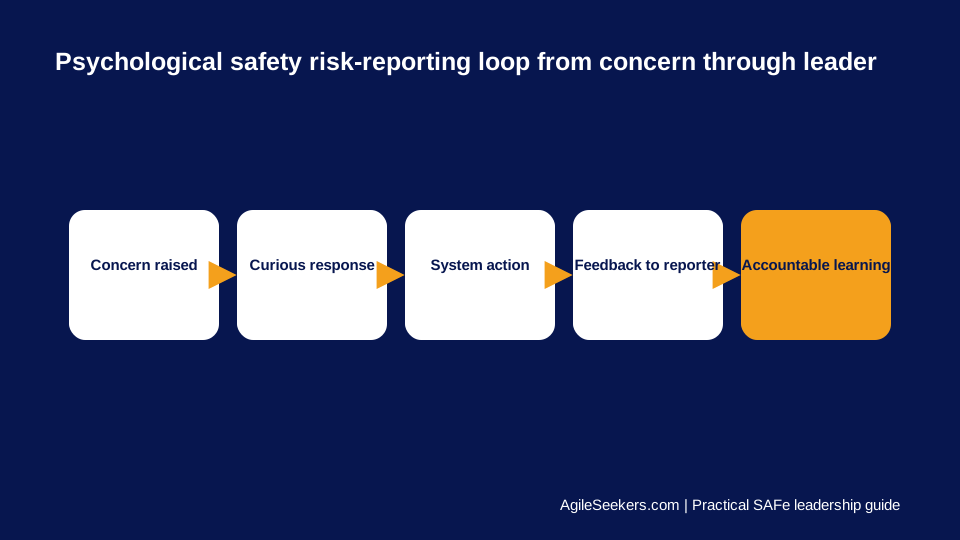
Safety is tested when the news is inconvenient
Psychological safety means people can raise questions, mistakes, risks, and dissent without interpersonal punishment. It does not remove quality standards, honest performance conversations, or responsibility for harmful choices. Across ARTs, safety depends on how leaders and governance systems respond when information threatens a commitment, budget, supplier relationship, or executive narrative.
Build safety into the escalation path
- Offer direct, facilitated, and confidential reporting routes.
- Acknowledge the concern and name the response owner.
- Separate immediate containment from causal learning.
- Protect reporters from retaliation and gossip.
- Return the decision and action to affected people.
- Escalate systemic patterns beyond the local team.
Replace blame reviews with accountable learning
Examine conditions, signals, decisions, incentives, workload, interfaces, and safeguards. People still own deliberate misconduct and repeated disregard of known standards. The review should distinguish human error, risky system design, and reckless behavior rather than assuming every failure has the same response.
Signals safety is becoming performative
| Claim | Contrary evidence |
|---|---|
| Speak up | Forecast challenges disappear from large meetings |
| Learn from failure | Incident actions focus on retraining individuals |
| No blame | Leaders privately identify who caused the miss |
| Transparency | Bad news travels slowly upward |
| Accountability | Actions have no owner or completion evidence |
ICP-ACC coaching training develops listening and coaching capabilities. Leading SAFe certification training helps leaders redesign systems and model the response employees experience.