Many Agile professionals start their journey by facilitating ceremonies. They run stand-ups, plan sprints, guide retrospectives, and support reviews. They keep conversations structured and time-boxed. Teams appreciate them because meetings feel organized and predictable.
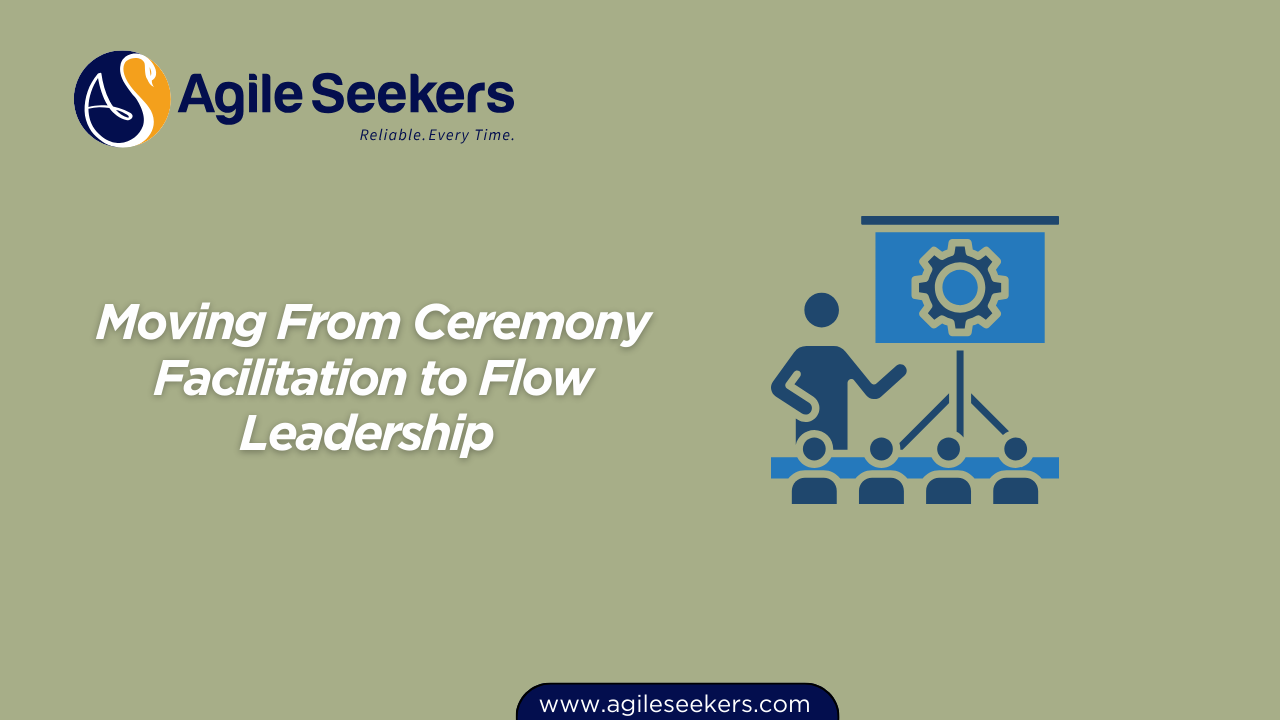
But here’s the thing. Agile maturity does not stop at well-run ceremonies. If you want real impact, you must move beyond facilitation and step into flow leadership.
Flow leadership shifts your focus from “Did we conduct the event?” to “Is value moving smoothly through the system?” It changes how you think about backlog structure, dependencies, WIP limits, decision latency, and delivery outcomes. It moves you from managing calendars to shaping systems.
This article explores how to make that shift, what it requires, and how roles such as Scrum Masters, Product Owners, and Release Train Engineers evolve when they start leading for flow instead of merely facilitating events.
What Ceremony Facilitation Looks Like
Ceremony facilitation is event-centered. The Scrum Master ensures the Daily Scrum happens. The Product Owner prepares for Sprint Planning. The RTE coordinates PI Planning. Everyone knows the cadence.
This work matters. Without structure, teams drift. Frameworks like Scrum and SAFe emphasize cadence and synchronization for a reason.
But problems arise when success is measured by attendance and agenda completion rather than business outcomes. You might hear statements like:
- “All ceremonies are happening regularly.”
- “Velocity is stable.”
- “Retrospectives are conducted every sprint.”
Yet customers still complain. Releases slip. Dependencies block progress. Features wait weeks for validation. Teams feel busy but not effective.
This gap signals the need for flow leadership.
What Flow Leadership Really Means
Flow leadership focuses on how work moves from idea to value. It asks tough questions:
- How long does it take for a feature to move from concept to customer?
- Where does work stall?
- Which dependencies slow us down?
- Are we optimizing locally while hurting the system?
Flow leadership uses metrics such as cycle time, lead time, throughput, and flow efficiency. It studies queues and handoffs. It looks at system-level bottlenecks instead of team-level output.
When you shift your attention from event management to system performance, your influence expands. You stop asking, “Did we complete the sprint?” and start asking, “Did we reduce time to value?”
Why Ceremony Excellence Is Not Enough
Let’s break it down. A team can run flawless ceremonies and still struggle because:
- Backlogs are overloaded.
- Features are oversized.
- Dependencies are unmanaged.
- Priorities change mid-iteration.
- Architectural runway is weak.
None of these problems get solved by better timekeeping in meetings.
Flow leadership addresses structural issues. It examines how epics decompose into features and stories. It challenges overcommitment. It ensures alignment between strategy and execution.
This is where deeper capability comes in. Programs like the SAFe certification help leaders understand system thinking, Lean principles, and portfolio alignment beyond team rituals.
From Facilitator to System Thinker
Moving to flow leadership requires a mindset shift.
1. Shift from Agenda to Outcome
Instead of asking, “What is the agenda for Sprint Review?” ask, “What learning do we need from customers this iteration?”
Instead of focusing on PI Planning logistics, focus on dependency mapping and risk exposure across teams.
2. Visualize Work End-to-End
Use Kanban systems to see how work moves. Visual boards reveal where items pile up. They expose handoff delays and approval bottlenecks.
The Kanban method, described by Kanban University, emphasizes limiting work in progress to improve predictability and flow. Flow leaders apply these principles across teams and trains.
3. Manage WIP Relentlessly
Too much work in progress creates invisible queues. Teams feel overloaded. Context switching increases. Quality suffers.
Flow leaders enforce WIP discipline even when stakeholders push for more parallel initiatives.
The Evolving Role of the Scrum Master
At early maturity levels, the Scrum Master focuses on event facilitation and team coaching. At advanced levels, the role expands into system optimization.
A Scrum Master operating as a flow leader:
- Tracks cycle time trends.
- Identifies systemic blockers across teams.
- Escalates cross-team constraints.
- Encourages smaller batch sizes.
- Works with Product Owners to refine slicing.
This evolution aligns strongly with the SAFe Scrum Master certification, which connects team facilitation to ART-level coordination and flow metrics.
For those ready to deepen their impact, the SAFe Advanced Scrum Master certification training expands into coaching for relentless improvement, DevOps flow, and system-level optimization.
The Product Owner’s Role in Flow Leadership
Product Owners often get trapped in backlog grooming mode. They refine stories, prioritize features, and answer developer questions.
Flow leadership requires them to think bigger.
- Are features sliced to deliver incremental value?
- Are we sequencing work based on economic impact?
- Are dependencies visible during planning?
- Is Cost of Delay influencing prioritization?
The SAFe POPM certification helps Product Owners connect backlog decisions to Lean economics and ART alignment.
When Product Owners lead for flow, they reduce large feature congestion. They challenge oversized epics. They collaborate with architecture to ensure early integration.
The Release Train Engineer as Flow Orchestrator
The RTE role illustrates flow leadership clearly. While early focus might be on coordinating PI Planning, mature RTEs manage ART flow as a whole.
They analyze:
- Cross-team dependency density.
- Feature aging in the Program Kanban.
- Predictability metrics.
- Flow distribution across work types.
The SAFe Release Train Engineer certification training prepares leaders to optimize ART-level flow rather than simply manage events.
RTEs operating as flow leaders remove systemic constraints. They work with business owners to stabilize priorities. They improve synchronization without increasing bureaucracy.
Measuring What Matters: Flow Metrics
Flow leadership demands better measurement. Velocity alone does not reveal system health.
Consider tracking:
- Lead Time – Time from idea to delivery.
- Cycle Time – Time from start to completion.
- Throughput – Number of items completed per unit time.
- Flow Efficiency – Active work time versus wait time.
When wait time exceeds active work time, your system suffers from hidden queues.
Research from IT Revolution highlights how flow metrics improve delivery predictability and reduce risk. Flow leaders use these insights to drive data-informed improvement.
Reducing Dependencies and Decision Latency
Dependencies are natural in scaling environments. The problem is unmanaged dependencies.
Flow leaders:
- Encourage vertical slicing to reduce cross-team reliance.
- Align architecture with business priorities.
- Promote early integration and continuous testing.
- Shorten approval cycles.
Decision latency kills flow. When features wait for sign-offs, value stalls. Flow leaders simplify governance. They clarify authority boundaries. They reduce unnecessary escalation.
Balancing Capacity and Demand
Another shift from ceremony facilitation to flow leadership involves capacity realism.
Facilitators may focus on ensuring sprint commitments look reasonable. Flow leaders examine demand patterns over multiple iterations.
They ask:
- Are we overloading the system quarter after quarter?
- Are strategic initiatives crowding out technical enablers?
- Is unplanned work disrupting delivery?
By stabilizing intake and limiting work, flow leaders improve predictability without increasing pressure.
Creating a Culture of Relentless Improvement
Retrospectives often become routine discussions of minor issues. Flow leadership elevates improvement to a strategic priority.
Instead of focusing only on team irritations, examine systemic patterns:
- Recurring blockers across sprints.
- Repeated spillover.
- Chronic integration failures.
- Long validation cycles.
Improvement experiments should target system flow, not just local efficiency.
Practical Steps to Start Leading for Flow
If you want to move beyond ceremony facilitation, start here:
- Map your value stream from idea to release.
- Identify the longest waiting states.
- Limit WIP at the team and program level.
- Encourage smaller feature slicing.
- Measure lead time and review trends monthly.
- Escalate systemic issues, not individual mistakes.
You do not need a title change to begin leading for flow. You need clarity and courage.
The Leadership Mindset Shift
Flow leadership demands comfort with data and systems thinking. It requires you to challenge assumptions and resist cosmetic improvements.
You may face resistance. Some stakeholders prefer visible busyness over measurable outcomes. Flow leaders stay focused on value delivery.
They influence without authority. They connect strategy to execution. They turn Agile from a meeting framework into a delivery engine.
Conclusion
Ceremony facilitation builds foundational discipline. It creates rhythm and structure. But it does not guarantee value.
Flow leadership transforms Agile roles into system optimizers. It reduces delays. It aligns priorities. It improves predictability. Most importantly, it accelerates value delivery.
If you want to elevate your Agile career, stop measuring success by how smoothly meetings run. Start measuring how smoothly value flows.
That shift changes everything.
Also read - Helping Teams Recover After a Failed PI
Also see - When Scrum Masters Should Challenge Product Decisions